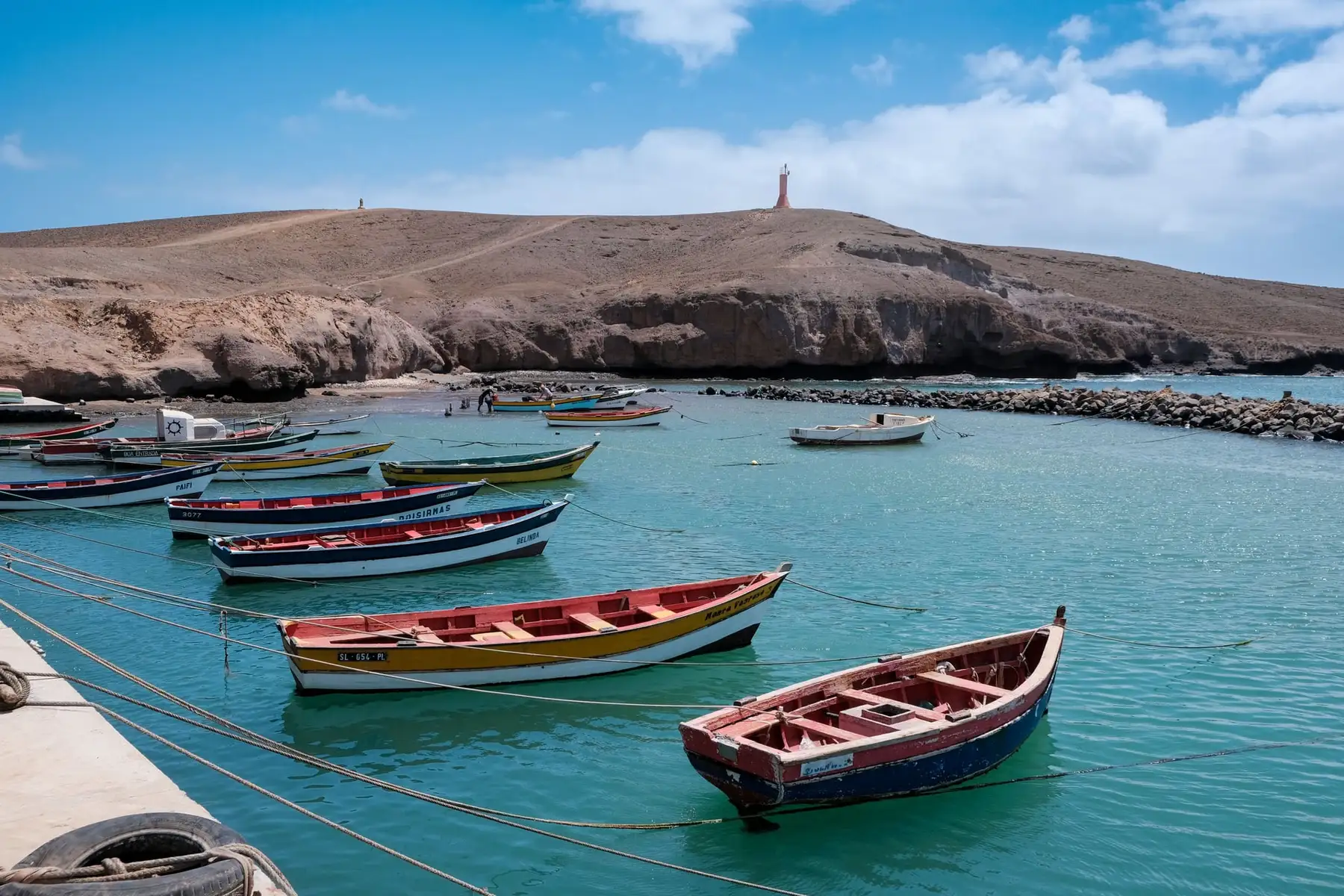
DESTINATION · SAL
Sal, flat and on purpose
A desert island four hundred miles off Senegal with almost no rain, no rivers and one town. It is on this list because the wind never stops and the water is warm in the months Britain is not.
- Airport
- SID · Cape Verde
- On sale
- 12 of 12 months
- Airport spread
- £488 across 9 UK airports
Today's best fare
Bristol Sal
£144 £160
Measured on a live search, refreshed hourly. Prices move — confirm on Kiwi.com.
Departure airports
£488 apart, depending where you take off
Every UK airport searched separately for this destination, cheapest first, as a return fare for one person with taxes in. Manchester to Sal and London to Sal are not the same route and we do not price them as one. Each figure is a fare of one stop at most — the same limit as the price at the top of this page — and each is that airport's own cheapest week, so the dates change from row to row. Every link opens on the dates its price was found on.
9 of 10 airports have a fare to Sal within one stop today. The rest either need two connections and most of a day to get there — which we will not print a price for — or did not answer the last search. London covers Heathrow, Gatwick, Stansted, Luton, City and Southend in one search.
From your airport
How long is the flight to Sal?
Distance, nonstop flight time, whether a direct flight exists and what it costs, worked out separately for each of the ten UK airports.
The year, month by month
When Sal is worth the airfare
Average daytime high for each month. The greyed months are ones we refuse to advertise — not because they are cheap, but because the place cannot deliver what the page promises.
- Jan 25°
- Feb 25°
- Mar 26°
- Apr 26°
- May 27°
- Jun 28°
- Jul 29°
- Aug 30°
- Sep 31°
- Oct 30°
- Nov 28°
- Dec 26° today's fare
12 of 12 months on sale. No closed season.
Sal sits twelve hundred miles south of the Canaries in open ocean, and the water around it is the whole story. The Canary Current runs past on its way to the equator, warming as it goes, so the sea here is meaningfully warmer than Tenerife on the same day — comfortable without a wetsuit through the British winter. Rain is close to theoretical: the island averages a handful of wet days a year, almost all of them in a short late-summer window when moisture occasionally reaches this far west.
The variable that actually matters is the wind, and it is a constant rather than a season. The north-east trades blow across four thousand kilometres of open Atlantic and arrive at a flat island with nothing to slow them, which is why the kiting is reliable in every month and why the beach can be a battle for anyone who wanted to read a book on it. There is a slightly calmer window at the height of the year, which is also when the humidity arrives and the sea is at its warmest.
Nothing here closes, which makes it one of the more forgiving destinations on this board for a British calendar. What moves is price rather than possibility: Christmas, February half-term and Easter fill the small hotel stock and the fares with it, while the quiet stretches either side are the same island for considerably less. Loggerhead turtles nest on these beaches through the late summer, which is worth knowing if that is the trip you want — Cape Verde is one of the largest nesting grounds in the world.
Pre-register five days before you fly
The EASE form and the airport security tax must be done in advance. Arriving without them doubles the fee at the border, and it is the commonest avoidable cost on this route.
The case for it
Why Sal
Sal is the oldest island in the Cape Verde archipelago, which is why it is the flattest — sixty million years of Atlantic weather has taken the volcano down to a plain. There is no fresh water on it. Everything drinkable is desalinated, nothing agricultural grows, and the island was settled in the first place for one reason: salt, evaporated from seawater in a flooded crater at Pedra de Lume and shipped out to Brazil and West Africa.
What that geology produces is a very specific holiday. The trade winds cross open ocean and hit a low island with nothing to break them, so they blow hard and almost without pause — which is why Sal is one of the two or three most reliable flat-water kiting spots on earth and why the schools here run all year rather than seasonally. The same wind and the same shallow shelf give Santa Maria eight kilometres of pale sand with water you can stand up in a long way out.
The honest warning is what Sal looks like. Anyone booking on the word tropical will land on basalt, scrub and dust: there are no palms except the planted ones, no hills worth the name, and the interior is a brown plain crossed by a single road. It is also a one-town island — outside Santa Maria there is an airport town and very little else — so a fortnight here without wind sports or a strong taste for doing nothing can feel long.
On the ground
Five things worth doing
- 01
Float in the Pedra de Lume salt crater
A collapsed volcanic caldera on the east coast, flooded through a tunnel cut in the 1800s and evaporated for salt until 1985. What is left is a brine pool dense enough that you cannot sink in it — the Dead Sea effect, without the crowds. Entry is €6 (about £5.20) and a rinse-off shower afterwards is €1, which you will want, because the crust dries on your skin. Do not shave that morning and keep it out of your eyes. Twenty minutes and a taxi ride from Santa Maria.
- 02
Time Buracona for midday
A collapsed lava tube on the north-west coast where, for a short window either side of noon on a clear day, the sun comes through an underwater opening and lights the pool an improbable blue. Entry is about €3 (£2.60), collected by the local association that maintains the site, and it is cash only. Outside that hour it is a dark hole in the rock and people leave disappointed. The blowholes along the same stretch of coast are worth the walk in any light.
- 03
Learn to kite where the wind is a constant
Kite Beach north of Santa Maria has cross-shore trade winds almost every day of the year and shallow water for a long way out, which is the combination that makes learning quick. Group lessons run about £35 an hour and a full beginner course to independent riding is around £300. Schools here are busy year round rather than seasonal, so book ahead in the British school holidays. Windsurfers use the same water and the same wind.
- 04
Walk out to the sharks at Shark Bay
A shallow bay on the east coast where juvenile lemon sharks come in to feed and can be waded among in water below the knee. It is free to reach if you drive, and about £25 as an organised half-day with transport. They are young, small and uninterested in people, and the guides keep you from standing on them. Go at high tide — at low water the bay empties and there is nothing to see but the flats.
- 05
Be at the Santa Maria pier when the boats land
The old salt-loading pier is where the day's catch comes ashore in the late afternoon, gutted on the concrete with the frigatebirds waiting. It costs nothing, it is the one part of the day that is not arranged for visitors, and the fish you are watching land is what appears on the restaurant menus two hours later. Times move with the boats rather than a schedule — ask at your hotel that morning.
After the flight
What it costs once you land
Santa Maria prices away from the hotel beach clubs. The escudo is pegged to the euro at a fixed rate, so unlike Egypt or Türkiye these figures do not move with a currency — and euros are taken almost everywhere, usually at a rate that rounds against you.
- Beer, local bar £1.20 a Strela; beach clubs are roughly triple
- Dinner for two, mid-range £24 grilled fish and a bottle of wine in town
- Airport to Santa Maria £12 taxi, about twenty minutes; the shared aluguer is around £1
- Car hire, per day £38 expensive and limited here — most people use taxis and aluguers
- Sunbed and parasol £5 per set on the public stretch of Santa Maria beach
- Cachupa lunch £3
Checked August 2026. Sources at the foot of this page.
Before you book
Practical, for a British passport
Entry rules are for a British Citizen passport holder and come from gov.uk, read on 2026-08-07. They change; check before you fly.
- Airport
- SID, Amílcar Cabral International, beside Espargos in the middle of the island and about twenty minutes from Santa Maria. It was built as a mid-Atlantic refuelling stop and is why Sal, rather than a prettier island, became the one with flights. Small, slow and short of seating — do not arrive hours early.
- Entry
- No visa, but compulsory pre-registration and an airport security tax. CVE 3,400 (about £27) — doubles to CVE 6,800 (about £54) if you have not pre-registered. Up to 30 days. Expiry at least 6 months after the date you arrive. Register on the EASE platform and pay the airport security tax at least five days before you fly, then travel with the confirmation. Since 1 July 2026 arriving without it means paying double at border control. This is the cheapest destination on the list to fly to and the one where the paperwork most often costs more than the mistake is worth.
- Currency
- Cape Verdean escudo, pegged to the euro at a fixed rate, so there is nothing to time. Euros are accepted almost everywhere and change is given in escudos, usually at a rate rounded in the seller's favour. Cards work in hotels and larger restaurants and not much else; the escudo cannot be exchanged outside the country, so spend it before you fly.
- Language
- Portuguese is official and Cape Verdean Creole is what people actually speak. English is widely understood in Santa Maria and in anything to do with tourism, and thins immediately outside it. A few words of Portuguese are received warmly.
- Time zone
- One hour behind the UK in winter and two hours behind British Summer Time. Cape Verde does not change its clocks, so the gap moves when Britain does — an easy one to get wrong on the return leg.
- Plugs
- Type C and F, 230V. A British type-G plug does not fit; bring an adapter. Power cuts are not unusual and generators take a moment to pick up.
- Health
- The GHIC is worthless here — Cape Verde is outside the EU — and private insurance is essential, with kitesurfing declared if you intend to do it, because most standard policies exclude it. There is a clinic in Santa Maria and a hospital in Espargos; anything serious means an evacuation flight, which is precisely what the insurance is for. Drink bottled water: the tap supply is desalinated and safe to wash in rather than to drink.
- Safety
- The FCDO has no warning against travel to Cape Verde. Crime is low and mostly opportunistic — bag-snatching on the Santa Maria beach at night. The genuine hazards are the sea and the sun: the Atlantic here has strong rip currents off the unpatrolled stretches, and a flat island with a constant cooling wind hides how hard the sun is working.
A bed
Where to stay in Sal
Two options, and that is not a simplification. Sal has one resort town and an airport town, and essentially everything a visitor does happens in the first of them.
Santa Maria
Eight kilometres of beach, a grid of low streets behind it, the pier at one end and the kite schools at the other. Everything is here — the restaurants, the dive shops, the bars, the hotels from small guesthouse to large all-inclusive — and it is all walkable. The stock skews to big resort properties at the edges of town, so book centrally if you want to walk out to dinner rather than eat in.
Stays in Santa Maria Opens in a new tab OFF THE STRIPElsewhere on Sal
There is a handful of places outside Santa Maria — a few properties near Murdeira bay, a couple in Espargos by the airport — and they suit people who want quiet, an early flight, or a price below the resort strip. The cost is mobility: with no town around you every meal and every beach is a taxi, and taxis here are not cheap by the standards of everything else.
Stays in Sal Opens in a new tabEvery area pinned on one map, set to the dates of the fare above. Change them for your own trip and it reloads live availability.
Open the Sal map Opens in a new tabGetting around
The aluguer is the local answer and it is very cheap. These shared minibuses run between Santa Maria and Espargos more or less continuously, leaving when they fill rather than to a timetable, and cost about a pound a head. You flag one on the main road, pay the driver, and say where you want to stop. They will not take you to the far-flung sites, only along the spine of the island.
For Pedra de Lume, Buracona and Shark Bay, either take a taxi with an agreed waiting time or join an island tour. Taxis are not metered — agree the fare first, and expect the round trip to Pedra de Lume with waiting to run to a few tens of pounds. An organised half-day covering three or four sites usually works out cheaper than doing it yourself and removes the negotiation.
Car hire exists and is expensive by the standards of everything else here, with a small fleet and a lot of unsurfaced side roads that most agreements exclude. Unless you want to explore the north coast on your own schedule it is hard to justify. Quad and buggy hire is heavily marketed and worth thinking twice about: the dust on the interior tracks is fierce and the accident rate reflects it.
Food and local tips
Cape Verdean food is West African and Portuguese at once, and the dish to find is cachupa — a slow stew of hominy corn, beans, cassava and whatever meat or fish there is, cooked for hours and then, the following morning, fried up with an egg and a sausage as cachupa refogada. That second version is breakfast and is the best three pounds on the island. Ask for it in a small place in town rather than at a hotel buffet, where it becomes a token gesture.
The fish is the other reason to eat out: tuna, wahoo and grouper landed at the pier that afternoon, grilled plainly and priced sensibly two streets back from the beach. Grogue, the sugarcane spirit, is the local drink and comes rough or as a ponche sweetened with honey and lime. Tipping is not the constant obligation it is in Egypt — round up and leave a little, and that is enough. Live morna and funaná start late in the Santa Maria bars, rarely before ten.
Cachupa refogada, for breakfast
Yesterday's stew fried with an egg on top, eaten in a back-street café in Santa Maria for around 350 escudos (£2.80). The national dish, and better on the second day than the first.
Ready for Sal?
Pick your departure airport and see what the route costs today from each of the ten we track.
See the £144 fare Opens in a new tabSame band
Other winter sun destinations
Where the numbers came from
- Pedra de Lume and Buracona entry fees takeyourbackpack.com Opens in a new tab read 2026-08-07
- Airport transfer and local taxi rates gobytaxi.com Opens in a new tab read 2026-08-07
- EASE pre-registration, airport security tax and entry rules gov.uk Opens in a new tab read 2026-08-07
- Entry rules for a British Citizen passport gov.ukOpens in a new tab read 2026-08-07