DESTINATION · MARRAKESH
Marrakesh, at close quarters
A walled city of about a million people where the streets were laid out to confuse cavalry and still do the same to visitors. Three hours from Britain, and the least European place you can reach in an afternoon.
- Airport
- RAK · Morocco
- On sale
- 10 of 12 months
- Airport spread
- £73 across 10 UK airports
Today's best fare
Bristol Marrakesh
£48 £62 −23%
Measured on a live search, refreshed hourly. Prices move — confirm on Kiwi.com.
Departure airports
£73 apart, depending where you take off
Every UK airport searched separately for this destination, cheapest first, as a return fare for one person with taxes in. Manchester to Marrakesh and London to Marrakesh are not the same route and we do not price them as one. Each figure is a fare of one stop at most — the same limit as the price at the top of this page — and each is that airport's own cheapest week, so the dates change from row to row. Every link opens on the dates its price was found on.
All 10 airports have a fare to Marrakesh within one stop today. London covers Heathrow, Gatwick, Stansted, Luton, City and Southend in one search.
From your airport
How long is the flight to Marrakesh?
Distance, nonstop flight time, whether a direct flight exists and what it costs, worked out separately for each of the ten UK airports.
The year, month by month
When Marrakesh is worth the airfare
Average daytime high for each month. The greyed months are ones we refuse to advertise — not because they are cheap, but because the place cannot deliver what the page promises.
- Jan 19°
- Feb 21°
- Mar 24°
- Apr 26°
- May 29°
- Jun 34°
- Jul 38° not sold
- Aug 38° not sold
- Sep 33°
- Oct 28°
- Nov 23°
- Dec 20° today's fare
10 of 12 months on sale. The reason is below, not in the numbers.
Marrakesh sits on a plain at 450 metres with the High Atlas behind it and the desert beyond that, and it has a continental climate rather than a Mediterranean one: nothing moderates it. The mountains take the little rain there is, so the city gets under ten wet days a year, and the sun is reliable in a way no coastal destination on this list can match. The same geography is why the deep summer is a different proposition entirely — the city empties, the souks half-shut in the afternoons, and walking the medina stops being pleasant and becomes something to endure.
The shoulders are where this city is at its best, and they are unusually long. From autumn through to late spring the days are warm enough for a rooftop and the nights cool enough to sleep, and the Atlas is close enough that a morning in the snow and an afternoon on a terrace is a normal thing to do. Winter nights genuinely get cold and riads are stone buildings designed to stay cool — check that yours has heating, because a good many do not.
For a British traveller the calendar to watch is Ramadan, which moves earlier by about eleven days each year. The city works differently through it: restaurants in the medina close during daylight, the pace changes, and the breaking of the fast at dusk is one of the better things to witness. It is not a bad time to come, but it is not the trip most people are picturing, and it is worth deciding on purpose rather than by accident.
Have your riad send someone
No taxi reaches most medina addresses. A riad will meet you at the nearest vehicle point with a porter and a barrow for a few euros, and it removes the single most stressful hour of the trip.
The case for it
Why Marrakesh
Marrakesh was founded in 1070 as a garrison on the caravan route out of the Sahara, and the shape of that decision is still the shape of the city. The medina is a walled circle of red pisé, eighteen kilometres of it, cut by lanes that were never meant for wheels and mostly still are not. Inside, the buildings turn their backs on the street: a blank wall with one door, and behind it a courtyard, a fountain and four walls of rooms looking inward. That is a riad, and it is why the city reveals nothing from outside.
What has changed recently is the money and where it goes. Two decades of riad conversion turned crumbling family houses into small hotels, and the effect on the medina has been real restoration rather than the theme-park version people expect. The airport is twenty minutes from the walls, budget routes from Britain have multiplied, and the city now sustains a serious food and design scene in Gueliz that has nothing to do with the souks at all.
It is also a city that asks something of you. The hassle is real — unsolicited guides, people who will walk you the wrong way and then want paying, a running negotiation over the price of everything — and it wears down travellers who wanted a rest. Anyone whose idea of a break is a quiet week without decisions should look at Agadir down the coast instead. Marrakesh rewards the opposite temperament.
On the ground
Five things worth doing
- 01
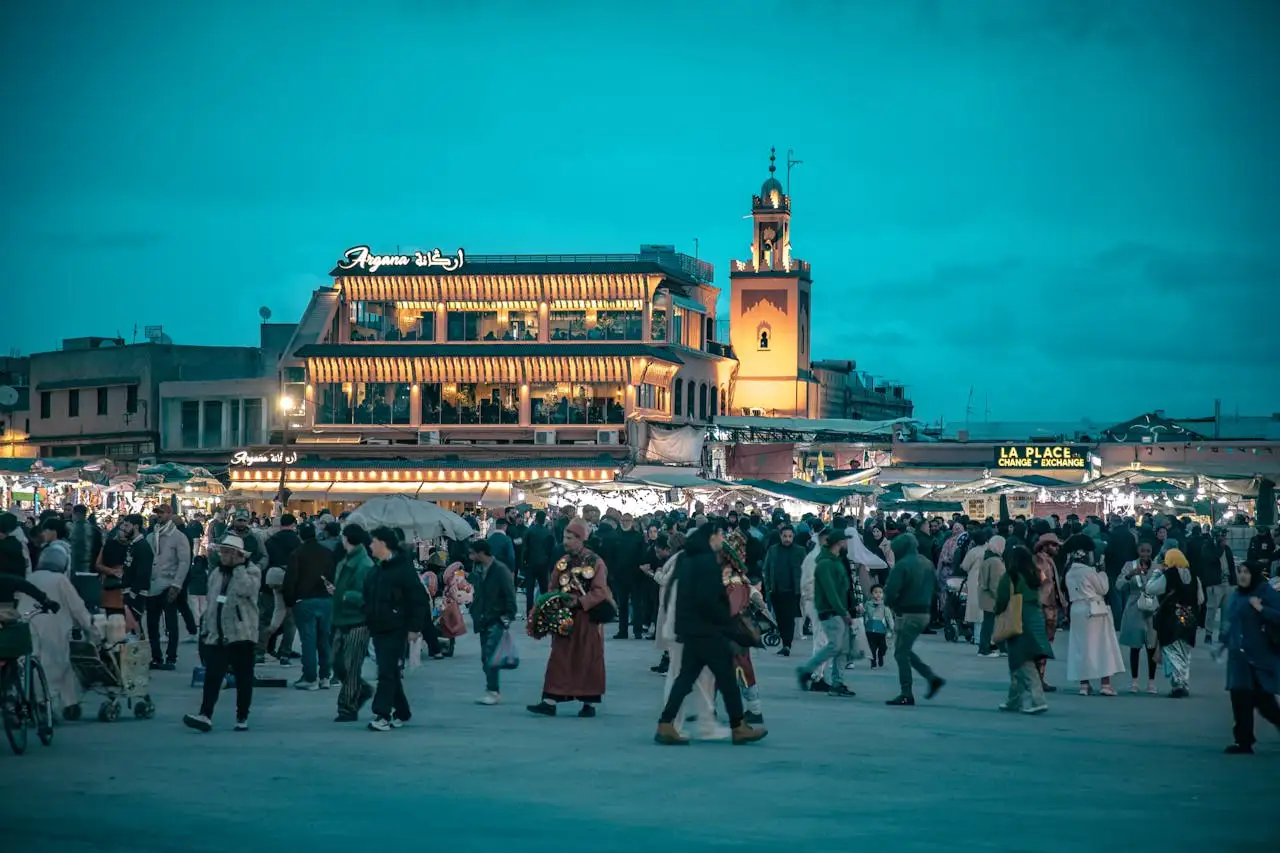
Arrive at Jemaa el-Fnaa around six
The main square is dead in the afternoon and unrecognisable at dusk, when a hundred numbered food stalls are assembled from nothing in about forty minutes and the smoke goes up under the floodlights. It costs nothing to walk through, and a bowl of harira with bread is about 15 dirham (£1.20). The rule is to sit at a stall with Moroccan families at it rather than one whose tout worked hardest, and to check prices before anything is put down — the bread and olives that arrive unasked are charged for. Photographing the performers costs a coin, and they will ask.
- 02
Bahia Palace, first thing
A late nineteenth-century vizier's palace built to be the finest in Morocco, and largely stripped when he died — which leaves the thing worth seeing, the ceilings and the tilework, without the furniture. Entry is 100 dirham (about £8). It is small, it is on every coach itinerary, and by eleven the painted-cedar rooms are shoulder to shoulder. Doors open at nine; being there at nine is the difference between a courtyard you can photograph and a queue you shuffle through. Allow an hour, no more.
- 03
Jardin Majorelle and the YSL museum
The cobalt-blue garden the painter Jacques Majorelle laid out in the 1920s and Yves Saint Laurent bought in 1980 to stop it being demolished. The garden alone is 170 dirham (about £13); with the Berber museum and the Saint Laurent museum next door it is around 330 dirham (£26). Buy on the official site — several convincing resellers are not honoured at the gate. It is a twenty-minute walk from the medina in Gueliz, and the timed entry means the crowding is manageable in a way Bahia's is not.
- 04
Get properly lost in the souks
The covered markets north of the square are organised by trade — dyers, slipper-makers, ironworkers, spice sellers — and the logic only becomes visible after an hour of wandering. Nothing has a price on it, and the only way to calibrate is to know one thing well: a decent pair of leather babouches settles at around 120 dirham (£10), and the opening ask will be three times that. Open at something under half, expect to land above it, and walk away at least once, which is part of the process rather than a rudeness. Anyone who tells you the way you are going is closed, or that today is a special Berber market, is steering you to a shop that pays commission.
- 05
Take a hammam seriously
The neighbourhood hammam is a working public bath, not a spa: you pay 10 to 40 dirham (under £3), take your own soap and a scrubbing mitt or buy them at the door for about 20 dirham (£1.60), and an attendant will scrub the skin off you for 50 dirham (£4). It is hot, communal and single-sex by session. The riad version — black soap, ghassoul clay, a massage, an hour of quiet — costs about €25 (£22) and is a different experience altogether. Do the public one once for the thing itself.
After the flight
What it costs once you land
Medina and Gueliz prices where a Moroccan would pay them, not the seafront-hotel equivalent. Almost everything here is negotiable, and the figures below assume you negotiate.
- Mint tea, café £1.20 beer is around £4 and only in licensed places; this is a Muslim country
- Dinner for two, mid-range £28 a good medina restaurant; a stall on the square is a fifth of it
- Airport to the medina £10 petit taxi, 100–150 dirham by day and up to 240 after ten at night
- Car hire, per day £20 the wrong tool inside the walls — no car reaches most riads
- Public hammam £1.20 a riad hammam with scrub and massage is about £22
- Street lunch £3 a tagine or a bowl of harira and bread
Checked August 2026. Sources at the foot of this page.
Before you book
Practical, for a British passport
Entry rules are for a British Citizen passport holder and come from gov.uk, read on 2026-08-07. They change; check before you fly.
- Airport
- RAK, Menara. Six kilometres from the medina and about twenty minutes by taxi in normal traffic — one of the shortest airport runs on this list. There is a fixed municipal tariff posted at the rank; the drivers will still open above it.
- Entry
- No visa. No fee. Up to 90 days for tourism. Expiry at least 3 months after the date you arrive. You may carry up to 2,000 dirham into or out of Morocco; the dirham is not convertible outside the country, so change it back before you fly. Foreign currency worth 100,000 dirham or more (roughly $10,000) must be declared on arrival. Check the border officer actually stamps you in — a missing entry stamp is a problem on the way out, not on the way in.
- Currency
- Moroccan dirham, and it is a closed currency — you cannot buy it before you fly and you cannot spend it after. Withdraw at the airport or in Gueliz, keep small notes for taxis and tips, and change what is left before you go back through security.
- Language
- Moroccan Arabic and Amazigh, with French as the second language of business and signage. French gets you further than English here, though the riads, the souks and anywhere touristed will handle English easily.
- Time zone
- Morocco keeps UTC+1 year round, so it is an hour ahead of the UK in winter and level with British Summer Time. The exception is Ramadan, when the clocks drop back an hour for the month.
- Plugs
- Type C and E, 230V. A British type-G plug does not fit and an adapter is essential; riads occasionally have one to lend, hotels usually not.
- Health
- The GHIC is worthless here — Morocco is outside the EU, so private travel insurance is not optional. Care in Marrakesh is decent and private clinics expect payment up front. Drink bottled water, and be more careful with salad and juice than with the grilled food, which is cooked in front of you.
- Safety
- The FCDO has no warning against travel to Marrakesh. Violent crime against visitors is rare; the everyday problem is the confidence trick — the false guide, the closed-road story, the shop you did not choose to be taken to. Say no once, clearly, and keep walking.
A bed
Where to stay in Marrakesh
The real decision is inside the walls or outside them, and it is a decision about what kind of week you want rather than about money — the medina holds both the cheapest beds in the city and the most expensive.
The medina
Riads by the hundred, from twenty pounds a night to several hundred, all built to the same inward-facing plan around a courtyard. You are walking distance from everything worth seeing and you will not sleep through the dawn call to prayer. The trade-off is arrival and departure: no vehicle gets to the door, luggage goes by barrow, and finding your way back the first two nights takes longer than you think.
Stays in Marrakech Medina Opens in a new tab EASIEST ARRIVALGueliz
The French-built new town, laid out on a grid twenty minutes' walk from the square. Ordinary hotels with lifts and car parks, the city's better modern restaurants, the Majorelle garden at the end of the street. Choose it if the medina sounds exhausting or if you are travelling with anyone who would struggle on uneven ground. You will be commuting to the part you came for.
Stays in Gueliz Opens in a new tab POOLS AND QUIETHivernage
The hotel district between Gueliz and the walls — larger properties, gardens, pools, and the calm that the medina cannot offer. It suits a trip built around resting with a couple of days of sightseeing attached, rather than the reverse. Thin on character and thin on anywhere to eat that is not a hotel, so plan on taxis into town most evenings.
Stays in Hivernage Opens in a new tabEvery area pinned on one map, set to the dates of the fare above. Change them for your own trip and it reloads live availability.
Open the Marrakesh map Opens in a new tabGetting around
Walk. The medina is roughly two kilometres across and closed to most traffic by geometry rather than by law, and everything inside it is reachable on foot in twenty minutes. Take a paper map or a downloaded offline one, because the phone signal drops between high walls and the lanes are not all named. Getting lost is not dangerous, it is just slow, and asking a shopkeeper rather than someone who approaches you gets a straight answer.
For everything outside the walls, petit taxis — small, beige, metered in theory. In practice the meter is often 'broken', so agree the fare before you get in; the medina to Gueliz should be about 30 dirham by day. Grand taxis, the older Mercedes estates, run shared routes out of the city and can be hired whole for a day to the Ourika valley or the Atlas foothills for something like 600 to 800 dirham, which split between four is the cheapest way to see the mountains.
Do not hire a car for the city. Nothing you want to reach in Marrakesh has parking, the medina is closed to you, and the one-way system in Gueliz is punishing. Hire one at the airport only if the trip is really about Essaouira or the mountains, and take the riad's porter for the last two hundred metres either way.
Food and local tips
Moroccan food is slower and less spiced than people arrive expecting — warm rather than hot, built on cumin, ginger, saffron and preserved lemon. The tagine is a cooking vessel before it is a dish, and the good ones have been in the pot for hours; anything that arrives in ten minutes came out of a tray. Couscous is Friday food, made properly for the family meal after prayers, and a restaurant serving it every day is serving it to tourists. Harira, the tomato and lentil soup that breaks the fast, is the best two pounds you will spend.
Where you eat matters more than what. The square's stalls are cheap, theatrical and perfectly safe, but they are the show; the food is better in the small medina places with four tables and no English menu, and better again in Gueliz, where the city's own restaurants are. Tipping runs at around ten per cent and small change is genuinely useful. Alcohol is restricted rather than absent — licensed restaurants, hotel bars and a few shops sell it, and it costs what it would in Britain.
Tanjia, from a wood-fired oven
A clay urn of beef or lamb with cumin, garlic and preserved lemon, sealed and left overnight in the ashes of the neighbourhood bathhouse furnace. Marrakesh's own dish, not found much elsewhere, and about 70 dirham (£6) in a medina restaurant.
Ready for Marrakesh?
Pick your departure airport and see what the route costs today from each of the ten we track.
See the £48 fare Opens in a new tabSame band
Other winter sun destinations
Where the numbers came from
- Bahia Palace, Jardin Majorelle and YSL museum entry prices introducingmarrakech.com Opens in a new tab read 2026-08-07
- Airport taxi tariffs and hammam prices marrakechtaxi.com Opens in a new tab read 2026-08-07
- Entry rules, passport validity and dirham currency restrictions gov.uk Opens in a new tab read 2026-08-07
- Entry rules for a British Citizen passport gov.ukOpens in a new tab read 2026-08-07