DESTINATION · AGADIR
Agadir, rebuilt from nothing
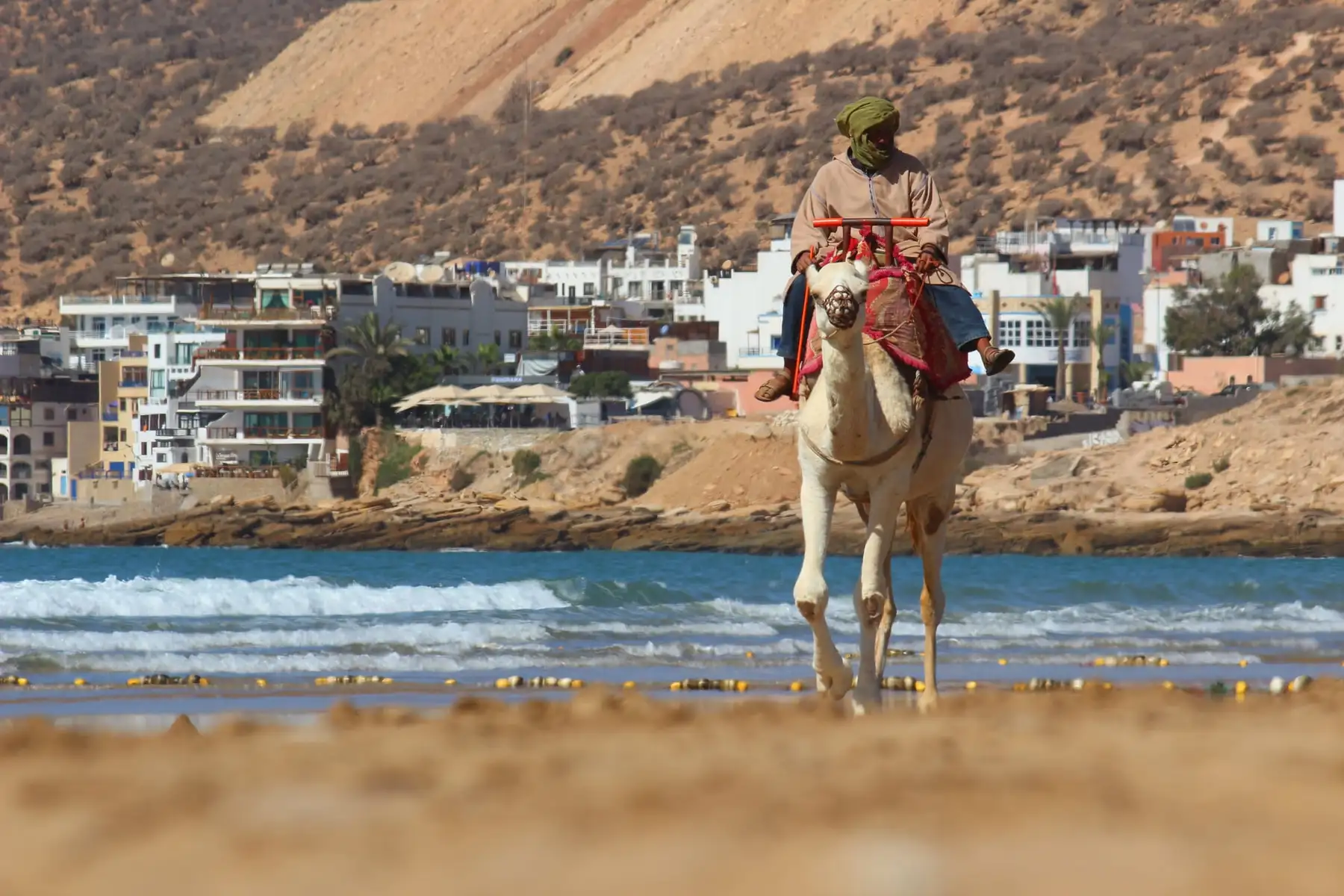
In 1960 an earthquake destroyed the city in fifteen seconds. What stands now was laid out afterwards, on a different site, facing a ten-kilometre beach — which is why Morocco's biggest resort has no old town at all.
- Airport
- AGA · Morocco
- On sale
- 12 of 12 months
- Airport spread
- £109 across 10 UK airports
Today's best fare
London Agadir
£53 £61
Measured on a live search, refreshed hourly. Prices move — confirm on Kiwi.com.
Departure airports
£109 apart, depending where you take off
Every UK airport searched separately for this destination, cheapest first, as a return fare for one person with taxes in. Manchester to Agadir and London to Agadir are not the same route and we do not price them as one. Each figure is a fare of one stop at most — the same limit as the price at the top of this page — and each is that airport's own cheapest week, so the dates change from row to row. Every link opens on the dates its price was found on.
All 10 airports have a fare to Agadir within one stop today. London covers Heathrow, Gatwick, Stansted, Luton, City and Southend in one search.
From your airport
How long is the flight to Agadir?
Distance, nonstop flight time, whether a direct flight exists and what it costs, worked out separately for each of the ten UK airports.
The year, month by month
When Agadir is worth the airfare
Average daytime high for each month. The greyed months are ones we refuse to advertise — not because they are cheap, but because the place cannot deliver what the page promises.
- Jan 20°
- Feb 21°
- Mar 23°
- Apr 24°
- May 26°
- Jun 27°
- Jul 28°
- Aug 28°
- Sep 27°
- Oct 26°
- Nov 23° today's fare
- Dec 21°
12 of 12 months on sale. No closed season.
Agadir and Marrakesh are three hours apart and have almost nothing in common climatically, which is the most useful thing a British traveller can know about either. Marrakesh sits inland on a plain with the Atlas behind it and bakes; Agadir sits on the Atlantic with the cold Canary Current running past it, and the sea holds the air temperature inside a narrow band all year. The same current that keeps the city comfortable in high summer is why the water is colder than the latitude suggests and why the surf schools issue wetsuits in every month.
That is why nothing here shuts. There is no season the resort stands down, no monsoon, and rain arrives in a handful of days across the winter rather than in a block. What changes through the year is the wind and the swell: the Atlantic pushes bigger surf into the points from autumn onwards, which is the season the board-carrying half of the visitor list comes for and the season families find the beach less inviting. The morning sea fog that rolls over the bay in summer burns off by mid-morning and catches people out on their first day.
For a British calendar this is one of the more forgiving destinations. February half-term and the Easter fortnight bring the package operators and the prices, and the Souss fills with French and Moroccan holidaymakers in high summer. Late autumn and the weeks before Christmas are quiet, warm and cheap at once. Ramadan shifts earlier by about eleven days a year and changes the rhythm of the city rather than closing it — the hotel strip carries on largely unaffected, the town does not.
Fly here, drive to Marrakesh
The two cities are three hours apart on a good road and answer completely different briefs. Basing on the coast and taking two days inland is often cheaper and more comfortable than the reverse.
The case for it
Why Agadir
On the night of 29 February 1960 an earthquake lasting about fifteen seconds levelled Agadir and killed something like a third of the population. The old city was not rebuilt; it was covered over and left as a memorial, and a new one was planned from scratch a little to the south, on a grid, facing the Atlantic. That is the single fact that explains everything about the place — the wide boulevards, the low modernist blocks, the complete absence of the winding medina that visitors to Morocco expect.
What it has instead is the coast. A ten-kilometre crescent of sand, a sea breeze that holds the temperature down when the interior is unbearable, and one of the most reliable run of clear days anywhere on this list. Twenty minutes north the same coast turns into Taghazout, a fishing village that became a serious surf destination, and an hour inland the Atlas throws up Paradise Valley, a palm gorge with pools cold enough to be a shock.
The honest warning is that Agadir is not the Morocco of the brochures, and people book it expecting Marrakesh by the sea. There is no ancient medina — the walled market in the centre is a purpose-built replica from the 1990s — and the hotel strip could be on any Atlantic coast. The Atlantic itself is another surprise: the same cold current that makes the climate pleasant makes the water bracing and the surf substantial, and it is not a lagoon.
On the ground
Five things worth doing
- 01
Ride up to Agadir Oufella
The kasbah on the hill is one of the few structures that survived 1960, and even that only as walls. A cable car opened in 2022 and costs 80 dirham (about £6) one way or 120 (£10) return, running from the north end of the beach to a terrace with the whole crescent laid out below it. Go for the last hour of daylight, when the bay turns and the lettering on the hillside lights up. The site itself takes twenty minutes; the view is the reason, so do not pay for a guide.
- 02
Spend a morning in Souk El Had
Around six thousand stalls behind a wall on the edge of the centre, and free to walk into. This is a working market for the city rather than a tourist one — produce, spices, argan oil, olives, second-hand clothes, live poultry — and the tourist section is a small corner of it. Go early, when the produce is out and before the heat, and carry small notes. Prices are negotiable everywhere, and unlike Marrakesh nobody will follow you down the street about it.
- 03
Get to Paradise Valley early
An hour inland, a gorge in the Atlas foothills where the Tamraght river carves through palm and rock into a chain of green pools. A shared taxi from Aourir costs 25 to 30 dirham (£2–£2.50) a head; a private car for the day runs to about 300 (£24). The water level is the whole experience and it drops sharply through the dry season, so ask before you commit to a day. By eleven the accessible pools have coach parties at them; the ones worth swimming in are a further twenty minutes' scramble upstream.
- 04
Learn to surf at Taghazout
Twenty kilometres north, a village of blue houses that grew into one of Africa's better surf towns on the back of a run of consistent right-hand point breaks. A group lesson with board and wetsuit hire is about 250 to 350 dirham (£20–£28) for a half day, and the beach breaks at Tamraght and Banana Beach are the beginner ground rather than Anchor Point, which is not. The wetsuit is not optional — this is the Canary Current and it is colder than the air suggests.
- 05
Buy argan oil where it is actually made
The Souss valley holds the only argan forest on earth, and the women's cooperatives along the Essaouira road press the oil by hand and sell it at a fraction of European prices — roughly 120 to 200 dirham (£10–£16) for a bottle of the culinary grade. Buy at a cooperative with a UCFA sign rather than at a roadside stop your driver suggests, since commission arrangements are near-universal. Culinary oil is roasted and nutty; cosmetic oil is not, and paying cosmetic prices for the wrong one is the usual mistake.
After the flight
What it costs once you land
City prices rather than hotel-strip prices, which run two to three times higher. Agadir is a resort city and the beachfront is priced accordingly; two streets inland it is an ordinary Moroccan town.
- Mint tea, café £0.80 beer is about £3.50 and only in licensed hotels and bars
- Dinner for two, mid-range £22 grilled fish at the port; the beachfront restaurants are double
- Airport to the beachfront £18 about 200 dirham by day, up to 300 after dark; the airport is 25km out
- Car hire, per day £18 worth it for Taghazout and Paradise Valley, unnecessary in the city
- Sunbed and parasol £4 per set on the public beach; hotel beaches include theirs
- Street lunch £2.50 grilled sardines and bread at the port, sold by weight
Checked August 2026. Sources at the foot of this page.
Before you book
Practical, for a British passport
Entry rules are for a British Citizen passport holder and come from gov.uk, read on 2026-08-07. They change; check before you fly.
- Airport
- AGA, Al Massira, twenty-five kilometres inland — a thirty-minute drive rather than the ten-minute hop Marrakesh offers. There is a fixed tariff board at the rank and drivers will still quote above it; agree the number before the boot opens.
- Entry
- No visa. No fee. Up to 90 days for tourism. Expiry at least 3 months after the date you arrive. You may carry up to 2,000 dirham into or out of Morocco; the dirham is not convertible outside the country, so change it back before you fly. Foreign currency worth 100,000 dirham or more (roughly $10,000) must be declared on arrival. Check the border officer actually stamps you in — a missing entry stamp is a problem on the way out, not on the way in.
- Currency
- Moroccan dirham, a closed currency you cannot obtain in Britain or spend after you leave. Withdraw on arrival, keep small notes for taxis and the souk, and change the remainder back before security. Cards work in hotels and larger restaurants, not in the market.
- Language
- Moroccan Arabic and Tashelhit, the Amazigh language of the Souss, with French throughout commerce and signage. English is common along the hotel strip and in Taghazout and thin elsewhere; a little French goes a long way.
- Time zone
- Morocco keeps UTC+1 all year, so an hour ahead of Britain in winter and the same as British Summer Time. The clocks drop back for the month of Ramadan.
- Plugs
- Type C and E, 230V. A British type-G plug does not fit; bring an adapter, since the larger hotels lend them out and run short.
- Health
- The GHIC does not apply — Morocco is outside the EU — so private travel insurance is essential and should cover surfing if you intend to. Agadir has decent private clinics that expect payment up front. Drink bottled water; the grilled fish at the port is cooked in front of you and is not the risk that unwashed salad is.
- Safety
- No FCDO warning against travel to Agadir, and it is a markedly easier city than Marrakesh — far less hustling, and the beachfront is patrolled. The real hazard is the ocean: Atlantic rips are strong along this coast, the lifeguarded season does not cover the whole year, and the surf beaches are not swimming beaches.
A bed
Where to stay in Agadir
Three quite different propositions within twenty kilometres: the purpose-built hotel strip, the working city behind it, and the surf village up the coast.
Founty
The beachfront hotel zone at the southern end of the bay, where the large resorts and most of the all-inclusive stock sit, with the promenade and the marina at either end. Comfortable, well kept and entirely self-contained — which is also the drawback. Nothing here is Moroccan except the staff, and everything costs two to three times what it does a ten-minute taxi ride inland.
Stays in Founty Opens in a new tab LOCAL PRICESAgadir centre
The grid behind the beach — Talborjt and the streets around the market — where the city actually lives. Smaller hotels at a fraction of the strip's rates, the souk within walking distance, and restaurants priced for residents. Less polished, noisier, and a fifteen-minute walk to the sand rather than a set of steps down to it.
Stays in Agadir Opens in a new tab SURFTaghazout
Twenty kilometres north, and a different holiday altogether: surf camps, hostels, small guesthouses and a village that runs on boards and coffee. The point breaks are on the doorstep and the atmosphere is young and international. There is no real beach for lying on, the swimming is poor, and you will need a taxi or a car for anything in the city.
Stays in Taghazout Opens in a new tabEvery area pinned on one map, set to the dates of the fare above. Change them for your own trip and it reloads live availability.
Open the Agadir map Opens in a new tabGetting around
In the city, walk or take a petit taxi. The centre is a grid and flat, the beachfront promenade runs the length of the bay, and the orange petit taxis are metered — insist on it, since the meter goes unused with visitors more often than not. A run from the hotel strip to the souk should be about 20 dirham. They are licensed for the city only and cannot take you up the coast.
For Taghazout and Paradise Valley, either a grand taxi or a hire car. Shared grand taxis leave from fixed ranks when full and cost a few pounds a head, which is how locals get to Aourir and Tamraght; hiring one outright for the day runs to about 300 to 400 dirham and is the sensible way to do Paradise Valley without a tour. Car hire is cheap and the coast road is easy, though the last stretch into the valley is rough and narrow.
Agadir is also the practical base for Essaouira, two and a half hours up the coast, and for Marrakesh at three. There are comfortable intercity coaches — CTM and Supratours — running both routes several times a day for around 100 to 150 dirham, which is cheaper and less stressful than driving it yourself.
Food and local tips
The port is the reason to eat in Agadir. A row of open-air grills beside the fishing harbour sells whatever came in that morning by the kilo — sardines, sea bream, prawns, sole — grilled plainly with bread, salad and cumin, and a large plate for two comes to a few pounds. It is loud, plastic-chaired and one of the best-value meals in Morocco. Ignore anyone who intercepts you outside and pick a stall with Moroccan families sitting at it.
Beyond the fish, the Souss has a cooking of its own that Marrakesh does not: amlou, a paste of argan oil, almonds and honey eaten at breakfast; tagines built on the region's preserved lemons and olives; and harira in the evenings. The hotel strip serves an international menu with a Moroccan section attached and there is nothing wrong with it, but the difference in both price and quality between the strip and the town is larger here than in most places. Alcohol is easier to find than in Marrakesh — Agadir is a resort city and licensed bars are normal — though still absent from ordinary local restaurants.
Grilled sardines at the fishing port
Bought by weight and cooked while you wait. A kilo with bread and salad feeds two for around 60 dirham (£5), and it is the single cheapest good meal on this whole list.
Ready for Agadir?
Pick your departure airport and see what the route costs today from each of the ten we track.
See the £53 fare Opens in a new tabSame band
Other winter sun destinations
Where the numbers came from
- Agadir Oufella cable car prices agadir-oufella.ma Opens in a new tab read 2026-08-07
- Al Massira airport taxi fares and Paradise Valley transport costs welcomepickups.com Opens in a new tab read 2026-08-07
- Entry rules, passport validity and dirham currency restrictions gov.uk Opens in a new tab read 2026-08-07
- Entry rules for a British Citizen passport gov.ukOpens in a new tab read 2026-08-07