DESTINATION · MADEIRA
Madeira, and almost no sand
A volcanic ridge in the Atlantic with laurel forest on top and a capital built into the side of it. The one destination on this list where the walking is the point and the swimming is an afterthought.
- Airport
- FNC · Portugal
- On sale
- 12 of 12 months
- Airport spread
- £117 across 10 UK airports
Today's best fare
London Madeira
£56 £58
Measured on a live search, refreshed hourly. Prices move — confirm on Kiwi.com.
Departure airports
£117 apart, depending where you take off
Every UK airport searched separately for this destination, cheapest first, as a return fare for one person with taxes in. Manchester to Madeira and London to Madeira are not the same route and we do not price them as one. Each figure is a fare of one stop at most — the same limit as the price at the top of this page — and each is that airport's own cheapest week, so the dates change from row to row. Every link opens on the dates its price was found on.
All 10 airports have a fare to Madeira within one stop today. London covers Heathrow, Gatwick, Stansted, Luton, City and Southend in one search.
From your airport
How long is the flight to Madeira?
Distance, nonstop flight time, whether a direct flight exists and what it costs, worked out separately for each of the ten UK airports.
The year, month by month
When Madeira is worth the airfare
Average daytime high for each month. The greyed months are ones we refuse to advertise — not because they are cheap, but because the place cannot deliver what the page promises.
- Jan 19°
- Feb 19°
- Mar 20°
- Apr 20°
- May 22°
- Jun 23°
- Jul 25°
- Aug 26°
- Sep 26°
- Oct 25°
- Nov 23° today's fare
- Dec 20°
12 of 12 months on sale. No closed season.
Madeira has the narrowest temperature range of anywhere on this list, and the reason is that it is a small piece of rock in a very large ocean. The Atlantic around it barely moves through the year, and the air above it follows. What changes instead is where the cloud sits. The north-east trades hit the northern slopes and drop their water there, which is why the north is green and the south is dry, and why the two coasts can be having entirely different days at the same hour.
That geography also means altitude matters more than season. The cloud usually forms as a layer somewhere between six hundred and twelve hundred metres, so a grey morning in Funchal is often bright sunshine at Pico do Arieiro, and a walk that starts in drizzle can finish above a white floor with the peaks sticking out of it. The corollary is that the mountain weather is its own thing: the ridge runs far colder than the seafront with wind on top of that, and people set off in shorts and turn back.
Nothing here shuts. There is no closed season, no monsoon and no cyclone risk, and the rain that falls does so on the north side and in short bursts. For a British calendar the weeks to avoid are the obvious school ones and the turn of the year, when Funchal's New Year fireworks — once a world record holder — book the island out months ahead at several times the usual rate. Late autumn and the stretch after the New Year crowds leave are the quiet, cheap, entirely usable weeks.
Check the trail status, not the forecast
The regional forestry service publishes which levadas and mountain paths are open. Closures after rockfall last weeks and are enforced, and a shut trail is the commonest wasted day here.
The case for it
Why Madeira
Madeira is the top of a volcano that rises six kilometres off the sea floor and keeps going another 1,860 metres above it. There is no coastal plain — the land goes from Atlantic to cloud forest in about eight miles, which is why the roads are tunnels and the villages are terraces. Funchal sits in the one natural amphitheatre big enough to hold a city, and every road out of it climbs.
The thing that makes it walkable is an accident of farming. From the fifteenth century the settlers cut levadas — narrow irrigation channels — to carry water from the wet north to the dry south, and they now run to something over two thousand kilometres. Because water must fall gently, every one of them is close to level, and the maintenance paths beside them became the finest network of easy mountain walking in Europe. A fifth of the island is laurisilva, a laurel cloud forest that is a UNESCO site and a survivor from before the ice ages.
What Madeira does not have is a beach. There is essentially no natural sand on the island: swimming happens off concrete lido platforms, in volcanic rock pools, or on one imported-sand cove in the west. Anyone booking a week of lying down should look at the Canaries instead. The other honest warning is the airport, which is built on stilts over the sea with a famously short runway, and which diverts flights in a strong crosswind more often than any other on this list.
On the ground
Five things worth doing
- 01
Walk a levada, and pick the right one
The channels are free to walk and there are hundreds of kilometres of them, but they are not interchangeable. Levada dos Balcões is forty minutes on the flat with a view over the central massif and suits anyone. Levada do Caldeirão Verde is a serious half-day with unlit tunnels — take a torch, and the head-height rock is why. Levada das 25 Fontes is the famous one and the car park fills by nine. Several routes have sheer unfenced drops on the outer side; check the official trail status before you set off, because closures after rain are common and enforced.
- 02
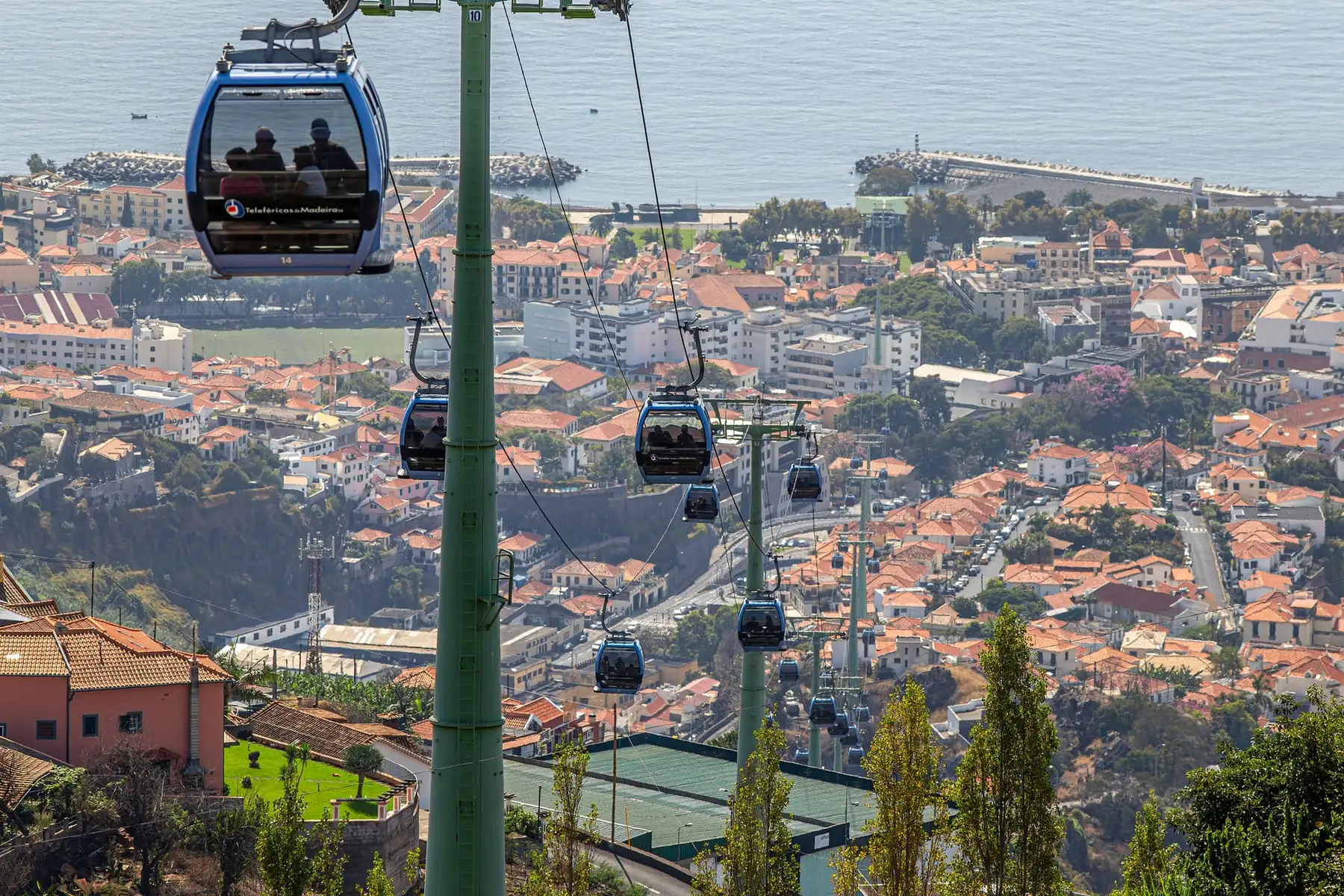
Ride the cable car up to Monte
Fifteen minutes from the Funchal seafront to the village six hundred metres above it, for €22 (about £19) return or €16 (£14) one way. At the top are the Monte Palace gardens and the reason most people come: the carros de cesto, wicker toboggans on wooden runners that two men in straw hats push and steer down two kilometres of public road. It costs about €30 (£26) for two, lasts ten minutes and stops well short of town, so budget a taxi or the bus back.
- 03
Stand on the Cabo Girão skywalk
A glass platform bolted to the lip of one of the highest sea cliffs in Europe, 580 metres straight down to a beach you can see people standing on. Entry is €3 (about £2.60) and it takes twenty minutes. Go early or late: the coach tours arrive in a block mid-morning and the platform holds a limited number at once. The viewpoint faces south-west, so the light is far better at the end of the day than at the start.
- 04
Cross the ridge from Pico do Arieiro
The PR1 runs from the third-highest peak to the highest, Pico Ruivo, along a ridge cut with staircases and tunnels, and it is the best day's walking on the island. It is free, takes five to seven hours there and back, and is genuinely exposed. The car park at Arieiro fills before sunrise and the road up is often above the cloud when Funchal is grey. Take a torch for the tunnels, water for all of it, and check the trail is open — sections close after rockfall and the fines for ignoring that are real.
- 05
Drink Madeira where they make it
The wine is fortified and then deliberately cooked — the estufagem process heats it for months, which is why an opened bottle keeps for a year and why it survived Atlantic crossings when nothing else did. Blandy's Wine Lodge in central Funchal runs tastings from about €7 (£6) and tours from €10 (£9). Ask for a Verdelho or a Sercial rather than the sweet Malmsey if you have only met the cooking version. Poncha, the sugarcane spirit with honey and lemon, is the other local drink and costs about €3 (£2.60) a glass.
After the flight
What it costs once you land
Funchal prices away from the hotel zone. Madeira is an autonomous region of Portugal with its own reduced VAT rate, and eating out sits below mainland Portugal as a result.
- Beer, local bar £1.30 a Coral; the Lido strip is roughly double
- Dinner for two, mid-range £35 espetada and a bottle of vinho verde
- Airport to Funchal £24 taxi, about twenty minutes; the Aerobus is around £4.50
- Car hire, per day £26 the island is unusable without one unless you stay in Funchal
- Lido day pass £5 there is no beach — swimming is off concrete platforms
- Bolo do caco and coffee £4
Checked August 2026. Sources at the foot of this page.
Before you book
Practical, for a British passport
Entry rules are for a British Citizen passport holder and come from gov.uk, read on 2026-08-07. They change; check before you fly.
- Airport
- FNC, Cristiano Ronaldo, twenty minutes east of Funchal on a runway extended out over the sea on concrete columns. It has a reputation for crosswinds and it is earned: diversions to Porto Santo or the Canaries happen several times a year, so leave slack around a tight connection home.
- Entry
- No visa, but biometric registration at the border. No fee. Up to 90 days in any 180-day period, counted across the whole Schengen area. Two rules, both of which must hold: issued less than 10 years before the day you arrive, and expiring at least 3 months after the day you leave the Schengen area. The Entry/Exit System has been fully operational since 10 April 2026. On your first trip since registering you are sent to a booth for fingerprints and a photograph; it is free, takes a few minutes, and the record lasts three years or until the passport expires. After that the crossing is quicker than the old stamp. ETIAS — a separate, paid, apply-before-you-fly authorisation — is expected in the last quarter of 2026 and is not required yet. The ten-year issue-date rule catches passports renewed early before October 2018, which can carry more than ten years of validity and be refused despite an expiry date months away.
- Currency
- Euro. Cards are taken everywhere including small cafés and the levada car parks; the Monte toboggan men, the fish market and rural bars want cash.
- Language
- Portuguese, with English widely spoken in Funchal and in anything to do with tourism. The island has a long British connection through the wine trade, and it shows in how easily hotels and restaurants switch.
- Time zone
- The same as the UK all year. Madeira keeps WET in winter and WEST in summer, changing on the same dates Britain does, so there is never an hour to adjust to.
- Plugs
- Type C and F, 230V. A British type-G plug does not fit; bring an adapter.
- Health
- The GHIC is valid — Madeira is Portugal and the EU — and covers state treatment as a resident would get it. It is not insurance and it will not cover a mountain rescue, which matters more here than on a beach island: the levada network runs through terrain where a twisted ankle is a helicopter. Tap water is spring-fed and good.
- Safety
- No FCDO warning against travel. Crime is very low. The hazards are all geographic — unfenced drops beside several levadas, unlit tunnels, and an Atlantic swell on the north coast that is not for casual swimming. Trail closures after rain are posted and enforced with fines.
One of only four destinations we track where a GHIC is valid — this is the EU. It covers state treatment as a resident would get it, and nothing else: not repatriation, not a private clinic. It is not insurance.
A bed
Where to stay in Madeira
Funchal or not Funchal, essentially. The city holds most of the beds and all of the restaurants; the alternatives buy quiet, and in the west, noticeably more sun.
Funchal
The obvious base and the only one where you can manage without a car: the old town, the market, the cable car, the wine lodges and the lido platforms are all walkable, and the buses to the levada trailheads start here. Prices span hostel to grand hotel. The drawback is that Funchal is a working city of a hundred thousand people, not a resort, and the seafront is concrete rather than sand.
Stays in Funchal Opens in a new tab QUIET, NEAR THE AIRPORTCaniço
Fifteen minutes east of the city and ten from the airport, a smaller town on the cliffs with a marine reserve below it at Garajau and some of the island's better diving. Cheaper than Funchal for the same standard and much quieter after dark. You will be driving or taking the bus into town most evenings, which is the trade.
Stays in Caniço Opens in a new tab THE SUNNY ENDCalheta
Forty-five minutes west along the south coast, and measurably drier and sunnier than Funchal — the mountains take the cloud before it gets here. It also has the island's one proper sandy beach, imported from Morocco and held in place by two breakwaters. Remote in the sense that everything is a drive, and the evening choice is a handful of restaurants rather than a hundred.
Stays in Calheta Opens in a new tabEvery area pinned on one map, set to the dates of the fare above. Change them for your own trip and it reloads live availability.
Open the Madeira map Opens in a new tabGetting around
Hire a car unless you are staying in Funchal and intend not to leave it. The island is small but slow: the motorway along the south coast is fast and almost entirely tunnel, while everything off it is hairpins on gradients that will surprise anyone who learned to drive somewhere flat. Rates are reasonable and fuel is cheaper than Britain. Parking in central Funchal is the one genuine annoyance — use the underground car parks rather than hunting the street.
The bus network is better than the terrain suggests. Horários do Funchal covers the city and the near suburbs cheaply, and the long-distance operators reach most villages, including the levada trailheads at Ribeiro Frio and Santana. The catch is frequency: rural services are built around school and market times, and a route with four buses a day can strand you at the far end of a walk.
Levada walks are usually linear rather than circular, which is the planning problem nobody warns you about. Either arrange a taxi to collect you at the far end — the drivers know every trailhead and will quote a fixed price — or use one of the many walking outfits that run a minibus to the start and meet you at the finish for about €35 a head.
Food and local tips
The two dishes to eat are espetada and bolo do caco. Espetada is beef rubbed with garlic and bay, skewered on a laurel stick and grilled over wood, then hung from a hook at the table so it drips onto the bread below; it is a village festival dish that became a restaurant one and it is best inland at Câmara de Lobos or Estreito. Bolo do caco is a flat sweet-potato bread cooked on a stone and split with garlic butter, served as a starter everywhere and sold from stalls for a couple of pounds.
The fish is the other reason to be here. Espada — black scabbardfish — is caught at eight hundred metres off the south coast, looks alarming and tastes mild, and is traditionally fried with banana, which sounds wrong and is not. Lapas, limpets grilled with garlic and lemon, are the standard starter. Avoid the seafront rows in central Funchal where a tout stands outside with a menu; the mercado dos lavradores and the streets behind it feed the city rather than the visitors.
Espada com banana, at the market
Black scabbardfish fried with banana and passion fruit sauce. About €14 (£12) in a market restaurant in Funchal, and half that in a village one inland.
Ready for Madeira?
Pick your departure airport and see what the route costs today from each of the ten we track.
See the £56 fare Opens in a new tabSame band
Other winter sun destinations
Where the numbers came from
- Funchal cable car ticket prices madeiracablecar.com Opens in a new tab read 2026-08-07
- Cabo Girão skywalk entry and airport transfer costs madeiracitypass.tripnly.com Opens in a new tab read 2026-08-07
- Entry rules, GHIC validity and the Entry/Exit System gov.uk Opens in a new tab read 2026-08-07
- Entry rules for a British Citizen passport gov.ukOpens in a new tab read 2026-08-07