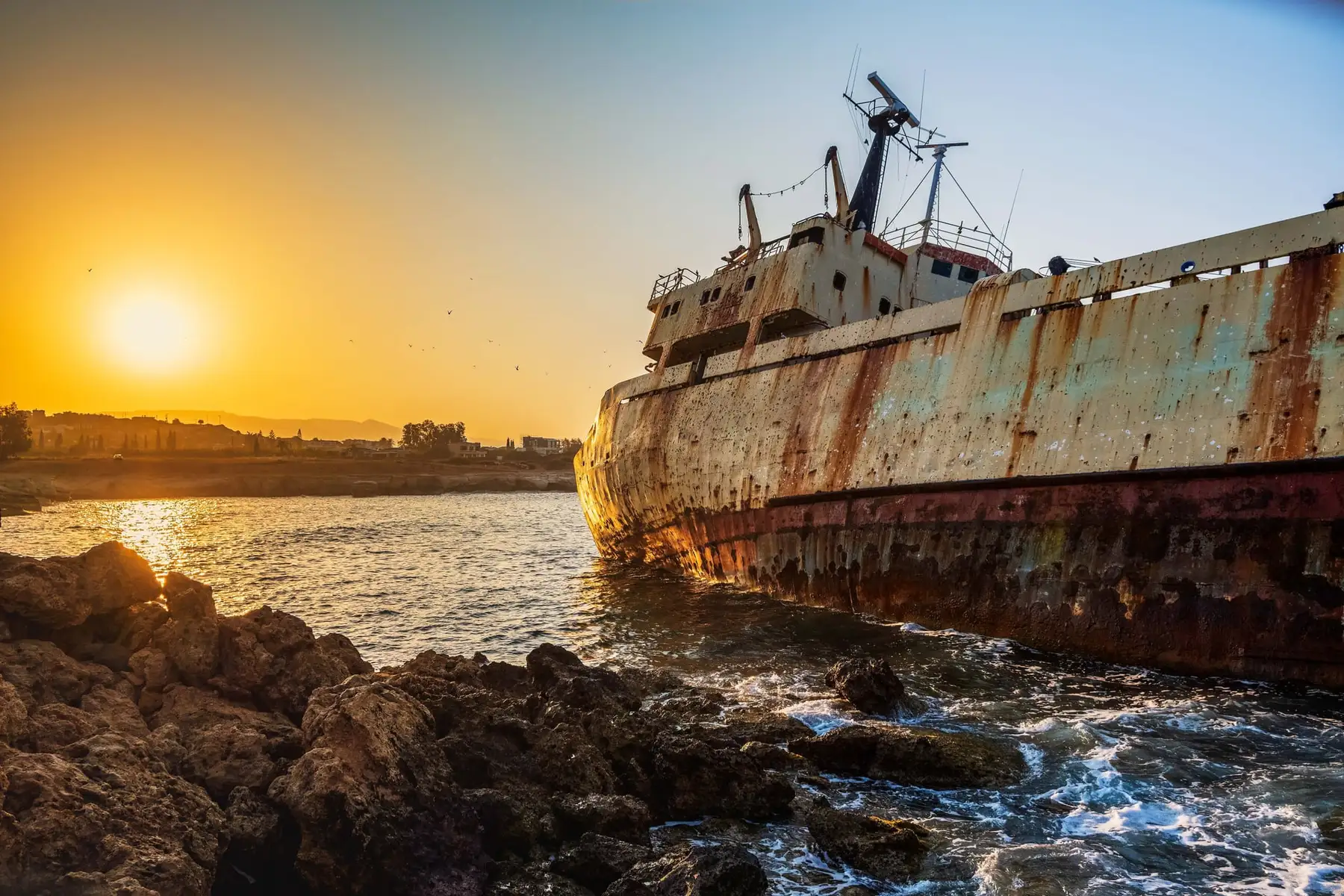
DESTINATION · PAPHOS
Paphos, where everything fits
Three-pin plugs, driving on the left, English on every sign and a Roman mosaic floor at the end of the promenade. The least friction of any flight on this list, and the only one where you can hire a car without relearning the road.
- Airport
- PFO · Cyprus
- On sale
- 8 of 12 months
- Airport spread
- £121 across 10 UK airports
Today's best fare
London Paphos
£74 £75
Measured on a live search, refreshed hourly. Prices move — confirm on Kiwi.com.
Departure airports
£121 apart, depending where you take off
Every UK airport searched separately for this destination, cheapest first, as a return fare for one person with taxes in. Manchester to Paphos and London to Paphos are not the same route and we do not price them as one. Each figure is a fare of one stop at most — the same limit as the price at the top of this page — and each is that airport's own cheapest week, so the dates change from row to row. Every link opens on the dates its price was found on.
All 10 airports have a fare to Paphos within one stop today. London covers Heathrow, Gatwick, Stansted, Luton, City and Southend in one search.
From your airport
How long is the flight to Paphos?
Distance, nonstop flight time, whether a direct flight exists and what it costs, worked out separately for each of the ten UK airports.
The year, month by month
When Paphos is worth the airfare
Average daytime high for each month. The greyed months are ones we refuse to advertise — not because they are cheap, but because the place cannot deliver what the page promises.
- Jan 17° not sold
- Feb 17° not sold
- Mar 19° not sold
- Apr 22°
- May 26°
- Jun 30°
- Jul 32°
- Aug 33°
- Sep 31°
- Oct 27°
- Nov 23° today's fare
- Dec 19° not sold
8 of 12 months on sale. The reason is below, not in the numbers.
Cyprus has a proper Mediterranean climate rather than the Atlantic one that keeps the Canaries level all year — which means a real summer and a real winter, and a much wider swing between them. Paphos sits on the exposed south-west corner, so it gets the sea breeze that makes high summer bearable and the westerly weather that makes winter grey. The sea is the slow part: it holds warmth into the autumn and is at its coldest well after the air has started to recover, so late in the year the swimming stays good long after you would expect, and early in the year it stays poor long after the sun returns.
That lag is the thing to plan around. Autumn is the best-value stretch of the year here — the sea at its warmest, the sites bearable to walk, the coaches gone. Spring is the opposite trade: the Akamas is green and covered in wild flowers, the gorges have water in them and the hiking is at its best, but the sea is still cold enough that most people do not get in. Deep winter is when the resort infrastructure genuinely stands down; hotels close, boat operators stop and the coast is a place to walk rather than to swim.
For a British traveller the pattern is unusually favourable, because the cheapest weeks are also good ones. October and early November avoid both the school holidays and the crowds while keeping warm water, and the Easter fortnight — which is a bigger event in Orthodox Cyprus than at home, and often falls on a different date — brings prices up and villages to life at the same time.
Check which airport the fare lands at
Larnaca is over an hour from Paphos and a taxi between them runs to three figures. A cheaper flight into LCA is often not cheaper once the transfer is added.
The case for it
Why Paphos
Cyprus was British for eighty-two years and the infrastructure never changed back. The island drives on the left, the sockets take a British three-pin plug without an adapter, the kettles are 240 volts, English is spoken by nearly everyone and appears on the road signs beneath the Greek. For a British traveller that removes almost every small friction of a foreign holiday at once — and it is the only destination in this band where it is true.
Paphos itself is two towns with a Roman city between them. The lower town holds a UNESCO archaeological park where villa floors from the second and third centuries were found by a farmer ploughing in 1962, and the mosaics are still in the rooms they were laid in rather than lifted into a museum. West of it the Akamas peninsula runs out into empty limestone headland, gorges and turtle beaches — the last stretch of Cypriot coast with nothing built on it.
What Paphos is not is lively. The town skews older and quieter than the eastern resorts, the nightlife is a handful of bars rather than a strip, and the whole coast winds down hard once the season ends: hotels close, boat trips stop, and the sea gets too cold to be the reason you came. Anyone booking a beach week needs to look at the calendar carefully, and anyone wanting noise should be looking at Ayia Napa instead.
On the ground
Five things worth doing
- 01
Walk the mosaics at Kato Paphos
The archaeological park costs €4.50 (about £4) and holds four Roman villas whose floors survived because the town was abandoned after earthquakes and nobody built over them. The House of Dionysos alone has around five hundred square metres of figured mosaic still in situ. There is almost no shade and the site is large — go early or late, take water, and give it two hours. The Odeon at the top still hosts summer performances, and the medieval castle on the harbour is a five-minute walk from the gate.
- 02
Drive out to the Akamas and Lara Bay
The peninsula beyond Coral Bay is a protected wilderness with no development, reached by a track that turns rough past the Baths of Aphrodite. Lara Bay is a nesting beach for loggerhead and green turtles, fenced off in season and monitored by conservation staff who will explain what you are looking at. The track is genuinely unsurfaced and most hire agreements exclude it — the common outcome is not a breakdown but an argument at the desk, so read the terms or take a jeep tour for about €50 (£44).
- 03
Take the Tombs of the Kings on your way past
Not tombs of kings — the name is Ptolemaic hyperbole for the burial chambers of local officials, cut down into solid rock with Doric columns around underground courtyards, the whole thing modelled on the houses the dead had lived in. Entry is about €2.50 (£2.20), it is a fifteen-minute walk up the coast from Kato Paphos, and an hour covers it. Wear proper shoes: the site is uneven rock with open shafts and no handrails, which is also why it is far more atmospheric than a museum.
- 04
Hike the Avakas Gorge before the heat
A limestone slot canyon in the Akamas where the walls close to a couple of metres apart and rise fifty above you. It is free, the walk in is about two kilometres, and the floor is a streambed — wet feet in spring, dry rubble later. Rockfall closed it for a period and the safe section is now marked; do not scramble past the signs. Go before nine, both for the temperature and because two coach parties turn the narrow section into a queue by mid-morning.
- 05
Climb into the Troodos for the painted churches
An hour and a half inland, ten small barn-roofed Byzantine churches hold frescoes from the eleventh to the sixteenth centuries and share a UNESCO listing between them. Entry is free or a couple of euros to whoever holds the key, which is often a villager in the house opposite. Asinou and Panagia tou Araka are the two worth the drive. The mountain roads are narrow and slow, so it is a full day out of a beach week rather than an afternoon.
After the flight
What it costs once you land
Town prices rather than seafront-hotel prices. Cyprus is not the cheap Mediterranean it was twenty years ago and sits above Greece and Türkiye on most lines, though below Spain's mainland resorts.
- Beer, local bar £2.60 a KEO or Leon; the harbour front is nearer £4.50
- Dinner for two, mid-range £45 a full meze for two, which arrives as fifteen or more dishes
- Airport to Kato Paphos £20 metered taxi, fifteen minutes; Coral Bay is about £24 by day
- Car hire, per day £30 left-hand drive as at home; the Akamas track is excluded from most waivers
- Sunbed and parasol £5 the standard municipal set of two beds and a parasol
- Souvlaki in pitta £3.50
Checked August 2026. Sources at the foot of this page.
Before you book
Practical, for a British passport
Entry rules are for a British Citizen passport holder and come from gov.uk, read on 2026-08-07. They change; check before you fly.
- Airport
- PFO, Paphos International, about fifteen minutes from Kato Paphos and twenty-five from Coral Bay. Small, quick and easy. Larnaca (LCA) is the island's other airport and is well over an hour away — worth checking which one a cheap fare actually lands at.
- Entry
- No visa, passport stamped by hand. No fee. Up to 90 days in any 180-day period. Expiry at least 3 months after the day you plan to leave. Cyprus is in the EU but not in the Schengen area, so the Entry/Exit System does not apply here and there is no biometric booth. Passports are still stamped the old way, which puts the burden back on you: check you have been stamped in and out. Without a stamp you can be treated as an overstayer, and the fix is producing boarding passes at the desk and asking a border guard to write the date in. Its 90 days are its own — they do not come out of your Schengen allowance.
- Currency
- Euro. Cyprus joined in 2008 and cards are accepted almost everywhere; village tavernas, the church key-holders in the Troodos and the beach kiosks want cash.
- Language
- Greek, with English spoken near-universally as a legacy of British administration and a large resident British population. Road signs are bilingual and menus are in English by default.
- Time zone
- Two hours ahead of the UK all year. Cyprus changes its clocks on the same dates Britain does, so the gap stays at two hours in both winter and summer.
- Plugs
- Type G, 230V — the British three-pin plug, fitted as standard across the island. No adapter needed, which is true of nowhere else on this list.
- Health
- The GHIC is valid: Cyprus is in the EU, and it covers state treatment on the same terms as a resident. It is not insurance and covers neither repatriation nor the private clinics most visitors actually end up in. Tap water is safe in Paphos though heavily chlorinated, and most people drink bottled.
- Safety
- No FCDO warning against travel. Crime against visitors is low. The practical risks are the sun and the road: the Akamas has no shade and no water, and Cypriot driving is fast and casual about indicators despite the familiar side of the road.
One of only four destinations we track where a GHIC is valid — this is the EU. It covers state treatment as a resident would get it, and nothing else: not repatriation, not a private clinic. It is not insurance.
A bed
Where to stay in Paphos
Paphos spreads a long way along the coast, and the three sensible bases are genuinely different: one for walking to the ruins, one for the beach, one for getting away from both.
Kato Paphos
The lower town, wrapped around the harbour and the archaeological park, with the hotels, the tavernas and the mosaics all within twenty minutes on foot. The obvious choice for a first visit and the only base where a car is optional. The beach here is small and mostly imported sand, and the harbour restaurants are priced for people walking past rather than for people coming back.
Stays in Kato Paphos Opens in a new tab BEST BEACHCoral Bay
Fifteen minutes up the coast, and the proper sandy bay the town itself lacks — sheltered, shallow at the edges and the reason most families book this end. A short strip of bars and restaurants behind it, quieter than Kato Paphos and more expensive per night. You will want a car or the regular bus for anything cultural, since the ruins are back the other way.
Stays in Coral Bay Opens in a new tab QUIETESTPolis
Forty minutes north on the far side of the peninsula, a small town with a long pebble beach, a working square and the Akamas on its doorstep. Prices drop noticeably and the tourist infrastructure thins to almost nothing. Choose it for walking, turtles and evenings where the loudest thing is the taverna; do not choose it if you want the ruins, the harbour or anything happening after eleven.
Stays in Polis Opens in a new tabEvery area pinned on one map, set to the dates of the fare above. Change them for your own trip and it reloads live availability.
Open the Paphos map Opens in a new tabGetting around
Hire a car, and enjoy the novelty of not having to think about it. Cyprus drives on the left, the signs are bilingual, the hire fleet is right-hand drive and a British licence is accepted without an international permit. The motorway east towards Limassol is fast and empty, and everything this page recommends — the Akamas, the gorge, the Troodos churches — is a drive rather than a bus ride. Fuel is cheaper than at home.
The bus network is real but slow. Route 615 runs Kato Paphos to Coral Bay frequently and cheaply, 612 covers the harbour to the upper town, and there is an airport service into Paphos and on to Limassol. Fares are a couple of euros and a day ticket is about five. What buses will not do is get you into the peninsula or the mountains, and services thin sharply outside the season.
Taxis are metered within town and fixed-price for airport runs, and there is no meaningful ride-hailing. The one route to think about before booking is the airport transfer: PFO is close, LCA is not, and the taxi between Larnaca and Paphos costs more than two days of car hire.
Food and local tips
The meze is the local institution and the local trap. Order it and you are committing to fifteen to thirty small dishes arriving over two hours — dips, grilled halloumi, snails, sheftalia, koupepia, then the meat — and there is no polite way to stop it halfway. It is excellent value for two hungry people and far too much for one. Halloumi is Cypriot, protected, and squeaks properly when it is fresh; the supermarket version at home is a different product.
Beyond the meze, look for kleftiko — lamb sealed in a clay oven for hours, a dish invented by people hiding stolen goats from the Ottomans — and for the village tavernas inland, where a meal costs half what the harbour charges. The wine has improved sharply: the indigenous Xynisteri and Maratheftiko are worth trying over the international varieties, and Commandaria, the sweet dessert wine, has been made here since antiquity and is genuinely old rather than marketed as such.
Kleftiko from a proper clay oven
Slow-baked lamb on the bone, sealed in the oven and opened at the table. About €16 (£14) in a village taverna, and worth the drive inland to find one where the oven is outside.
Ready for Paphos?
Pick your departure airport and see what the route costs today from each of the ten we track.
See the £74 fare Opens in a new tabSame band
Other winter sun destinations
Where the numbers came from
- Paphos Archaeological Park and Tombs of the Kings entry prices tourismattractions.net Opens in a new tab read 2026-08-07
- Paphos airport transfer fares paphos-airport.com Opens in a new tab read 2026-08-07
- Entry rules, passport stamping and Cyprus being outside the Entry/Exit System gov.uk Opens in a new tab read 2026-08-07
- Entry rules for a British Citizen passport gov.ukOpens in a new tab read 2026-08-07