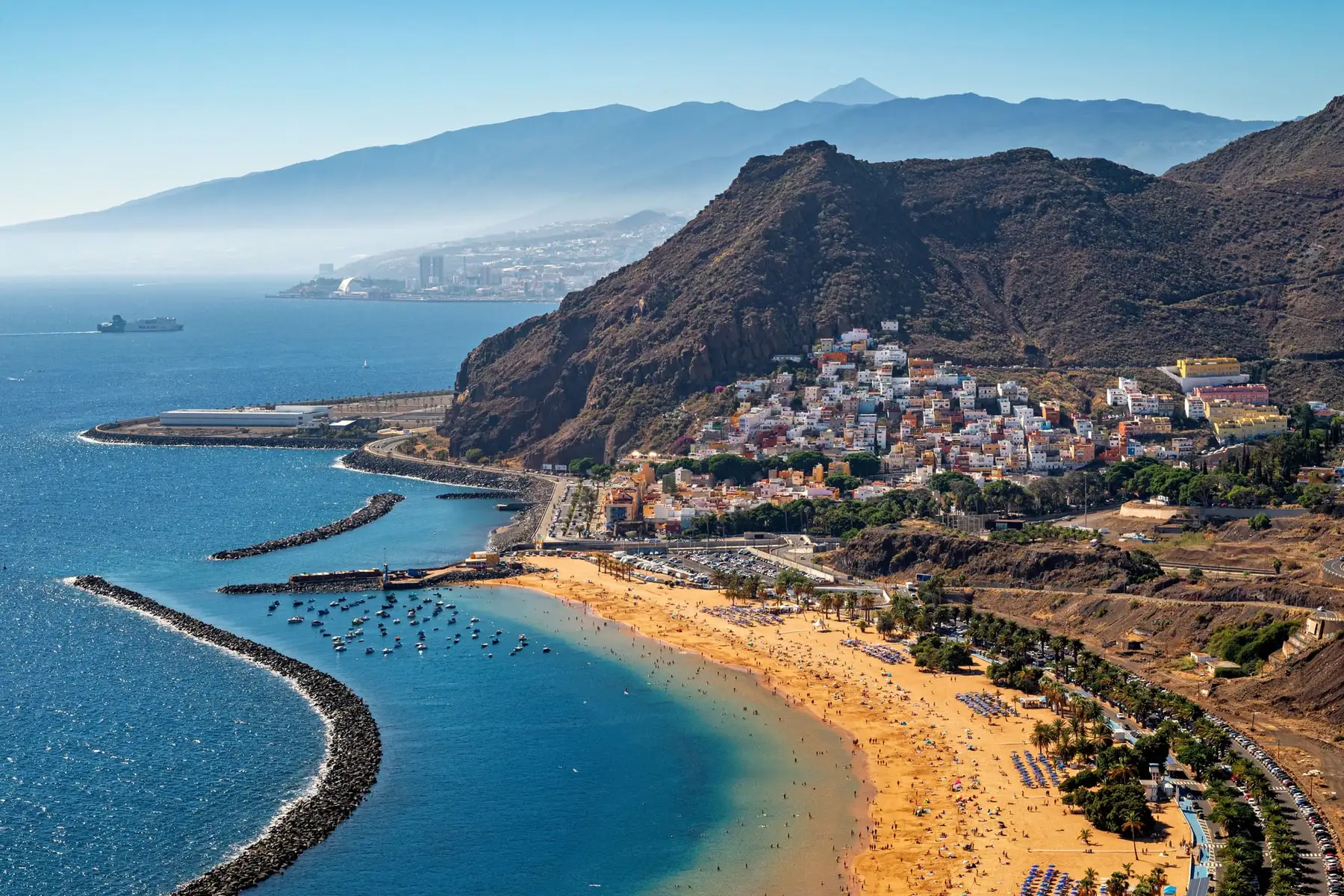
DESTINATION · TENERIFE
Tenerife is two islands
A desert in the south and a rainforest in the north, separated by the highest mountain in Spain. Most British visitors only ever see one of them, and a good many book the wrong one.
- Airport
- TCI · Spain
- On sale
- 12 of 12 months
- Airport spread
- £69 across 10 UK airports
Today's best fare
Birmingham Tenerife
£51 £60
Measured on a live search, refreshed hourly. Prices move — confirm on Kiwi.com.
Departure airports
£69 apart, depending where you take off
Every UK airport searched separately for this destination, cheapest first, as a return fare for one person with taxes in. Manchester to Tenerife and London to Tenerife are not the same route and we do not price them as one. Each figure is a fare of one stop at most — the same limit as the price at the top of this page — and each is that airport's own cheapest week, so the dates change from row to row. Every link opens on the dates its price was found on.
All 10 airports have a fare to Tenerife within one stop today. London covers Heathrow, Gatwick, Stansted, Luton, City and Southend in one search.
From your airport
How long is the flight to Tenerife?
Distance, nonstop flight time, whether a direct flight exists and what it costs, worked out separately for each of the ten UK airports.
The year, month by month
When Tenerife is worth the airfare
Average daytime high for each month. The greyed months are ones we refuse to advertise — not because they are cheap, but because the place cannot deliver what the page promises.
- Jan 21°
- Feb 21°
- Mar 22°
- Apr 23°
- May 24°
- Jun 26°
- Jul 28°
- Aug 29°
- Sep 28°
- Oct 26°
- Nov 24°
- Dec 22° today's fare
12 of 12 months on sale. No closed season.
The reason Tenerife is warm in the British winter has nothing to do with latitude and everything to do with the sea. The Canary Current runs cold down the African coast and holds the air temperature in a narrow band all year — the island never gets properly hot and never gets properly cold, and the difference between its warmest month and its coolest is smaller than the difference between a good and a bad day in Britain. What varies is not heat but cloud, and where the cloud sits depends entirely on which side of the mountain you are.
The trade winds pile a permanent bank of low cloud against the northern slopes, the panza de burro or donkey's belly, which can sit over Puerto de la Cruz for days at a time while the south is in full sun forty minutes away. Above about 1,200 metres you come out of it altogether, which is why the drive up to Teide so often starts in grey and ends in glare. The one genuine disruption is the calima, a Saharan dust wind that arrives a few times a year, turns the sky orange and cuts visibility to a few hundred metres for two or three days.
For a British traveller the weeks to avoid are the obvious ones — February half-term, the Easter fortnight, and the last two weeks of July when the island fills with mainland Spanish holidaymakers as well. Late January and the first half of December are the quiet, cheap, entirely usable weeks. Carnival in Santa Cruz, in February, is the exception worth paying for: it is the largest in Europe and the city is booked solid months ahead.
Book the Teide peak permit before anything else
It is free, it is the only way onto the summit cone, and slots open roughly eight weeks ahead and disappear in days. Everything else about the trip can be arranged later.
The case for it
Why Tenerife
Tenerife is a single volcano with an island built around it. Teide rises to 3,715 metres — the highest point in Spain and, measured from the sea floor, the third-tallest volcanic structure on earth — and it does something no other Canary Island can: it stops the weather. The north-easterly trades hit the northern slopes, dump their moisture and arrive in the south with nothing left. The result is one island with two climates and two entirely different landscapes.
The south is where almost every British flight lands and where the resorts are: arid, reliably sunny, built up along a coastline that was empty scrub fifty years ago. The north is green, cooler, wetter, and far older — La Laguna is a UNESCO town, La Orotava is a valley of banana terraces and colonial balconies, and the Anaga hills hold a laurel forest that is a relic of what covered the Mediterranean before the ice ages.
The catch is that the southern resorts are dense in a way Lanzarote refused to allow, and the stretch from Los Cristianos through Playa de las Américas is closer to a small city than to a beach village. Some people want exactly that. Anyone who pictures the Tenerife of the tourist board — the pine forests, the black-sand coves, the volcano above the cloud — and books a tower block in Adeje without a hire car will spend the week a long way from it.
On the ground
Five things worth doing
- 01
Go up Teide, and decide how far
The cable car costs €41.50 (about £36) return and lifts you to 3,555 metres in eight minutes, leaving 160 metres of ascent to the crater rim. That last stretch needs a free permit, booked online through the national park, and slots open about eight weeks ahead and are gone within days in summer. Without one you can still walk two marked ridge trails from the top station. Altitude is the real issue rather than fitness — take it slowly for the first twenty minutes and turn back if your head goes.
- 02
Watch pilot whales, not on a booze cruise
The channel between Tenerife and La Gomera holds a resident population of short-finned pilot whales and bottlenose dolphins, present all year rather than seasonally, and it is one of the most reliable cetacean sightings in Europe. Trips from Los Cristianos and Puerto Colón run about €30 to €40 (£26–£35). Choose an operator with the Blue Boat flag, which is the regional licence for approach distance; the cheaper unmarked boats crowd the animals and play music at them, and it shows.
- 03
Cross the Anaga hills
The far north-east of the island is a UNESCO biosphere reserve of laurisilva — a subtropical laurel cloud forest that covered southern Europe millions of years ago and now survives on a handful of Atlantic islands. The Sendero de los Sentidos above Cruz del Carmen is short, marked and free; the longer descent to Taganana takes most of a day. It is wet, cool and often inside the cloud, which is the point. Bring a waterproof, not a swimsuit.
- 04
Spend a morning in La Laguna
The old capital, twenty minutes above Santa Cruz, laid out on a grid in 1500 that became the template for colonial cities across the Americas — which is why it is a World Heritage Site and why it looks nothing like a resort. Free to walk, and a working university town rather than a preserved one, so the bars are full of students and the prices are local. The tram from Santa Cruz costs about €1.35 (£1.20) and drops you in the middle of it.
- 05
Take the ferry to La Gomera
Fifty minutes from Los Cristianos, around €70 (£61) return as a foot passenger, to an island with no airport worth the name and a national park of the same ancient laurel forest at its centre. San Sebastián is where Columbus took on water in 1492. Go as a day trip and you get four or five hours, which is enough for the port town and one valley; the island deserves an overnight, and the crossing back is often rougher than the crossing out.
After the flight
What it costs once you land
Local prices, a street or two back from the seafront. The Canaries charge IGIC at seven per cent instead of mainland VAT, so eating and drinking sit below the Spanish average, though the southern resort strips price like anywhere else in Europe.
- Beer, local bar £2.20 a caña; on the Adeje seafront closer to £4.50
- Dinner for two, mid-range £40 two courses and wine in a guachinche or a town restaurant
- TFS airport to Costa Adeje £33 metered taxi, about twenty-five minutes; the 111 bus is under £5
- Car hire, per day £25 the north is effectively unreachable without one
- Sunbed and parasol £7 per bed per day on the southern beaches
- Bocadillo and coffee £4.50
Checked August 2026. Sources at the foot of this page.
Before you book
Practical, for a British passport
Entry rules are for a British Citizen passport holder and come from gov.uk, read on 2026-08-07. They change; check before you fly.
- Airport
- TCI covers both: Tenerife South (TFS), twenty minutes from the southern resorts and where nearly every British flight lands, and Tenerife North (TFN) above La Laguna, mostly inter-island and mainland. They are an hour apart — check which one your ticket says before you book a transfer.
- Entry
- No visa, but biometric registration at the border. No fee. Up to 90 days in any 180-day period, counted across the whole Schengen area. Two rules, both of which must hold: issued less than 10 years before the day you arrive, and expiring at least 3 months after the day you leave the Schengen area. The Entry/Exit System has been fully operational since 10 April 2026. On your first trip since registering you are sent to a booth for fingerprints and a photograph; it is free, takes a few minutes, and the record lasts three years or until the passport expires. After that the crossing is quicker than the old stamp. ETIAS — a separate, paid, apply-before-you-fly authorisation — is expected in the last quarter of 2026 and is not required yet. The ten-year issue-date rule catches passports renewed early before October 2018, which can carry more than ten years of validity and be refused despite an expiry date months away.
- Currency
- Euro. Cards are accepted everywhere including small bars; the guachinches in the north, the Teide cable car car park and rural buses want cash.
- Language
- Spanish, spoken with the soft Canarian accent that drops final consonants. English is universal in the southern resorts and patchy in the north, where a little Spanish makes a real difference.
- Time zone
- The same as the UK all year. The Canaries change clocks on the same dates Britain does, so there is no hour to lose in either direction.
- Plugs
- Type C and F, 230V. A British type-G plug does not fit; pack an adapter or two, since hotel desks run out.
- Health
- The GHIC works here — this is Spain and the EU — and covers state treatment as a resident would get it. It does not cover repatriation, the private clinics that fill the resort strips, or a mountain rescue off Teide, so private insurance still matters. Tap water is safe but desalinated and unpleasant; almost everyone buys bottled.
- Safety
- No FCDO warning against travel to the Canaries. The real hazards are geographic: the north-coast beaches have serious Atlantic currents and drownings happen most years, and Teide is a high-altitude mountain where the weather turns fast and the cable car shuts in wind. Check the flag, and check the park website before driving up.
One of only four destinations we track where a GHIC is valid — this is the EU. It covers state treatment as a resident would get it, and nothing else: not repatriation, not a private clinic. It is not insurance.
A bed
Where to stay in Tenerife
Pick the half of the island first and the resort second. The south is sun and building; the north is green, Canarian and cloudier, and the two are ninety minutes apart on a good motorway.
Costa Adeje
The newer, quieter and more expensive end of the southern strip, with the better hotels, the calmer beaches and Siam Park at the top of the hill. Nearest to the whale-watching boats at Puerto Colón. It is comfortable rather than characterful — you are staying in a resort built this century, and the nearest thing to a Canarian town is a drive away.
Stays in Costa Adeje Opens in a new tab SOUTH, BEST VALUELos Cristianos
The old fishing port at the other end of the same bay, cheaper, flatter and genuinely walkable, with a working harbour and the ferry to La Gomera leaving from it. More British and more lived-in than Adeje, with a long-established retired community. The beach is smaller and busier, and the town does not stop at the edges the way the purpose-built resorts do.
Stays in Los Cristianos Opens in a new tab NORTH, THE OTHER ISLANDPuerto de la Cruz
The original Tenerife resort, established when the south was still scrub — a real town on the green coast below the Orotava valley, with black-sand beaches, Manrique's seawater lido and Loro Parque. Cooler and cloudier than the south, and that is the trade: you get the Canarian island instead of the sunbathing one. Come here if the mountain and the forest are the point.
Stays in Puerto de la Cruz Opens in a new tabEvery area pinned on one map, set to the dates of the fare above. Change them for your own trip and it reloads live availability.
Open the Tenerife map Opens in a new tabGetting around
The TITSA bus network is better than a holiday island has any right to have: line 111 runs the airport to Los Cristianos and Adeje for a few euros, the 343 links both airports to the southern resorts, and long-distance services reach Santa Cruz, La Laguna and Puerto de la Cruz. A Ten+ travel card knocks around half off every fare and is worth buying at the airport counter on arrival if you plan to use buses more than twice.
For the interior, hire a car. Teide, Anaga, Masca and the guachinches of the north are either unreachable by bus or reachable in a way that eats the day. Rates here are among the cheapest in Europe and the motorway down the east coast is fast. The mountain roads are another matter — the descent into Masca and the lanes through Anaga are single-track with blind bends, and the drive to the Teide crater climbs 2,000 metres in under an hour, which is hard on brakes and on passengers.
Taxis are metered and reliable but the island is large, and a run from the southern resorts to the north can cost more than a day's car hire. The tram in Santa Cruz is the exception worth using — two lines, flat fare, and it is the sensible way from the capital up to La Laguna.
Food and local tips
Canarian food is the plain end of Spanish cooking: papas arrugadas in salt-crusted skins, the two mojo sauces — red with paprika, green with coriander — that go on everything, goat rather than lamb, and fish sold by weight and named by species rather than by dish. Ask for vieja, cherne or sama. The cheeses are goat's and often lightly smoked, and the almogrote from La Gomera, a rough paste of hard cheese, garlic and pepper, is worth bringing home.
The thing to seek out in the north is a guachinche — a farmhouse licensed to sell its own wine and a short menu of home cooking, traditionally only until the barrel runs out. They are cash-only, seasonal, signposted by hand and concentrated in the Orotava valley, and they are the cheapest good meal on the island. In the south, walk two streets back from the promenade before you sit down: the seafront is priced for people who will not be here next week.
Wine from the Orotava valley
Grown on cordón trenzado — vines plaited into ropes metres long and laid on the ground, a training method used nowhere else in the world. A bottle at a guachinche is about €8 (£7), and most of it never leaves the island.
Ready for Tenerife?
Pick your departure airport and see what the route costs today from each of the ten we track.
See the £51 fare Opens in a new tabSame band
Other winter sun destinations
Where the numbers came from
- Teide cable car prices and the free summit permit volcanoteide.com Opens in a new tab read 2026-08-07
- Tenerife South airport transfer costs welcomepickups.com Opens in a new tab read 2026-08-07
- Entry rules, GHIC validity and the Entry/Exit System gov.uk Opens in a new tab read 2026-08-07
- Entry rules for a British Citizen passport gov.ukOpens in a new tab read 2026-08-07