DESTINATION · LANZAROTE
Lanzarote, built to a rule
An island that decided in the 1960s what it would refuse to become, and then held the line. No high-rise, no roadside advertising, white walls throughout — which is why it looks like nowhere else in the Canaries and why the volcano is still the tallest thing you can see.
- Airport
- ACE · Spain
- On sale
- 12 of 12 months
- Airport spread
- £50 across 10 UK airports
Today's best fare
London Lanzarote
£48 £52
Measured on a live search, refreshed hourly. Prices move — confirm on Kiwi.com.
Departure airports
£50 apart, depending where you take off
Every UK airport searched separately for this destination, cheapest first, as a return fare for one person with taxes in. Manchester to Lanzarote and London to Lanzarote are not the same route and we do not price them as one. Each figure is a fare of one stop at most — the same limit as the price at the top of this page — and each is that airport's own cheapest week, so the dates change from row to row. Every link opens on the dates its price was found on.
All 10 airports have a fare to Lanzarote within one stop today. London covers Heathrow, Gatwick, Stansted, Luton, City and Southend in one search.
From your airport
How long is the flight to Lanzarote?
Distance, nonstop flight time, whether a direct flight exists and what it costs, worked out separately for each of the ten UK airports.
The year, month by month
When Lanzarote is worth the airfare
Average daytime high for each month. The greyed months are ones we refuse to advertise — not because they are cheap, but because the place cannot deliver what the page promises.
- Jan 21°
- Feb 21°
- Mar 22°
- Apr 23°
- May 25°
- Jun 26°
- Jul 28°
- Aug 29°
- Sep 28°
- Oct 27°
- Nov 24° today's fare
- Dec 22°
12 of 12 months on sale. No closed season.
Lanzarote sits closer to the Sahara than to Spain, and the sea does the temperature regulating. The Canary Current runs cold down the African coast, which is why the water never gets properly warm and why the air never gets properly hot — the island has the narrowest spread between its warmest and coolest months of anywhere in this band. What moves instead is the wind. The north-easterly trades blow hardest from spring into late summer, and they are the single biggest variable in whether a day on the sand is pleasant or a battle.
That constancy is the argument for coming when Britain is at its worst. There is no season the island shuts, no monsoon, no cyclone risk, and the rain that does fall arrives in a handful of days between November and February and is over by lunchtime. The trade-off is that nothing here is ever hot enough for the people who want hot: this is a place for walking a volcano and swimming briefly, not for lying still.
The British calendar matters more than the Canarian one. February half-term and the fortnight either side of Easter are when the island fills and the package operators price accordingly; late January, and the first half of December before the Christmas run, are when the same hotel costs a fraction of it. If you are not tied to school terms, those are the weeks worth watching.
Book Timanfaya before you book dinner
Entry is timed and online-only, and the slots for the first three hours of the day sell out weeks ahead in every school holiday.
The case for it
Why Lanzarote
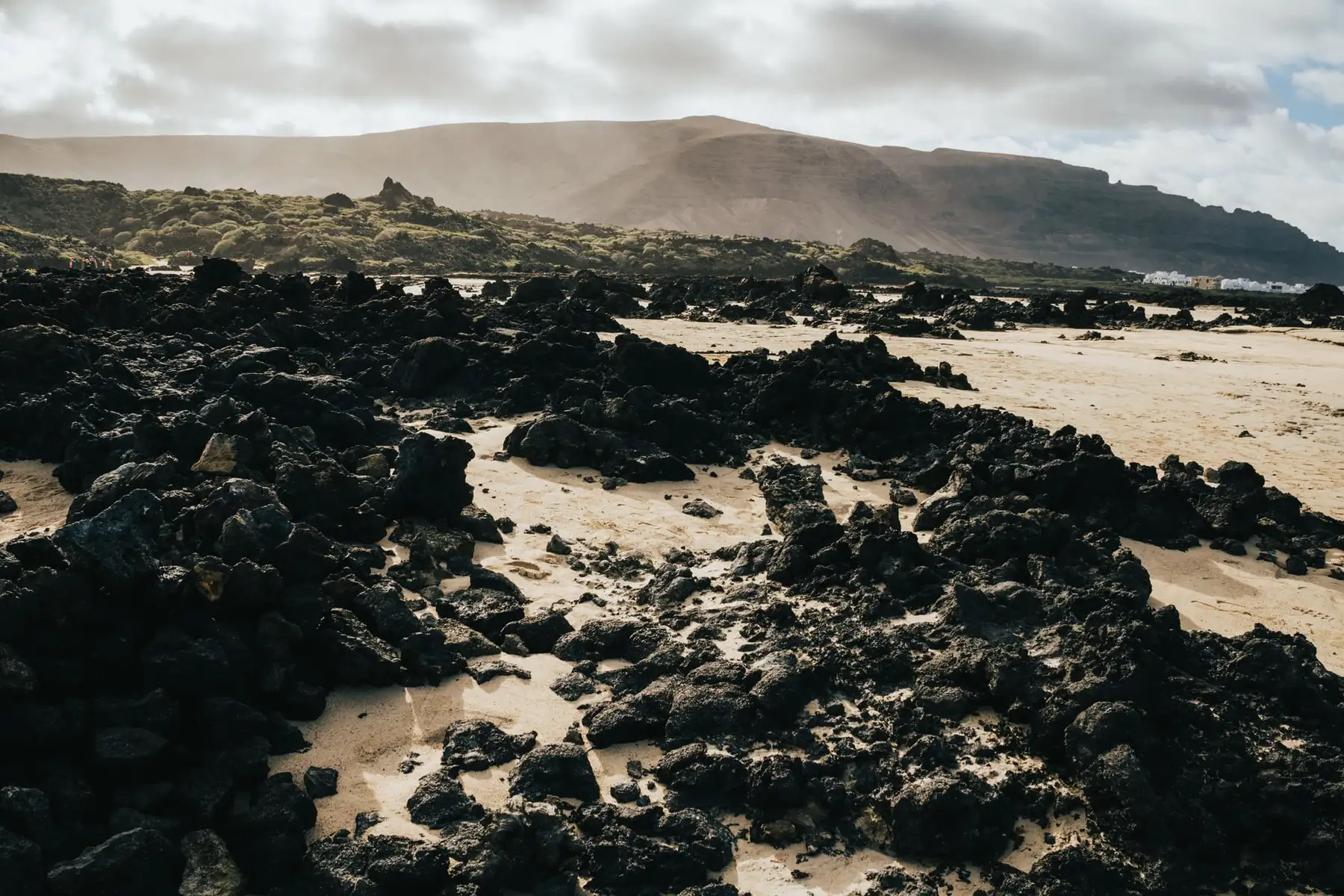
Lanzarote is the driest and youngest-looking of the main Canary Islands, and the one where a single person changed how it looks. César Manrique came home from New York in 1966, saw what mass tourism was doing to the Spanish mainland, and spent the rest of his life arguing for building limits, buried cables and white paint. The rules held. Almost nothing rises above three floors, there are no billboards on the roads, and the lava is left where it fell.
That makes it an unusually legible place. The 1730s eruptions buried a quarter of the island under ash and left a landscape that has barely weathered — you can drive from a working vineyard to a field of black cinder in ten minutes. The wine of La Geria still grows in hand-dug pits sheltered by crescent stone walls, one vine per hollow, because that is the only way anything holds water here. It looks like an art project and it is farming.
The honest caveat is that this is not a lush island and it does not pretend to be. There are almost no trees, the interior is grey and brown, and the trade winds blow more or less constantly — pleasant when you are walking, tiresome on a beach lounger, and the reason the east coast fills with windsurfers. If you want green hills and still air, Madeira does that and Lanzarote does not.
On the ground
Five things worth doing
- 01
Cross Timanfaya by coach
The Montañas del Fuego are a national park you are not allowed to walk in. Entry is €30 (about £26) and includes the only way through: a coach along the Ruta de los Volcanes, a fourteen-kilometre road cut between craters that no private car may use. At the visitor centre staff drop brushwood into a pit and it ignites on the ground heat, and pour water into a borehole that comes back as a geyser. Tickets are sold online only, for a timed slot, and the mid-morning ones go first. Book before you fly, not the night before.
- 02
Walk into a lava tube at Jameos del Agua
A six-kilometre tunnel left by the Corona volcano, part of which Manrique turned into an auditorium, a saltwater lagoon and a white pool nobody is allowed to swim in. Entry is €17 (about £15). The lagoon holds a blind albino crab found nowhere else on earth, about a centimetre long, and people miss it entirely because they are looking at the architecture. Cueva de los Verdes, the unlit stretch of the same tube twenty minutes away, costs the same and is the better half — go there if you only do one.
- 03
Drive La Geria and drink what grows in it
The wine road runs through several thousand conical pits dug into black ash, each holding a single vine behind a semicircular wall of stacked stone. Most bodegas pour a flight of three or four for about €8 (£7) and sell Malvasía Volcánica you will not find in a British supermarket, at around €12 (£10) a bottle. Bodega Rubicón and El Grifo, the latter founded in 1775, both take walk-ins. The road is narrow with slow-moving hire cars and a lot of sudden stopping for photographs; drive it before eleven and you will have it largely to yourself.
- 04
Get to the Papagayo beaches early
A run of small sand coves at the southern tip, reached by a dirt track from Playa Blanca that costs about €3 (£2.60) per car at the barrier. They are the best swimming on the island — sheltered, clear, no development behind them — and by midday the car park is full and the boat trips have arrived. The track is rough but ordinary hire cars manage it slowly; the damage-waiver small print on unsurfaced roads is worth reading first. Take water, because there is one small kiosk and nothing else.
- 05
Take the ferry to La Graciosa
Twenty-five minutes from Órzola, around €25 (£22) return, to an island of five hundred people with no tarmac roads. Transport is a 4x4 taxi, a hired bicycle or your own legs, and the beaches on the far side — Playa de las Conchas in particular — are as empty as anything in the archipelago. The crossing is short and often rough, which catches people out. Go on the first boat and come back on the last, or you will spend more of the day waiting at the harbour than walking.
After the flight
What it costs once you land
Local prices away from the seafront strips, not resort or hotel rates. The Canaries charge IGIC at seven per cent rather than mainland Spanish VAT, which is why drink and eating out land noticeably below the Costa del Sol.
- Beer, local bar £2.20 a caña; double it on the Puerto del Carmen strip
- Dinner for two, mid-range £40 two courses and a bottle of local wine
- Airport to Puerto del Carmen £20 metered taxi, about fifteen minutes; Playa Blanca is nearer £50
- Car hire, per day £25 cheaper here than most of Europe; check the unsurfaced-road exclusion
- Sunbed and parasol £6 per bed per day on the municipal beaches
- Bocadillo and coffee £4.50
Checked August 2026. Sources at the foot of this page.
Before you book
Practical, for a British passport
Entry rules are for a British Citizen passport holder and come from gov.uk, read on 2026-08-07. They change; check before you fly.
- Airport
- ACE, Arrecife. Fifteen minutes from Puerto del Carmen, twenty from Costa Teguise, forty from Playa Blanca. One terminal building for arrivals, and a taxi rank that empties fast when two flights land together.
- Entry
- No visa, but biometric registration at the border. No fee. Up to 90 days in any 180-day period, counted across the whole Schengen area. Two rules, both of which must hold: issued less than 10 years before the day you arrive, and expiring at least 3 months after the day you leave the Schengen area. The Entry/Exit System has been fully operational since 10 April 2026. On your first trip since registering you are sent to a booth for fingerprints and a photograph; it is free, takes a few minutes, and the record lasts three years or until the passport expires. After that the crossing is quicker than the old stamp. ETIAS — a separate, paid, apply-before-you-fly authorisation — is expected in the last quarter of 2026 and is not required yet. The ten-year issue-date rule catches passports renewed early before October 2018, which can carry more than ten years of validity and be refused despite an expiry date months away.
- Currency
- Euro. Cards work everywhere including small bars, and contactless is normal. Beach kiosks, the Papagayo track barrier and the Teguise Sunday market want coins.
- Language
- Spanish. English is spoken throughout the resort areas and by most people in the wine bodegas and restaurants; inland villages less so, and a few words are noticed.
- Time zone
- The same as the UK all year. The Canaries keep WET in winter and WEST in summer, shifting on the same dates as British Summer Time, so there is never an hour to lose.
- Plugs
- Type C and F, 230V. A British type-G plug does not fit; bring an adapter. Some hotels keep a box at reception but do not count on it.
- Health
- The GHIC is valid here — Lanzarote is Spain and therefore the EU — and gives you state treatment on the same terms as a resident. It is not insurance: it will not fly you home and it does not cover the private clinics that resort areas are full of. Tap water is desalinated and safe but tastes of it; most people buy bottled.
- Safety
- The FCDO has no warnings against travel to the Canary Islands. The practical risk is the Atlantic, not crime: Famara and the north-west beaches have strong currents and are not for casual swimming, and the flag system is enforced for good reason.
One of only four destinations we track where a GHIC is valid — this is the EU. It covers state treatment as a resident would get it, and nothing else: not repatriation, not a private clinic. It is not insurance.
A bed
Where to stay in Lanzarote
Three resorts, and they are genuinely different rather than three names for the same strip. The choice is really about wind and how much noise you want after ten at night.
Puerto del Carmen
The long one — six kilometres of seafront with everything on it, from the old harbour at the quiet end to the bar strip at the other. Best value across the island and the easiest base without a car, since the buses all start here. The drawback is the Avenida de las Playas after dark, which is loud in a way the rest of the island is not; book at the harbour end if that matters.
Stays in Puerto del Carmen Opens in a new tab CALMEST WATERPlaya Blanca
The southern tip, newer, tidier and more expensive, sheltered from the trade winds by the bulk of the island. The Papagayo coves are a short drive and the Fuerteventura ferry leaves from the marina. It is also the furthest from the airport and the quietest at night — a virtue or a problem depending on who you are travelling with.
Stays in Playa Blanca Opens in a new tab BEST FOR WINDCosta Teguise
The windiest of the three, which is the point: this is where the windsurfing and kitesurfing schools are, and prices sit below Puerto del Carmen for the same standard of hotel. Closest to Arrecife and to the northern sites. If you came to lie flat on a beach rather than be pushed across one, this is the wrong end of the island.
Stays in Costa Teguise Opens in a new tabEvery area pinned on one map, set to the dates of the fare above. Change them for your own trip and it reloads live availability.
Open the Lanzarote map Opens in a new tabGetting around
Hire a car. It is the one recommendation on this page that carries no qualification: Lanzarote is cheap to rent in, the roads are empty and well surfaced, and the things worth seeing — Timanfaya, La Geria, the northern lava tubes, El Golfo — are spread across an island with no railway and thin bus links between resorts. A week's hire often costs less than three days of taxis, and the fuel is cheaper than the mainland.
If you would rather not drive, the Intercity bus network connects the three resorts to Arrecife reliably and cheaply, and there is a direct service from the airport into Puerto del Carmen. What it will not do is get you to the national park or the wine road, both of which are effectively car-only. Taxis are metered, licensed and honest; agree nothing in advance, just check the meter is running.
One local trap: the dirt track to the Papagayo beaches and several of the tracks in the north are excluded from most hire-car damage waivers. The road itself is fine at walking pace in an ordinary car — the exposure is contractual rather than mechanical, and it is worth ten minutes with the rental terms before you set off.
Food and local tips
Canarian cooking is plainer and older than mainland Spanish, and better for it. The two things on every table are papas arrugadas — small potatoes boiled to collapse in heavily salted water, skins left on — and mojo, a pair of sauces you put on everything: red with paprika and garlic, green with coriander. Goat appears more than lamb, the fish is whatever came in that morning rather than whatever is on the menu, and vieja and cherne are the ones to ask for.
The strip restaurants in Puerto del Carmen serve a version of this alongside full English breakfasts, and there is nothing wrong with them, but the island's own food is two streets inland or in the villages. El Golfo, on the west coast, is a row of fish restaurants above a black beach where the catch is priced by weight and the sunset is the reason to book. Teguise on a Sunday morning is a market that has run since the fifteenth century and is now half craft stalls — go for the cheese and the almogrote, not the leather.
Malvasía Volcánica, from La Geria
A dry white grown in volcanic ash, almost none of which leaves the island. A bottle at a bodega runs about €12 (£10), and a tasting flight of three or four rarely passes €8 (£7).
Ready for Lanzarote?
Pick your departure airport and see what the route costs today from each of the ten we track.
See the £48 fare Opens in a new tabSame band
Other winter sun destinations
Where the numbers came from
- Timanfaya, Jameos del Agua, Cueva de los Verdes and Jardín de Cactus ticket prices cactlanzarote.com Opens in a new tab read 2026-08-07
- Airport taxi fares and car hire rates welcomepickups.com Opens in a new tab read 2026-08-07
- Entry rules, GHIC validity and the Entry/Exit System gov.uk Opens in a new tab read 2026-08-07
- Entry rules for a British Citizen passport gov.ukOpens in a new tab read 2026-08-07