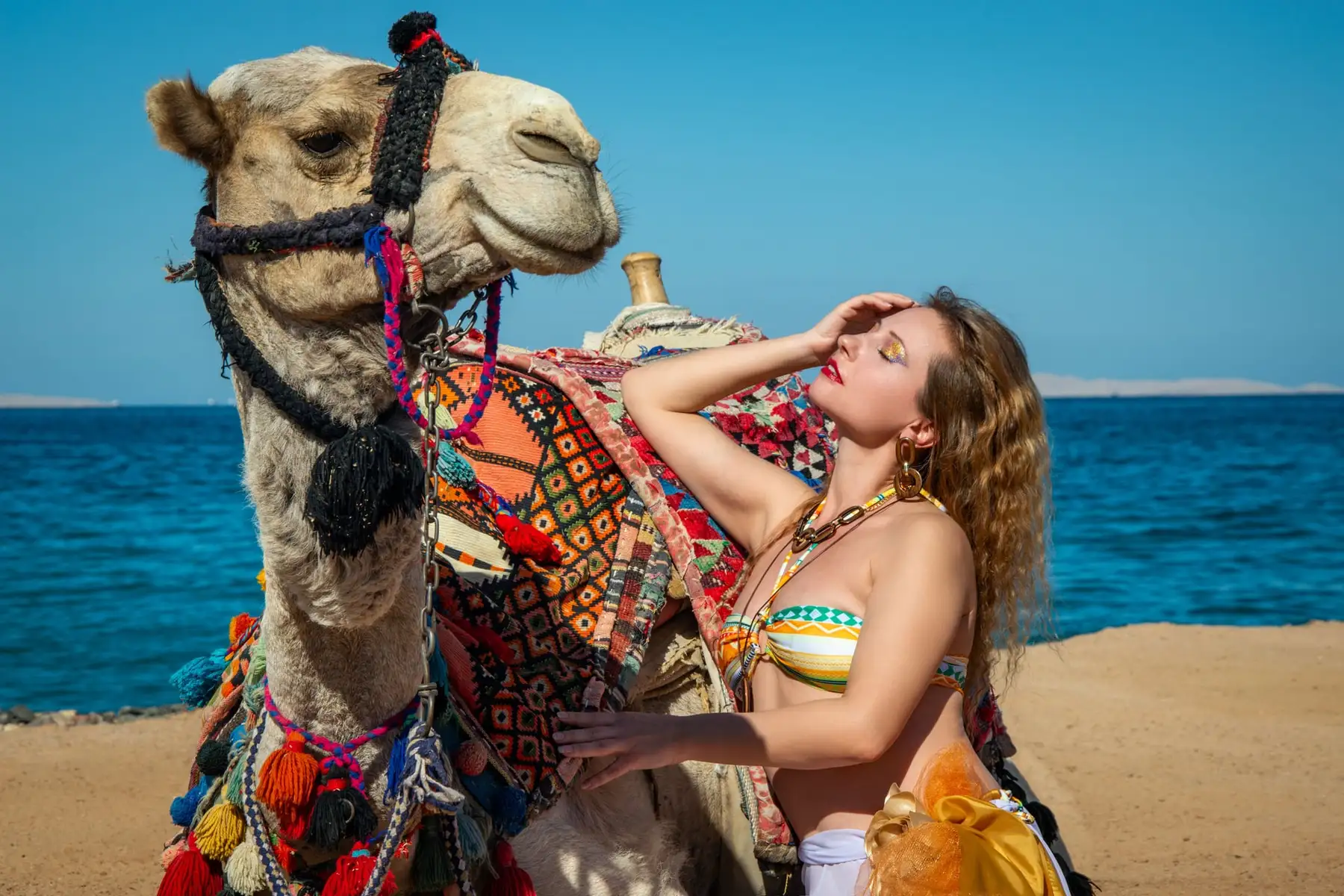
DESTINATION · HURGHADA
Hurghada, forty kilometres long
A fishing village that became a coastline. There is no centre here — just bay after bay of hotels down the mainland shore of the Red Sea, and some of the flattest, most reliable wind-sport water on earth.
- Airport
- HRG · Egypt
- On sale
- 10 of 12 months
- Airport spread
- £304 across 10 UK airports
Today's best fare
London Hurghada
£106 £136 −22%
Measured on a live search, refreshed hourly. Prices move — confirm on Kiwi.com.
Departure airports
£304 apart, depending where you take off
Every UK airport searched separately for this destination, cheapest first, as a return fare for one person with taxes in. Manchester to Hurghada and London to Hurghada are not the same route and we do not price them as one. Each figure is a fare of one stop at most — the same limit as the price at the top of this page — and each is that airport's own cheapest week, so the dates change from row to row. Every link opens on the dates its price was found on.
All 10 airports have a fare to Hurghada within one stop today. London covers Heathrow, Gatwick, Stansted, Luton, City and Southend in one search.
From your airport
How long is the flight to Hurghada?
Distance, nonstop flight time, whether a direct flight exists and what it costs, worked out separately for each of the ten UK airports.
The year, month by month
When Hurghada is worth the airfare
Average daytime high for each month. The greyed months are ones we refuse to advertise — not because they are cheap, but because the place cannot deliver what the page promises.
- Jan 22°
- Feb 24°
- Mar 26°
- Apr 30°
- May 34°
- Jun 36°
- Jul 37° not sold
- Aug 38° not sold
- Sep 35°
- Oct 32°
- Nov 28°
- Dec 24° today's fare
10 of 12 months on sale. The reason is below, not in the numbers.
The Red Sea is a narrow trench of water shut in by desert on both sides, and that is the whole reason this coast works in the British winter. It has almost no exchange with a cold ocean, so it warms further and cools less than anything else within reach — the water here stays swimmable without a wetsuit when the Canaries have gone cold. Rain is close to a non-event; in some years none is recorded at all.
The constraint is heat rather than weather. This is low-latitude desert with mountains behind it that radiate the day back at night, and at the peak of the year the air passes the point where shade helps. Walking the strip becomes something for either end of the day, an open dive boat stops being pleasant, and that is why we stop advertising this destination for a stretch each year rather than selling it at a discount. The wind is the other variable: it blows hard and consistently, which is superb if you came for a kite and tiresome if you came for a lilo.
For a British calendar the fit is unusually good, because the months this coast is at its best are the ones home is at its worst. Autumn through to spring is the run to aim at — warm water, land temperatures you can walk in, and the reefs at their most comfortable. Christmas and February half-term are when the charters fill and prices climb; the weeks either side of them are quiet and cheap at once.
Hurghada is not Sharm on the visa
There is no free resort stamp on this side of the water. Mainland Egypt needs the full visa from day one, bought online beforehand or in cash dollars at the airport bank counter.
The case for it
Why Hurghada
Hurghada was a village of a few hundred fishermen until the 1980s and is now a strip of resort development running some forty kilometres down the Egyptian mainland coast. That is the first thing to understand about it: this is not a town with hotels, it is a road with bays off it, and the distance between the top and the bottom is an hour's drive. What holds it together is the water — shallow, warm, protected by an offshore reef line and dotted with islands.
Two things here are genuinely world class. The first is the kiting and windsurfing: the lagoons south of the city are waist-deep for hundreds of metres with a steady side-shore wind, which is about as forgiving as flat water gets and why the schools are full of people learning rather than posing. The second is the wreck diving. The reef at Abu Nuhas has four cargo ships piled on one shoal, sunk between 1869 and 1981, all within recreational depth.
The reservations are real and worth stating. Unlike Sharm across the water, Hurghada is mainland Egypt and needs the full visa from the first day — there is no free resort stamp here. The strip has no centre to walk to, the old quarter at El Dahar is a taxi ride from most hotels, and the hassle from touts along the promenades is more persistent than in Sinai. And the wind that makes the kiting superb makes the sea choppy for anyone who just wants to swim.
On the ground
Five things worth doing
- 01
Take a boat to Giftun and Orange Bay
The islands opposite the city are a protected national park and the standard day out: two snorkelling stops on different reefs, a couple of hours on a sandbar, lunch aboard. Prices start around €19 (about £17) on a shared boat and climb sharply for speedboats and private charters. Take the cheaper option and the slower boat — you get more time in the water and less time being sold photographs. Park fees are usually included; confirm before you pay, because they are collected separately if not.
- 02
Learn to kite in the southern lagoons
The water off the lagoons south of the city is waist-deep for a very long way with a steady cross-shore wind, which is the combination beginners need and rarely find. Group lessons run about £30 an hour, and a full beginner course to independent riding is roughly £250 to £320. Book with a school flying an IKO or VDWS flag. The season is long here and the wind is far more reliable than in the Mediterranean, which is why European schools send instructors to work the winter.
- 03
Dive the wrecks at Abu Nuhas
A shoal an hour north with four merchant ships on it — the Giannis D, the Carnatic, the Chrisoula K and the Kimon M — all lying between twelve and twenty-seven metres, so all within ordinary recreational limits. A two-dive day boat runs about £55 to £70 including lunch. The Carnatic went down in 1869 and the wooden ribs are still recognisable. Check your insurance explicitly covers diving to the depth you plan, because standard travel policies stop well short.
- 04
Walk El Dahar and its souk
The old quarter at the northern end is the only part of Hurghada that existed before the hotels, and it is free to walk. The souk is a covered street of spice, cotton and shisha sellers that is aimed at visitors but priced far below the resort shops, and the surrounding streets are ordinary Egyptian town. Go in the evening. Expect to be called at constantly and treat the first price as an opening bid; a firm no and continued walking is understood here and not taken badly.
- 05
Wander El Gouna for an afternoon
Twenty minutes north, a privately built town of interconnected islands and canals, developed since 1989 with its own marina, hospital and golf course. It is free to walk around and does not feel remotely Egyptian, which is either the appeal or the objection. The water taxis between the islands cost a couple of pounds and are the pleasant way to see it. Prices in the marina restaurants are European rather than Egyptian, so eat before you come or accept that.
After the flight
What it costs once you land
Prices outside the hotel gates, which matters here because most visitors are on all-inclusive boards and the resort mark-up on everything else is steep. Egypt's currency has moved sharply in recent years, so sterling figures shift faster than local ones.
- Beer, local bar £2.40 a Stella; alcohol is resort and licensed premises only
- Dinner for two, mid-range £16 in El Dahar rather than on the marina promenade
- Airport to the hotel strip £8 pre-booked transfer; El Gouna and Sahl Hasheesh are further
- Giftun Island boat day £17 shared boat with lunch and two snorkelling stops
- Kitesurf lesson, per hour £30 group rate with gear; a full beginner course is around £280
- Koshary from a street stall £1
Checked August 2026. Sources at the foot of this page.
Before you book
Practical, for a British passport
Entry rules are for a British Citizen passport holder and come from gov.uk, read on 2026-08-07. They change; check before you fly.
- Airport
- HRG, Hurghada, a few minutes from the central bays but up to an hour from the far ends of the strip — El Gouna is twenty-five minutes north, Sahl Hasheesh twenty south, Soma Bay closer to an hour. Confirm which bay your hotel is in before you agree a transfer price.
- Entry
- Visa required. USD 30 (about £24) — cash dollars on arrival, or an e-visa online beforehand. Up to 30 days. Expiry at least 6 months after the date you arrive, and at least one blank page. The visa on arrival is paid in cash US dollars at the airport bank counter before immigration, not by card. The e-visa is valid for up to three months and avoids the queue.
- Currency
- Egyptian pound, though resorts quote in euros, dollars and sterling and will take all three at a rate that favours them. Draw pounds from an ATM for anything outside a hotel. Keep small notes constantly: tipping is expected for almost every interaction and nobody ever has change.
- Language
- Arabic. English is spoken across the resort belt to a working standard, and Russian and German nearly as widely. In El Dahar and away from the strip it thins quickly.
- Time zone
- Egypt keeps UTC+2 in winter and moves to summer time, so it sits one or two hours ahead of Britain depending on the date. The two countries do not change clocks on the same day — check the gap for your actual travel week rather than assuming.
- Plugs
- Type C, 220V. A British type-G plug does not fit; bring an adapter. Power in older resorts is not always steady, so charge when you can.
- Health
- The GHIC does not apply — Egypt is outside the EU — and private insurance is essential, with diving declared explicitly if you intend to dive, since standard policies exclude it below a few metres. There is a decompression chamber in Hurghada. Drink bottled water only, avoid ice outside hotels, and be more careful with buffets and salad than with anything grilled in front of you.
- Safety
- The FCDO advises against all but essential travel to the North Sinai governorate and to areas near the Libyan border, neither of which is near here; it also advises against travel on some desert roads. Locally the risks are the sun, the reef and the road — fire coral, sea urchins in the shallows, and quad tours run without helmets.
A bed
Where to stay in Hurghada
The strip runs forty kilometres and the ends have nothing to do with each other. Choose by how much you want to walk out to and how far you are prepared to be from the airport.
Hurghada
The central bays and the old quarter, with by far the widest range of beds at every price and the only part of the coast with a street life of its own — the souk at El Dahar, the marina at Sekalla. Closest to the airport and the Giftun boats. It is also the busiest, the most built and where the touting along the promenades is heaviest.
Stays in Hurghada Opens in a new tab A TOWN, BUILTEl Gouna
Twenty-five minutes north, a privately developed resort town of islands and canals with its own marina, hospital and golf, and the best-regarded stock on this coast. Immaculate, safe and entirely artificial — there is no hassle at all because there are no touts, and no Egypt either. Restaurant prices are European. It suits people who want the Red Sea without the country attached.
Stays in El Gouna Opens in a new tab QUIET AND NEWSahl Hasheesh
Twenty minutes south, a purpose-built bay of large newer hotels along a curved sandy shore with a good house reef. Quieter and lower-density than the centre, and the beach is better. There is nothing to walk to — the promenade is the promenade and everything else is a taxi — so it suits a week of not moving much rather than one of going out.
Stays in Sahl Hasheesh Opens in a new tabEvery area pinned on one map, set to the dates of the fare above. Change them for your own trip and it reloads live availability.
Open the Hurghada map Opens in a new tabGetting around
Taxis are the default and none of them are metered. Agree the fare before you get in, expect an opening quote around three times the going rate, and settle near a third of it. The strip is long, so know roughly what your journey should cost before you start — the hotel desk will tell you honestly. Uber operates in Hurghada and removes the negotiation entirely, which is often worth the small premium.
The blue and white minibuses that run the main coast road are the local transport and cost pennies. You flag them down, pass the fare forward and shout to be let off. They are perfectly usable in daylight and are how staff get to work; they will not take you to a hotel gate, only to the road outside it.
There is little reason to hire a car. The distances are long but the destinations are few, the driving is assertive and the checkpoints on the desert roads are frequent. The two excursions worth making — Luxor and the wreck sites — are a coach and a boat respectively, and the Luxor run is four hours each way, which makes it a very long day out of a beach week rather than an afternoon.
Food and local tips
Most visitors here eat on an all-inclusive board, and that is a fair description of why the holiday is cheap rather than a criticism. The food worth leaving the hotel for is in El Dahar, where the restaurants are Egyptian rather than international and cost a third of the marina. Koshary — lentils, rice, macaroni, fried onion and a sharp tomato sauce — is the national dish, is entirely vegetarian and costs about a pound.
The Red Sea catch is the other reason to go out. Fish is picked from ice, priced by the kilo and grilled plainly with bread, tahini and salad, and it is the best-value serious meal on this coast. Alcohol is restricted rather than absent, sold in resorts, licensed restaurants and a few shops. Tipping runs constantly and in small amounts — for the bags, the boat crew, the man who points at a parking space — so keep a pocket of low-value notes for the purpose.
Grilled fish in El Dahar
Chosen from ice and cooked plainly with bread, tahini and salad. About 250 Egyptian pounds (£4) a head, and a fraction of the same plate on the El Gouna marina.
Ready for the Red Sea?
Pick your departure airport and see what the route costs today from each of the ten we track.
See the £106 fare Opens in a new tabSame band
Other winter sun destinations
Where the numbers came from
- Giftun Island and Orange Bay boat trip prices egyptra.pro Opens in a new tab read 2026-08-07
- Red Sea diving day-trip costs aquariusredsea.com Opens in a new tab read 2026-09-26
- Egyptian visa rules and the mainland-versus-Sinai distinction gov.uk Opens in a new tab read 2026-08-07
- Entry rules for a British Citizen passport gov.ukOpens in a new tab read 2026-08-07