DESTINATION · CANCÚN
Cancún, and the seaweed problem
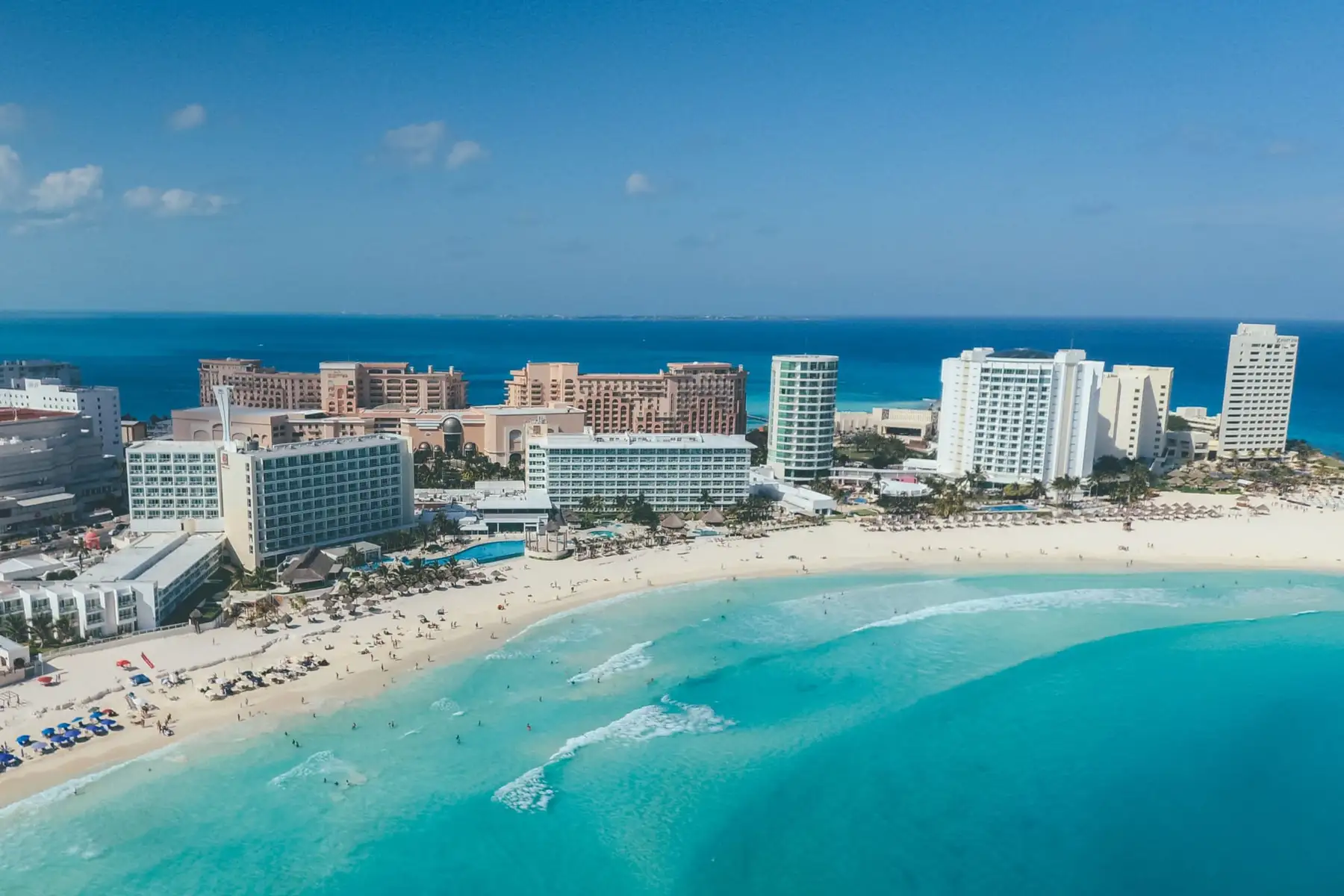
A twenty-kilometre sand bar of all-inclusives on genuinely Caribbean water — and, for a growing part of the year, a tide of sargassum that no brochure mentions and that decides whether the beach is usable.
- Airport
- CUN · Mexico
- On sale
- 10 of 12 months
- Airport spread
- £252 across 9 UK airports
Today's best fare
Birmingham Cancún
£516 £682 −24%
Measured on a live search, refreshed hourly. Prices move — confirm on Kiwi.com.
Departure airports
£252 apart, depending where you take off
Every UK airport searched separately for this destination, cheapest first, as a return fare for one person with taxes in. Manchester to Cancún and London to Cancún are not the same route and we do not price them as one. Each figure is a fare of one stop at most — the same limit as the price at the top of this page — and each is that airport's own cheapest week, so the dates change from row to row. Every link opens on the dates its price was found on.
9 of 10 airports have a fare to Cancún within one stop today. The rest either need two connections and most of a day to get there — which we will not print a price for — or did not answer the last search. London covers Heathrow, Gatwick, Stansted, Luton, City and Southend in one search.
From your airport
How long is the flight to Cancún?
Distance, nonstop flight time, whether a direct flight exists and what it costs, worked out separately for each of the ten UK airports.
The year, month by month
When Cancún is worth the airfare
Average daytime high for each month. The greyed months are ones we refuse to advertise — not because they are cheap, but because the place cannot deliver what the page promises.
- Jan 28°
- Feb 29° today's fare
- Mar 30°
- Apr 31°
- May 33°
- Jun 33°
- Jul 34°
- Aug 34°
- Sep 33° not sold
- Oct 31° not sold
- Nov 29°
- Dec 28°
10 of 12 months on sale. The reason is below, not in the numbers.
The Yucatán is tropical with a wet half and a dry half, and the wet half doubles as the Atlantic hurricane season — that is what takes this destination off our board for a stretch each year. Rain here is usually a violent hour in the afternoon rather than a lost day, but a storm several hundred miles out closes the airport, cancels flights in blocks and shuts the beaches, and that risk is different in kind from a shower.
The variable that has changed most is the sargassum, and it is now a bigger practical influence on a beach holiday than the weather. The seaweed drifts in on Atlantic currents from a belt that has been growing for a decade; 2026 is tracking toward a record year. It typically builds from the early spring, peaks through the warm months and clears through the winter, and it lands unpredictably — one beach buried, the next one clear. Sheltered west and north-facing shores, including Isla Mujeres and the bay beaches inside the hotel zone, fare much better than the open east-facing strip.
For a British calendar the good news is that the clearest water coincides with our winter. The stretch from late autumn through to early spring gives dry weather, no hurricane risk and the least seaweed, which is why it is also the most expensive. Christmas and February half-term are the peaks; the weeks either side of them are the same coast for meaningfully less.
Pay the Visitax before you fly home
Quintana Roo's tourist tax is about £12 a head, paid on the state's own site, and enforcement at the airport departure gates has tightened. It is not on your hotel bill and it is not included in any package.
The case for it
Why Cancún
Cancún was chosen by computer. In 1970 the Mexican government ran a study to find the best site for a purpose-built resort city and the answer was an uninhabited sand bar off the Yucatán with three fishermen on it. Everything you see was built after that: a twenty-kilometre strip of hotels on a bar between the Caribbean and a lagoon, with a real Mexican city of a million people behind it that almost no visitor sees.
What makes it more than a beach is what surrounds it. Chichén Itzá is two hours inland and is one of the most complete Maya sites anywhere. The limestone shelf under the whole peninsula is riddled with cenotes — collapsed sinkholes filled with fresh water so clear it is disorienting to swim in. And the second-largest barrier reef in the world runs south from here down the coast.
Two things need saying plainly. Sargassum, the floating seaweed that arrives on Atlantic currents, has been building year on year and 2026 is tracking toward a record; when it lands it can cover a beach in a metre of decomposing weed that smells of sulphur, and the hotels rake it but cannot stop it. And Quintana Roo charges its own tourist tax, separately from anything a hotel bills, which is now checked at the airport when you leave.
On the ground
Five things worth doing
- 01
Do Chichén Itzá early or not at all
Entry for foreign visitors is 697 pesos (about £29), split at the gate into a federal and a state ticket — bring cash for the second, which several booths will not take by card. It is two hours from Cancún and the site has almost no shade, so the coaches that arrive at eleven put people on open limestone at the worst hour. Go on the first bus or drive yourself and be at the gate at opening. Three hours covers it properly.
- 02
Swim in a cenote, and pick a quiet one
Sinkholes in the limestone, filled with rainwater filtered through rock, at a constant temperature all year. Entry runs 200 to 400 pesos (about £8 to £17). The Ruta de los Cenotes inland from Puerto Morelos has dozens with a fraction of the crowds at Ik Kil, which is the one every Chichén Itzá tour stops at. Sun cream must be washed off before entering — it kills the ecosystem, and most sites enforce it at the door.
- 03
Take the ADO bus rather than a transfer
The airport coach into the hotel zone costs about 170 pesos (£7) against thirty or forty pounds for a private transfer, runs from terminals 2, 3 and 4, and is comfortable and air-conditioned. The catch is frequency — departures every two hours during the day only — so it suits a daytime arrival. The same ADO network runs down the coast to Playa del Carmen for about 250 pesos (£10) and on to Tulum for a little more, and is how most independent travellers move here.
- 04
Snorkel the reef at Puerto Morelos
Half an hour south, a national marine park where the reef sits close inshore and the boats are run by a local cooperative rather than the resorts. Two hours with a guide is about £30 including the park fee. It is regulated: no sun cream, no touching, limited numbers, guide compulsory — which is exactly why it is in better condition than the sites the big operators use. The village itself is what Cancún was before 1970.
- 05
Check the seaweed before you commit a beach day
This costs nothing and it is the most useful thing on this page. Several trackers publish daily beach-by-beach reports with photographs for the whole coast. Sargassum lands unevenly — one bay can be buried while another two kilometres away is clear — and the sheltered north-facing beaches at Playa Caracol and Isla Mujeres often stay clean when the east-facing strip does not. Look at today's photographs, not at a brochure.
After the flight
What it costs once you land
Hotel-zone prices are quoted in dollars and priced for visitors; downtown Cancún, ten minutes away by bus, runs at a third of them. Tipping is expected at 10 to 15% and many all-inclusive staff are paid on the assumption of it.
- Beer, downtown bar £1.60 a Modelo; the same bottle on the hotel strip is nearer £6
- Dinner for two, mid-range £30 downtown; hotel-zone restaurants are two to three times it
- Airport to the hotel zone £7 ADO coach; a private transfer is £30 to £40
- Visitax, per visitor £12 state tourist tax, paid online, checked when you leave
- Cenote entry £8–£17 per person; the inland ones are cheaper and emptier
- Tacos al pastor, three £2.50
Checked August 2026. Sources at the foot of this page.
Before you book
Practical, for a British passport
Entry rules are for a British Citizen passport holder and come from gov.uk, read on 2026-08-07. They change; check before you fly.
- Airport
- CUN, twenty minutes south of the hotel zone and the second busiest airport in Mexico. Arrivals opens into a corridor of aggressive timeshare touts posing as transfer or information desks — walk past all of them to the marked ADO counter or the official taxi rank outside. This is the single most reported annoyance of a Cancún arrival.
- Entry
- No visa, plus a state tourist tax in Quintana Roo. Visitax, set by Quintana Roo — paid at visitax.gob.mx; the amount is set by the state and changes. Up to up to 180 days, at the officer's discretion. Valid for the duration of your stay; the Mexican embassy advises 180 days, being the longest a tourist can stay. Cancún sits in Quintana Roo, which charges its own entry tax on top of anything national. Pay it online at visitax.gob.mx before you travel or during the stay, and keep the proof — it is checked before you leave the airport on departure, which is a bad moment to discover it. The days written into your entry stamp are what counts, not the 180-day maximum; officers routinely grant less.
- Currency
- Mexican peso, though the hotel zone quotes and takes US dollars at a rate that favours the seller. Pay in pesos wherever you can and decline the card machine's offer to charge you in sterling. ATMs inside bank branches rather than freestanding ones in shops; the latter carry heavy fees and skimming reports.
- Language
- Spanish. English is universal in the hotel zone and on the tourist coast, and thins quickly downtown and inland. Maya is still spoken in the villages around the archaeological sites.
- Time zone
- Five hours behind the UK in winter and six behind British Summer Time. Quintana Roo keeps a fixed time zone and does not observe daylight saving, so the gap widens when Britain moves its clocks forward rather than when Mexico does.
- Plugs
- Type A and B, 127V. A British type-G plug does not fit and the voltage is roughly half of home; chargers cope, hair appliances often do not.
- Health
- The GHIC does not apply. Private hospitals in the hotel zone are good and expensive and there have been repeated reports of inflated billing for tourists, so an insurer who will deal with them directly matters more here than usual. Drink bottled water. Sun cream must be the reef-safe kind for the cenotes and the marine parks, and it is checked.
- Safety
- The FCDO advises against all but essential travel to several Mexican states, none of them Quintana Roo, and notes that violence linked to organised crime does occasionally occur in tourist areas of this state. In practice the hotel zone is heavily policed. The everyday risks are the timeshare touts at the airport, unlicensed taxis, and rip currents on the open Caribbean side when the flags are red.
A bed
Where to stay in Cancún
The sand bar or the mainland, and they are entirely different holidays at entirely different prices. The third option is not Cancún at all.
Hotel Zone
The strip itself — large all-inclusives on both a Caribbean shore and a lagoon, with the malls, the clubs and the beach access. The reason most people come and the easiest thing to book. Everything is priced in dollars and for visitors, there is no town to walk to, and the east-facing beaches are the ones that catch the seaweed hardest.
Stays in Hotel Zone Opens in a new tab WHERE THE CITY ISDowntown Cancún
Ten minutes inland by bus, a working Mexican city of a million people with markets, taquerías and hotel rates at a fraction of the strip. The base for anyone who would rather see Mexico than a resort corridor. You are not on the beach — the public beaches are a short bus ride — and the evening is a neighbourhood rather than a nightlife district.
Stays in Downtown Cancun Opens in a new tab DOWN THE COASTPlaya del Carmen
An hour south by coach, and a town rather than a strip: Fifth Avenue running parallel to the beach, a ferry to Cozumel, and the cenotes and Tulum closer than they are from Cancún. More European and more walkable, with better independent restaurants. The beach is narrower and it catches the same seaweed on the same days.
Stays in Playa del Carmen Opens in a new tabEvery area pinned on one map, set to the dates of the fare above. Change them for your own trip and it reloads live availability.
Open the Cancún map Opens in a new tabGetting around
The R1 and R2 buses run the length of the hotel zone and into downtown constantly, cost about 12 pesos, and take cash from the driver. They are how everyone who works on the strip gets there and they are the cheapest thing in Cancún by a wide margin. Flag them anywhere along the boulevard.
The ADO coach network is the answer for anything beyond the city — Playa del Carmen, Tulum, Mérida, Chichén Itzá — and it is comfortable, punctual and inexpensive. Book at the downtown terminal or on the app. Colectivos, the shared vans running the coast road, are cheaper again and are how locals travel between the beach towns.
Taxis in Cancún are not metered and the rates are set by zone, with a printed tariff that visitors are rarely shown. Agree the fare before getting in and expect the hotel zone to cost several times what the same distance costs downtown. Uber operates but has a long-running conflict with the taxi unions here and pickups from the airport and some hotels are restricted. Hire a car only for the cenote routes inland.
Food and local tips
Yucatecan food is its own cuisine and is not what the hotel buffets serve. Cochinita pibil — pork marinated in bitter orange and achiote, wrapped in banana leaf and cooked underground — is the dish to find, sold from stalls in the morning and gone by lunchtime. Sopa de lima, panuchos and salbutes are the other three worth knowing. Habanero is the local chilli and it is served on the side rather than cooked in, which is a mercy.
The price gradient is the steepest of any destination on this list. Three tacos al pastor from a downtown stand costs about two pounds fifty; the same thing plated in a hotel-zone restaurant is fifteen. The Mercado 28 and the taquerías along Avenida Yaxchilán are where the city eats. Pay in pesos, always decline the card machine's offer to convert to sterling, and tip 10 to 15% in cash where you can.
Cochinita pibil, before ten in the morning
Slow-cooked pork with pickled red onion on a soft tortilla, sold from a stall in Mercado 28 and finished by lunchtime. About 30 pesos (£1.25), and the reason to get up early in Cancún.
Ready for Cancún?
Pick your departure airport and see what the route costs today from each of the ten we track.
See the £516 fare Opens in a new tabSame band
Other long-haul destinations
Where the numbers came from
- Chichén Itzá entrance fee and the two-ticket split chichenitzamexico.org Opens in a new tab read 2026-08-08
- Visitax cost and airport enforcement traveltourister.com Opens in a new tab read 2026-08-08
- Sargassum forecasts and beach-by-beach tracking howisthesargassum.com Opens in a new tab read 2026-08-08
- Entry rules for a British Citizen passport gov.ukOpens in a new tab read 2026-08-07