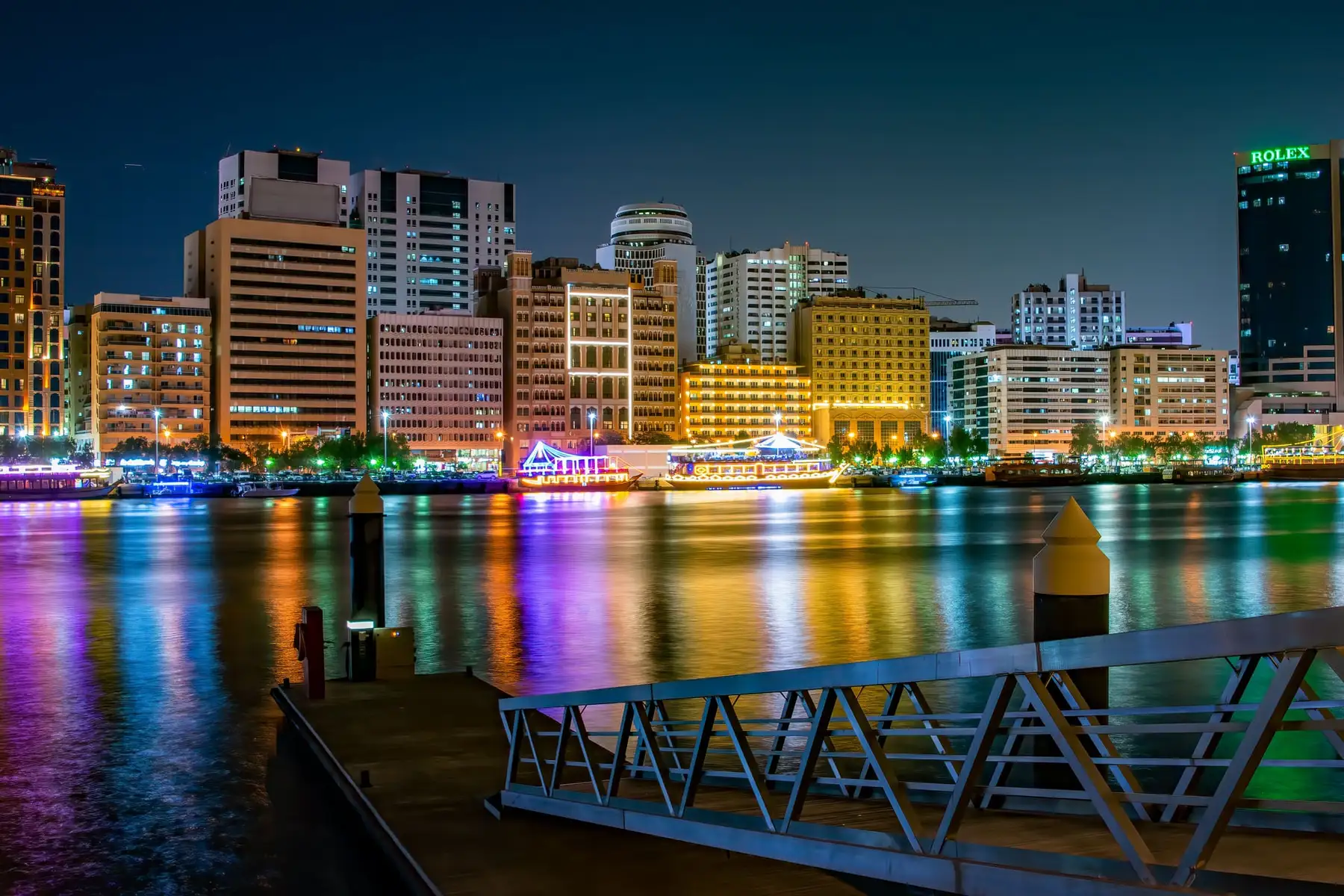
DESTINATION · DUBAI
Dubai, the cheap flight to an expensive city
Consistently the least expensive long-haul fare we track from Britain, and one of the priciest places to be once you land. What you do with that gap is the whole trip.
- Airport
- DXB · UAE
- On sale
- 8 of 12 months
- Airport spread
- £193 across 10 UK airports
Today's best fare
London Dubai
£254 £255
Measured on a live search, refreshed hourly. Prices move — confirm on Kiwi.com.
Departure airports
£193 apart, depending where you take off
Every UK airport searched separately for this destination, cheapest first, as a return fare for one person with taxes in. Manchester to Dubai and London to Dubai are not the same route and we do not price them as one. Each figure is a fare of one stop at most — the same limit as the price at the top of this page — and each is that airport's own cheapest week, so the dates change from row to row. Every link opens on the dates its price was found on.
All 10 airports have a fare to Dubai within one stop today. London covers Heathrow, Gatwick, Stansted, Luton, City and Southend in one search.
From your airport
How long is the flight to Dubai?
Distance, nonstop flight time, whether a direct flight exists and what it costs, worked out separately for each of the ten UK airports.
The year, month by month
When Dubai is worth the airfare
Average daytime high for each month. The greyed months are ones we refuse to advertise — not because they are cheap, but because the place cannot deliver what the page promises.
- Jan 24°
- Feb 25°
- Mar 28°
- Apr 33°
- May 38°
- Jun 40° not sold
- Jul 41° not sold
- Aug 41° not sold
- Sep 39° not sold
- Oct 35°
- Nov 31° today's fare
- Dec 26°
8 of 12 months on sale. The reason is below, not in the numbers.
Dubai sits on the southern shore of the Gulf, which is a shallow, almost enclosed sea, and that is what makes its year so lopsided. Shallow water heats through and stays hot, so the sea offers no cooling at all in the second half of the year — instead it adds humidity to desert air that is already extreme, and the combination is what makes the peak of the year genuinely dangerous rather than merely uncomfortable. That, not rainfall, is why we stop advertising this destination for a stretch.
The rest of the year is close to faultless, and it is the reason the city fills with Europeans when Europe is at its worst. Rain is a handful of days, cloud is rare, and the outdoor infrastructure — the beaches, the terraces, the desert camps, the outdoor malls that shut in the heat — all comes back into use. The one weather event worth knowing about is the shamal, a north-westerly that raises dust for a day or two at a time and grounds the desert trips.
For a British calendar the fit is straightforward: the months this city works are the months home does not. Christmas and February half-term are when the flights and the hotels are dearest, and the quiet weeks either side of them are the same destination for considerably less. Ramadan moves earlier by about eleven days each year and changes the rhythm — daytime eating and drinking in public is restricted, the malls and hotels carry on, and the evenings become the best food in the city.
Two nights on the way somewhere else
Dubai is the natural break on a route to Thailand, the Maldives or Australia, and a stopover often costs little more than the connection you were making anyway.
The case for it
Why Dubai
Dubai was a pearling and trading port of a few tens of thousands until oil money arrived in the 1960s, and almost everything a visitor sees has been built since 1990. That is the thing to hold in mind: this is a city with the density of a metropolis and the age of a suburb, laid out along a single motorway with clusters of towers at intervals. The Burj Khalifa is not the tallest building in the world by a small margin — it is nearly two hundred metres clear of second place.
For a British traveller it works as two different holidays. As a destination it is beach, malls, restaurants and the desert an hour inland, in a climate that is reliably clear when Britain is not. As a stopover it is close to unbeatable: Emirates and flydubai make it the natural break on the way to Thailand, the Maldives or Australia, and a two-night stop costs little more than the connection you would have made anyway.
The reservations are about money and law. The fare is cheap and the ground is not — a beer runs to the price of a meal elsewhere, and the attractions are priced in a way that adds up fast. And the rules are real rather than decorative: alcohol only in licensed premises, no drinking in public, no public displays of affection, and prescription medicines that are ordinary at home requiring approval in advance. People are prosecuted for all of these.
On the ground
Five things worth doing
- 01
Go up the Burj Khalifa, but not at sunset
The 124th and 125th floor decks cost about AED 173 (£37) at a standard slot and AED 250 (£54) for the prime hours in the late afternoon, and the higher Lounge levels run to several times that. Book online for a timed entry; the walk-up price is worse and the good slots go days ahead. The unpopular truth is that the sunset slot costs half again for a view through glass that is often hazy — a mid-morning slot is clearer, cheaper and far less crowded.
- 02
Cross the creek on an abra
A wooden water taxi between Deira and Bur Dubai, seating twenty, running continuously, and costing AED 1 — about £0.20, and the best value in the city by a wide margin. On either bank are the gold and spice souks, which is the only part of Dubai that predates the towers and the only part that rewards aimless walking. Go late afternoon when the heat drops. Ignore the men offering a private abra tour at fifty times the fare.
- 03
Take a desert safari, and check what is in it
A shared 4x4 into the dunes with dune bashing, a camel, sandboarding and a barbecue at a camp runs about AED 150 to 250 (£32 to £54) including hotel pickup. The cheap end is a large convoy and a crowded camp; the expensive end is a smaller group and a quieter site, and the difference is worth more than the money. Dune bashing is genuinely rough — it is not for anyone with a back problem, and the drivers do not always ask.
- 04
Look at the Frame and decide what you think
A 150-metre gilded picture frame standing between the old city and the new, deliberately positioned so that one side shows historic Dubai and the other shows the skyline. Entry is about AED 50 (£11) and takes an hour. It is either the most literal piece of civic architecture ever built or a very good joke, and either way the glass floor on the top walkway is the bit people remember. Go in the morning, looking east into the old city.
- 05
Use the public beaches rather than a club
Kite Beach and the JBR strip are free, clean, staffed with lifeguards and busy with residents rather than visitors, and both have showers and food stalls behind them. A beach club day pass at a hotel runs about £55 a head and buys a lounger, a pool and a towel. On a first visit the free ones tell you more about the city, and the walk along the JBR beachfront to the Marina is one of the few genuinely pleasant strolls Dubai offers.
After the flight
What it costs once you land
Prices where residents pay them, away from hotel and marina frontage. The dirham is pegged to the US dollar, so these figures move with the pound against the dollar rather than with local inflation.
- Beer, licensed bar £9 alcohol is licensed-premises only and taxed accordingly
- Dinner for two, mid-range £30 a Lebanese or Indian place in Deira, not a marina restaurant
- Airport to Downtown £11 metered taxi, about twenty minutes; the metro is under £2
- Metro day pass £4 a Nol card costs about £5.40 and includes some credit
- Beach club day pass £55 the public beaches at Kite and JBR are free and lifeguarded
- Shawarma and fresh juice £2
Checked August 2026. Sources at the foot of this page.
Before you book
Practical, for a British passport
Entry rules are for a British Citizen passport holder and come from gov.uk, read on 2026-08-07. They change; check before you fly.
- Airport
- DXB, twenty minutes from Downtown and one of the busiest airports on earth — allow real time for immigration at peak arrival banks. It is on the metro Red Line, which is the cheapest way into the city by a distance. Al Maktoum (DWC) is the second airport, much further out, and used by some low-cost carriers.
- Entry
- Free visa on arrival. No fee. Up to 90 days in any 180-day period. Expiry at least 6 months after the date you arrive. The visa costs nothing and is issued at the desk. Medication is the real risk here, not paperwork: you may bring up to three months' supply, reduced to one month for anything on the controlled list, and controlled substances need written approval from the UAE Ministry of Health in advance. Arriving without it is prosecuted, not confiscated. Codeine and some common sleep and anxiety medicines are on the list.
- Currency
- UAE dirham, pegged to the US dollar. Cards work almost everywhere including taxis and the metro; the souks and the abra want cash. There is no VAT refund worth chasing on small purchases, and tipping is expected at around ten per cent.
- Language
- Arabic is official and English is the working language of the city — signage, menus, taxis and hospitals are all in English, and the majority of people you deal with will be expatriate rather than Emirati.
- Time zone
- Four hours ahead of the UK in winter and three ahead of British Summer Time. The UAE does not change its clocks, so the gap moves when Britain does.
- Plugs
- Type G, 220V — the British three-pin plug, fitted as standard throughout the UAE. No adapter needed, which is true of only two destinations on this list.
- Health
- The GHIC is worthless here and private care is excellent and expensive, so insurance is essential. Medication is the real trap: you may bring three months' supply, one month for anything on the controlled list, and controlled substances need written Ministry of Health approval in advance. Codeine and some common sleep and anxiety drugs are on that list, and arriving without approval is prosecuted rather than confiscated.
- Safety
- The FCDO has no warning against travel and street crime is close to non-existent. The risk here is legal rather than physical: drinking in public, being drunk in public, swearing or making a rude gesture, and public affection between any couple are all offences that have led to arrest. Photographing people without permission is another.
A bed
Where to stay in Dubai
The city runs forty kilometres along one motorway and the three areas below are strung along it. The metro connects them, which is the thing that decides whether you need taxis.
Downtown Dubai
The Burj Khalifa, the Dubai Mall and the fountain, with the highest concentration of the things visitors come for and the highest prices to match. Walkable in a way most of the city is not, and on the metro. The trade is that it is entirely new and entirely built for this purpose — you are staying in a development rather than a neighbourhood.
Stays in Downtown Dubai Opens in a new tab BEACH AND WATERDubai Marina
Towers around a man-made harbour at the southern end, with the JBR beach strip beside it and a tram loop connecting to the metro. The best base if the trip is about the sea rather than the sights, and the evening walk along the marina is genuinely pleasant. Furthest from the airport and from the old city, and the restaurant prices reflect the frontage.
Stays in Dubai Marina Opens in a new tab THE OLD CITYDeira
North of the creek, the trading quarter that existed before the towers — the gold and spice souks, the abra crossings, and food from every part of South Asia at a third of Marina prices. By far the cheapest beds in the city and the only part with a street life that is not curated. Older stock, no beach, and a taxi or a metro ride from everything modern.
Stays in Deira Opens in a new tabEvery area pinned on one map, set to the dates of the fare above. Change them for your own trip and it reloads live availability.
Open the Dubai map Opens in a new tabGetting around
The metro is clean, cheap, driverless and air-conditioned, and it runs the length of the city along the two lines that matter. A Nol card costs about £5.40 with credit on it and covers metro, tram, bus and the water bus. There is a Gold class carriage at roughly double the fare and a women and children carriage at the front of every train. It does not run all night and it starts late on a Friday.
Taxis are metered, honest and cheap by British standards — the cream Dubai Taxi cars and Careem, the local ride-hailing app, both work well. Where the metro does not reach, this is the answer, and it is rarely more than a few pounds. What will catch you out is distance: the city is long and thin, and a run from Deira to the Marina is half an hour of motorway.
Hiring a car is more defensible here than in most cities on this list — fuel is cheap, the roads are wide and well signed, and parking at hotels and malls is free or nearly so. The arguments against are the Salik toll gates that bill automatically and appear on the hire bill weeks later, and driving standards on the Sheikh Zayed Road that are best described as assertive.
Food and local tips
Dubai's population is overwhelmingly South Asian, Filipino, Levantine and Egyptian, and its best cheap food follows. The canteens of Deira and Karama serve Keralan, Pakistani and Sri Lankan food at prices that seem like a mistake, and the Lebanese places do mezze and grilled meat that beat anything on a marina waterfront. Shawarma from a hatch is a pound or two and is what the city actually eats. The Friday brunch is the local institution — a set-price hotel spread with drinks, priced accordingly, and a serious commitment.
Alcohol needs planning rather than avoidance. It is served in hotel bars and licensed restaurants and nowhere else, it is heavily taxed, and buying it retail requires a licence that visitors can now obtain free at the two official shops. There is no alcohol in ordinary restaurants at all, which is why so much eating out happens in hotels. Drinking in public or being visibly drunk outside licensed premises is an arrestable offence and is enforced.
A Keralan thali in Karama
Rice, three or four curries, pickle and a poppadum, refilled until you stop. About AED 20 (£4.30), and the best meal you will eat in Dubai for under a tenner.
Ready for Dubai?
Pick your departure airport and see what the route costs today from each of the ten we track.
See the £254 fare Opens in a new tabSame band
Other long-haul destinations
Where the numbers came from
- Burj Khalifa and Dubai Frame ticket prices thebettervacation.com Opens in a new tab read 2026-08-08
- Nol card, metro fares and airport taxi costs dubaimetrorails.com Opens in a new tab read 2026-08-08
- Entry rules and the medication restrictions gov.uk Opens in a new tab read 2026-08-08
- Entry rules for a British Citizen passport gov.ukOpens in a new tab read 2026-08-07