DESTINATION · PHUKET
Phuket, where the sea sets the calendar
An island the size of Singapore with fifty kilometres of west-facing coast, and a wind that turns and points the Andaman Sea straight at it for half the year. That, not the rainfall, is what decides when to come.
- Airport
- HKT · Thailand
- On sale
- 6 of 12 months
- Airport spread
- £756 across 8 UK airports
Today's best fare
London Phuket
£423 £473
Measured on a live search, refreshed hourly. Prices move — confirm on Kiwi.com.
Departure airports
£756 apart, depending where you take off
Every UK airport searched separately for this destination, cheapest first, as a return fare for one person with taxes in. Manchester to Phuket and London to Phuket are not the same route and we do not price them as one. Each figure is a fare of one stop at most — the same limit as the price at the top of this page — and each is that airport's own cheapest week, so the dates change from row to row. Every link opens on the dates its price was found on.
8 of 10 airports have a fare to Phuket within one stop today. The rest either need two connections and most of a day to get there — which we will not print a price for — or did not answer the last search. London covers Heathrow, Gatwick, Stansted, Luton, City and Southend in one search.
From your airport
How long is the flight to Phuket?
Distance, nonstop flight time, whether a direct flight exists and what it costs, worked out separately for each of the ten UK airports.
The year, month by month
When Phuket is worth the airfare
Average daytime high for each month. The greyed months are ones we refuse to advertise — not because they are cheap, but because the place cannot deliver what the page promises.
- Jan 32°
- Feb 33°
- Mar 34°
- Apr 33°
- May 32° not sold
- Jun 32° not sold
- Jul 31° not sold
- Aug 31° not sold
- Sep 31° not sold
- Oct 31° not sold
- Nov 31°
- Dec 31° today's fare
6 of 12 months on sale. The reason is below, not in the numbers.
Phuket's year is decided by which way the wind blows. For half of it the north-east monsoon comes off the Asian landmass, the air is dry and the Andaman Sea against the west coast is flat — this is the season the island is sold on, and it deserves it. Then the wind reverses, the south-west monsoon drives moist air and swell straight at those same west-facing bays, and the sea becomes the problem rather than the rain.
That distinction is the one thing worth carrying away from this page. The rainfall in the wet half is heavy but bursty, and plenty of people have perfectly good holidays through it. What is not negotiable is the water: onshore swell on a steep beach generates rip currents that form and disappear within minutes, and the bays that are gentle in one season are lethal in the other. Red flags are posted for that reason, lifeguards are only on some beaches, and this is why we stop advertising the destination rather than selling it at a discount.
For a British calendar the good season lines up neatly with our winter, which is why fares climb through it and why Christmas and February half-term are the two most expensive fortnights of the year here. The transitional weeks at either end of the dry season are the value: the sea has settled or has not yet turned, the crowds have gone, and hotel rates fall by half. Ask a hotel directly what the sea has been doing rather than reading a rainfall chart.
File the arrival card within 72 hours
The Thailand Digital Arrival Card has been compulsory since 2025, is free, and can only be submitted in the three days before you land. There is no paper version at the airport.
The case for it
Why Phuket
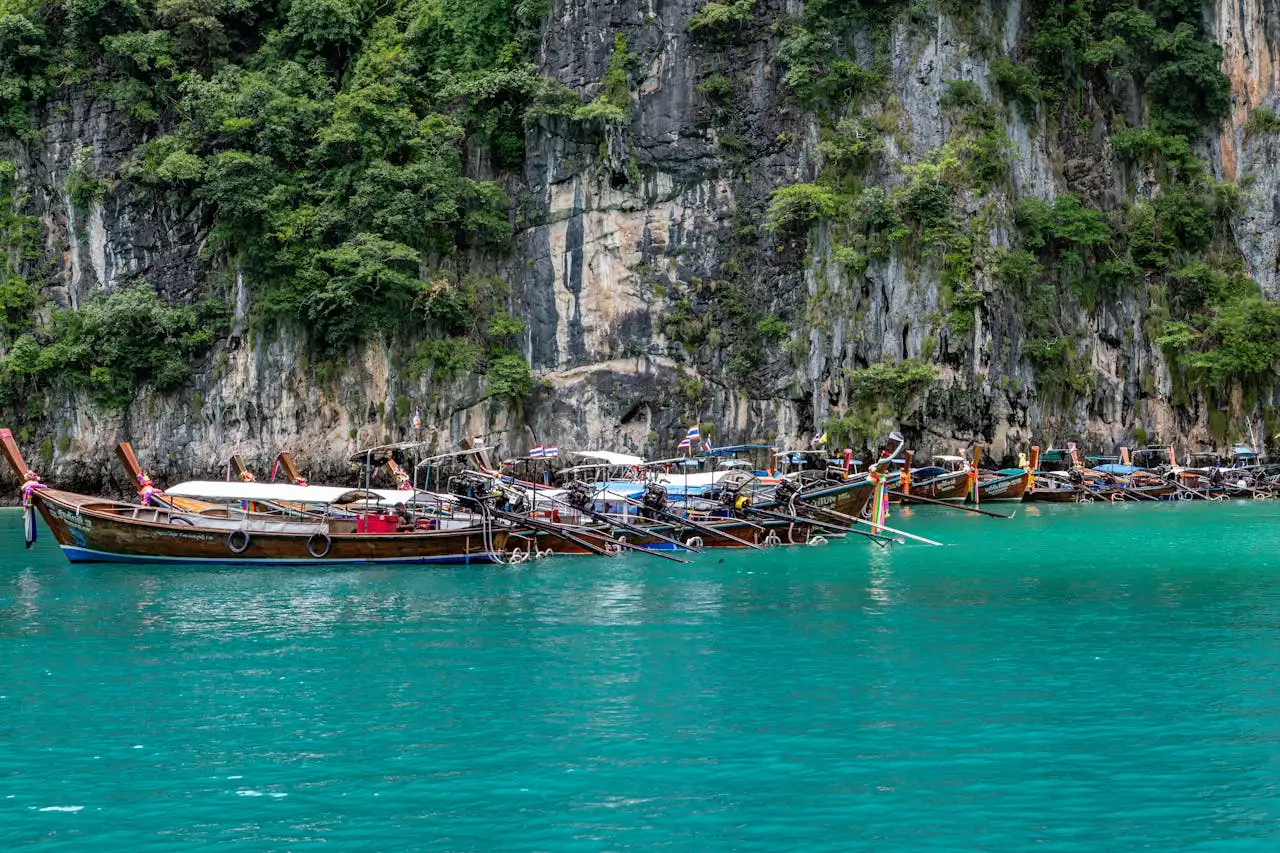
Phuket is Thailand's largest island and it is not really an island in feel — a bridge connects it to the mainland and it holds four hundred thousand people, an old town, an airport and a working economy beyond tourism. The west coast is a chain of bays facing the Andaman Sea, each with its own character, and behind them a spine of forested hills. The limestone karsts that make the postcards are offshore, in Phang Nga Bay and around Phi Phi.
What visitors underrate is Phuket Town. Before the beaches were anything, this was a tin-mining port that grew rich on Chinese labour and British capital, and the money went into shophouse terraces in ochre and green along Thalang and Dibuk roads — arcaded, tiled, and closer to Penang or Malacca than to anything else in Thailand. It is half an hour from the sand, costs a fraction of the coast, and is where the island's best food is by a distance.
The reservation is the one this page exists to make. For roughly half the year the monsoon turns the wind onshore and the west-coast beaches become genuinely dangerous — not merely rough. People drown here every year, most of them tourists who swam past a red flag on a beach that looked calm from a sunlounger. A cheap fare into that half of the year is buying a beach you should not enter, which is why we take this destination off the board rather than discounting it.
On the ground
Five things worth doing
- 01
Walk Phuket Old Town in the morning
Free, and the thing most visitors skip. Thalang, Dibuk and Krabi roads are lined with Sino-Portuguese shophouses from the tin-mining boom, now coffee shops, galleries and hostels, with the Sunday walking street market filling Thalang from four in the afternoon. Half a day covers it comfortably. Go early for the light on the facades and to eat breakfast where the town does, which is the real reason to be there.
- 02
Take the Phi Phi day trip on a small boat
Speedboat trips run about 1,990 to 2,590 baht (£46 to £60), and the 400 baht (£9.30) national park fee is almost never included — budget it separately. The big cruise boats are cheaper and slower and land you at Maya Bay with four hundred other people. Whatever you book, it is a long day on the water starting before seven, and it is a rough crossing when the wind is up, so ask about conditions rather than assuming the trip runs regardless.
- 03
Climb up to the Big Buddha
A forty-five metre marble figure on a hill between Kata and Chalong, visible from most of the south of the island. Entry is free — it is funded by donation — and it reopened in 2026 after a period of closure. Shoulders and knees covered; free sarongs at the entrance for anyone who forgets. The road up is steep and narrow with hairpins, which is worth knowing before you rent a scooter to do it. The view over Chalong Bay is the reward.
- 04
Learn the flag system on your first morning
This is free and it is the most useful ten minutes of the trip. Red means the sea is closed, and on this coast that is enforced by drowning rather than by lifeguards — rip currents form fast on the west-facing bays and pull outward, not under. If you are caught, swim parallel to the beach rather than against it. Two red flags crossed means no swimming at all. Kata and Karon have lifeguards; several smaller bays have none.
- 05
Eat at a night market rather than on the strip
The Chillva market in Phuket Town and the Naka weekend market are where the island eats, and both are free to walk into with dishes at 50 to 120 baht (£1.20 to £2.80). This is a different proposition from the Bangla Road end of Patong, where a plate of the same food costs four times as much and is cooked for people who will not be back. Go hungry, and let the queues at individual stalls choose for you.
After the flight
What it costs once you land
Island prices away from the Patong beachfront, where everything runs three to four times higher. Phuket is materially more expensive than mainland Thailand, and the gap between the tourist strips and everywhere else is the widest in the country.
- Beer, local bar £2.30 a large Chang; a Patong beach club is nearer £8
- Dinner for two, mid-range £20 a proper Thai restaurant; two night-market plates is under £5
- Airport to Patong £17 official taxi with the airport surcharge; Grab is £10 to £14
- Scooter hire, per day £6 cheap, common and the single biggest cause of tourist injury here
- Sunbed and parasol £4 per set on Kata or Karon; some beaches restrict them entirely
- Pad kra pao from a stall £1.30
Checked August 2026. Sources at the foot of this page.
Before you book
Practical, for a British passport
Entry rules are for a British Citizen passport holder and come from gov.uk, read on 2026-08-07. They change; check before you fly.
- Airport
- HKT, in the north of the island, and further from the beaches than people expect — forty-five minutes to Patong, an hour to Kata, and about thirty minutes to Phuket Town. The taxi rank has an official fare board and a surcharge on top; Grab is cheaper and must be met at a designated pickup area rather than at the kerb.
- Entry
- Visa exemption plus a compulsory digital arrival card. No fee. Up to 60 days, extendable once by 30. Expiry at least 6 months after the date you arrive, and at least one blank page. Since 1 May 2025 every arrival by air, land or sea must file the Thailand Digital Arrival Card online, and it can only be submitted within three days of arriving. It is free and takes minutes, but it is not optional and there is no paper fallback at the airport. The 60-day exemption is generous by regional standards and was 30 days until 2024.
- Currency
- Thai baht. Cards work in hotels, malls and larger restaurants; markets, songthaews, stalls and most taxis want cash. ATMs charge a fixed fee of around 220 baht per withdrawal regardless of the amount, so draw larger sums less often.
- Language
- Thai. English is widely spoken across the tourist areas to a working standard and thins quickly in the town and the villages. Written Thai transliterations vary a great deal, so have addresses on a phone map rather than written down.
- Time zone
- Seven hours ahead of the UK in winter and six ahead of British Summer Time. Thailand does not change its clocks, so the gap moves when Britain does.
- Plugs
- Type A, B and C, 220V. A British type-G plug does not fit. Most sockets here accept both flat and round pins, so a single simple adapter covers everything.
- Health
- The GHIC does not apply. Bangkok Hospital Phuket and Vachira are both used to treating visitors and expect payment or an insurer's guarantee up front. Two things to check on the policy: that it covers scooter riding, which most exclude unless you hold a full motorcycle licence, and that it covers diving to the depth you intend. Drink bottled water.
- Safety
- The FCDO advises against all but essential travel to parts of the far south near the Malaysian border, hundreds of kilometres from here. On the island the two real risks are the sea and the scooter: drownings on red-flagged west-coast beaches and road injuries among riders without licences or helmets are the commonest serious incidents involving tourists.
A bed
Where to stay in Phuket
The island is fifty kilometres long and the bays are genuinely different holidays. What you are choosing is how much noise you want and how far you are prepared to be from it.
Patong
The main resort strip, with the widest choice of hotels at every price, the longest beach on the west coast and Bangla Road behind it. Everything is walkable and everything is available. It is also brash, relentlessly touted and loud until very late — which is exactly what a good many people book it for, and exactly why others should not.
Stays in Patong Beach Opens in a new tab FAMILIES AND CALMKata
Twenty minutes south, a smaller bay with a good beach, lifeguards in season, a compact strip of restaurants and none of Patong's noise. The usual choice for families and for anyone who wants an early night. Prices are similar to Patong for better-rated stock. Less to do after ten and you will be taking a taxi for anything beyond the bay.
Stays in Kata Beach Opens in a new tab THE ACTUAL TOWNPhuket Town
Half an hour inland, the Sino-Portuguese old town with the shophouses, the markets and the island's best food, at a fraction of coastal prices. The base for anyone who would rather see Thailand than a beach resort, and the most interesting place on the island to walk around. You are not by the sea, and getting to a beach is a songthaew or a Grab each way.
Stays in Phuket Town Opens in a new tabEvery area pinned on one map, set to the dates of the fare above. Change them for your own trip and it reloads live availability.
Open the Phuket map Opens in a new tabGetting around
Grab is the answer for most journeys. The island has no real public transport for visitors and a long-running dispute between app drivers and the local taxi operators means pickup points are sometimes awkward, but the app fixes the price in advance and removes the negotiation that dominates every other option. Expect £10 to £14 from the airport to the west coast and a few pounds between neighbouring bays.
Songthaews — converted pickups with benches down the back — run fixed routes between Phuket Town and the main beaches for around 40 baht, and they are how the island's workers travel. They stop running in the early evening and they do not go bay to bay along the coast, only in and out of town, which surprises people looking at a map.
Scooters are everywhere, cost about six pounds a day and are the single biggest cause of serious injury to visitors here. Thai law requires a motorcycle entitlement on your licence or an international permit covering it; without one you are unlicensed, uninsured and liable. Police checkpoints are frequent. If you have never ridden one, Phuket's hills and traffic are not where to learn.
Food and local tips
Phuket has its own cooking, which is Southern Thai with a heavy Hokkien Chinese inheritance from the tin-mining years, and it is not what the resort menus serve. Look for mee hokkien, thick yellow noodles fried with pork and egg; moo hong, pork belly braised in soy and pepper; and o-tao, a fried oyster and taro pancake that is a Phuket Town speciality and found almost nowhere else. Southern curries are hotter than central Thai ones and are worth approaching with respect.
The economics of eating here are the widest of any destination on this list. The same dish costs a pound and a half at a night market stall, four pounds in a town restaurant and twelve on the Patong beachfront, and it is best at the first. Two streets back from any beach is the rule. Alcohol is heavily taxed in Thailand and imported wine is punitive, so beer is what everyone drinks with dinner.
Mee hokkien at a Phuket Town stall
Thick yellow noodles fried hard with pork, egg and greens — the island's own dish, from the Chinese tin miners. About 60 baht (£1.40) at a stall on Dibuk Road, and unavailable at a resort buffet.
Ready for Phuket?
Pick your departure airport and see what the route costs today from each of the ten we track.
See the £423 fare Opens in a new tabSame band
Other long-haul destinations
Where the numbers came from
- Phi Phi day trip prices and the national park fee lovephukettours.com Opens in a new tab read 2026-08-08
- Phuket airport taxi and Grab fares phuket101.net Opens in a new tab read 2026-08-08
- Beach flag system and rip current guidance phuketexpatguide.com Opens in a new tab read 2026-08-08
- Entry rules for a British Citizen passport gov.ukOpens in a new tab read 2026-08-07