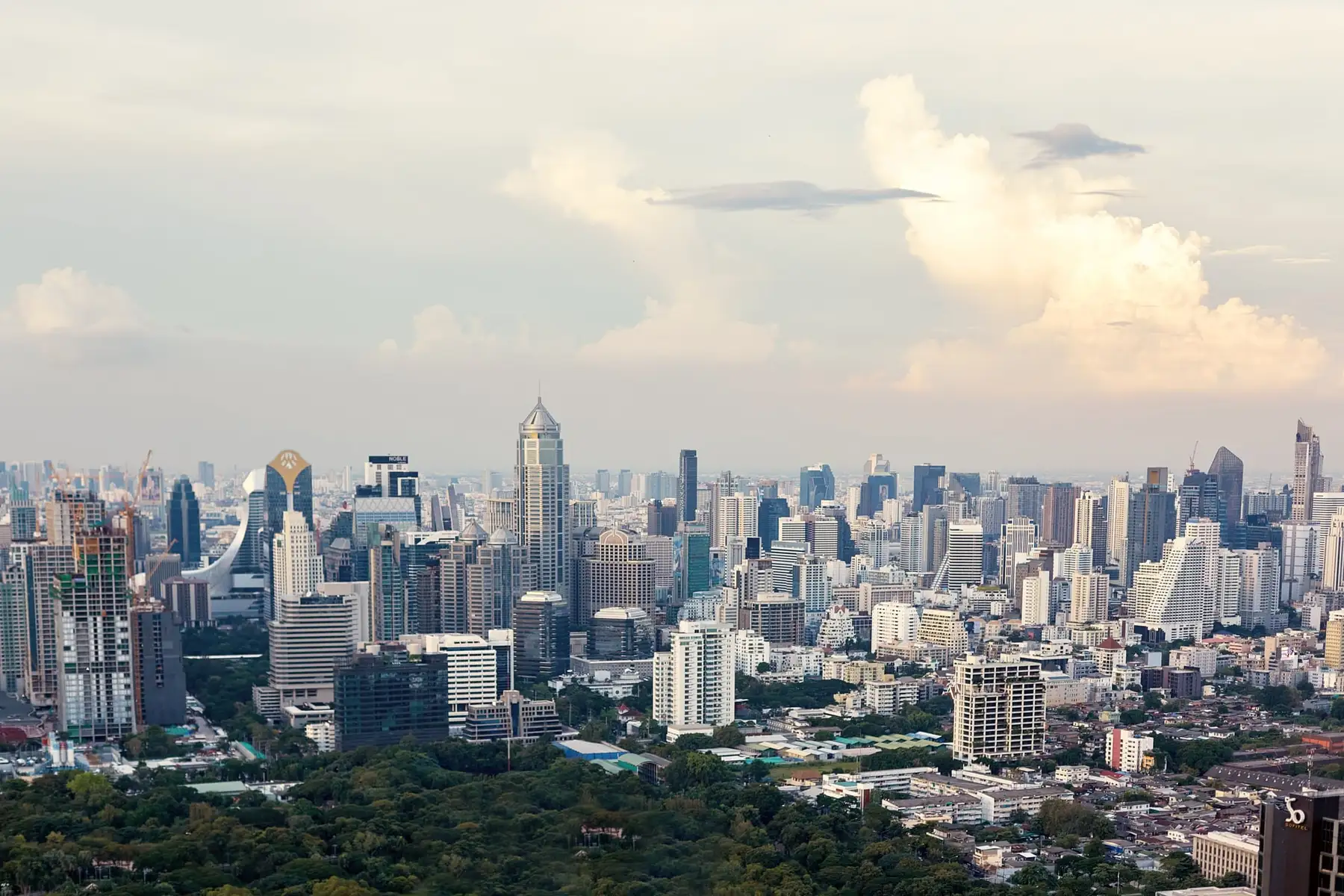
DESTINATION · BANGKOK
Bangkok, and the form you have to file
Eleven million people, a river running through the middle and the best cheap food on earth. Also a compulsory digital arrival card that can only be submitted in the three days before you land, and no paper fallback at the airport.
- Airport
- BKK · Thailand
- On sale
- 12 of 12 months
- Airport spread
- £576 across 10 UK airports
Today's best fare
London Bangkok
£411 £416
Measured on a live search, refreshed hourly. Prices move — confirm on Kiwi.com.
Departure airports
£576 apart, depending where you take off
Every UK airport searched separately for this destination, cheapest first, as a return fare for one person with taxes in. Manchester to Bangkok and London to Bangkok are not the same route and we do not price them as one. Each figure is a fare of one stop at most — the same limit as the price at the top of this page — and each is that airport's own cheapest week, so the dates change from row to row. Every link opens on the dates its price was found on.
All 10 airports have a fare to Bangkok within one stop today. London covers Heathrow, Gatwick, Stansted, Luton, City and Southend in one search.
From your airport
How long is the flight to Bangkok?
Distance, nonstop flight time, whether a direct flight exists and what it costs, worked out separately for each of the ten UK airports.
The year, month by month
When Bangkok is worth the airfare
Average daytime high for each month. The greyed months are ones we refuse to advertise — not because they are cheap, but because the place cannot deliver what the page promises.
- Jan 32°
- Feb 33°
- Mar 34°
- Apr 35°
- May 34°
- Jun 33°
- Jul 33°
- Aug 33°
- Sep 32°
- Oct 32°
- Nov 32° today's fare
- Dec 31°
12 of 12 months on sale. No closed season.
Bangkok has three seasons rather than two, and the middle one is the reason people get it wrong. The south-west monsoon brings the wet half of the year, but the rain here is not the all-day drizzle a British reader pictures — it arrives as a violent hour in the late afternoon and then stops, and the city carries on around it. Between the rains and the cool season sits the hot stretch, when the air is at its heaviest and walking the temples becomes genuinely punishing.
The cool season is a relative term on a city eight hundred miles from the equator. What it actually means is lower humidity rather than lower heat, and that difference is the whole comfort of the trip: the same walk that leaves you soaked in one season is pleasant in the other. Nothing closes at any point in the year, which is why this destination carries no closed months — the question is only how hard the day works you.
For a British calendar the cool, dry stretch coincides neatly with the worst of home, which is why fares climb through it. The wet season is materially cheaper and perfectly workable if you plan indoor things for late afternoons. Songkran, the Thai new year water festival in the middle of April, shuts much of the city for several days and turns the rest into a water fight — it is either the best week to come or exactly the one to avoid, and it is worth deciding on purpose.
File the arrival card in the three days before you fly
The Thailand Digital Arrival Card has been compulsory since 2025 and can only be submitted within 72 hours of arrival. It is free, it takes minutes, and there is no paper version at the airport.
The case for it
Why Bangkok
Bangkok was built on water. The old city is an island cut from the mainland by canals, the Chao Phraya is still a working transport artery rather than a view, and until the 1900s most of the city moved by boat. That history is why the layout makes no sense on a map and why the two elevated railways, threaded above the traffic on concrete legs, transformed the place when they opened — they are the only part of Bangkok that runs to a schedule.
It is also the best-value large city a British traveller can reach. Street food is measured in single pounds, the rail fares in pennies, and a good hotel costs what a mediocre one does in Europe. The Grand Palace, Wat Pho and Wat Arun sit within a kilometre of each other, and the same day can hold a fifteenth-century temple, a shopping mall with an aquarium in the basement and a rooftop bar fifty floors up.
The reservations are heat, traffic and the sheer scale of it. Bangkok is genuinely exhausting in a way that its individual attractions do not predict: the humidity is constant, the pavements are obstacle courses, and a journey that looks short on a map can take an hour in traffic. Three or four days is the right length for most people, and it works far better as a stop on the way somewhere than as a fortnight in itself.
On the ground
Five things worth doing
- 01
Do the Grand Palace first and early
Entry is 500 baht (about £11.60), bought at the gate — there is no official online booking, and the sites selling one are resellers. The ticket covers Wat Phra Kaew and the Emerald Buddha, the throne halls and the palace grounds. The dress code is enforced properly: shoulders and knees covered, no see-through, no sandals with an open heel on some days. Go at opening. By ten it is a slow-moving crowd in full sun, and there is very little shade inside the walls.
- 02
Walk to Wat Pho and have the massage
Seven hundred metres south of the palace, entry 300 baht (about £7), and home to a forty-six-metre reclining Buddha and the country's first public university — traditional Thai massage was codified here and is still taught on site. An hour costs around 500 baht (£11.60) in the temple's own school, which is the version to have: firmer and more clinical than a spa. Anyone who tells you the temple is closed today and offers a tuk-tuk to a different one is running the oldest scam in the city.
- 03
Take the public boat up the Chao Phraya
The orange-flag commuter boat runs the length of the river for about 16 baht (£0.37) a journey — not the blue tourist boat at ten times the fare for the same water. It stops at the piers for the palace, Wat Arun and Chinatown, and it is faster than the road at every hour of the day. Board quickly, hold on, and pay the conductor with the metal tube. Wat Arun on the far bank costs 200 baht (£4.65) and is best climbed late in the day.
- 04
Eat your way through Chinatown after dark
Yaowarat Road turns into a kilometre of open-air kitchens after about six. It is free to walk, and a plate of grilled prawns or a bowl of noodles from a stall runs 60 to 120 baht (£1.40 to £2.80), so a full evening of grazing comes to under a tenner for two. Look for the stalls with a queue of Thai families and a single dish on the sign — the specialists are better than the places offering everything. Chinatown is one of the few areas the rail network reaches directly now, at Wat Mangkon station on the blue line, which removed the one reason people used to skip it.
- 05
Go to Chatuchak on a weekend
Fifteen thousand stalls across twenty-six sections, open Saturday and Sunday, free to enter and reached directly by the Sukhumvit line to Mo Chit. It is the largest weekend market in the world and it is genuinely overwhelming — pick two or three sections from the map at the entrance rather than wandering. Go early for the heat and late for the bargaining. The plant and art sections are the ones people are surprised by.
After the flight
What it costs once you land
Street and neighbourhood prices, which is where most of the value is. Mall and hotel food runs three to five times these figures, and the gap is larger in Bangkok than in any other city on this list.
- Beer, local bar £2 a large Chang or Singha; rooftop bars are five times it
- Dinner for two, mid-range £18 a proper restaurant; two street plates is nearer £3
- Airport to Sukhumvit £1 Airport Rail Link to Phaya Thai; a Grab car is £9 to £14 with tolls
- BTS Skytrain single £0.40–£1.45 distance-based; a one-day pass is about £3.50
- Grand Palace entry £11.60 the most expensive single ticket in the city by a distance
- Pad thai from a stall £1.20
Checked August 2026. Sources at the foot of this page.
Before you book
Practical, for a British passport
Entry rules are for a British Citizen passport holder and come from gov.uk, read on 2026-08-07. They change; check before you fly.
- Airport
- BKK, Suvarnabhumi, forty-five minutes east and connected to the city by the Airport Rail Link for about a pound. Don Mueang (DMK) is the second airport, north of the city, used by regional low-cost carriers — if you are connecting onward within Asia, check you are not landing at one and departing from the other, which is an hour of city traffic between them.
- Entry
- Visa exemption plus a compulsory digital arrival card. No fee. Up to 60 days, extendable once by 30. Expiry at least 6 months after the date you arrive, and at least one blank page. Since 1 May 2025 every arrival by air, land or sea must file the Thailand Digital Arrival Card online, and it can only be submitted within three days of arriving. It is free and takes minutes, but it is not optional and there is no paper fallback at the airport. The 60-day exemption is generous by regional standards and was 30 days until 2024.
- Currency
- Thai baht. Cards work in malls, hotels and larger restaurants; street food, markets, boats and most taxis want cash. Use the bank ATMs rather than the standalone ones and expect a fixed withdrawal fee of around 220 baht regardless of amount, so draw larger sums less often.
- Language
- Thai. English is common in hotels, malls and anywhere touristed, and thin among taxi drivers and street vendors. Have your destination written in Thai or shown on a phone map — the transliteration of street names varies enough to cause real confusion.
- Time zone
- Seven hours ahead of the UK in winter and six ahead of British Summer Time. Thailand does not change its clocks, so the gap moves when Britain does rather than when Thailand does.
- Plugs
- Type A, B and C, 220V. British type-G plugs do not fit; most sockets here take both flat and round pins, so a simple adapter covers everything.
- Health
- The GHIC does not apply and private hospitals in Bangkok are excellent, internationally accredited and expect payment or an insurer's guarantee up front — Bumrungrad and Samitivej are the ones insurers deal with routinely. Drink bottled water, which is sold everywhere for pennies; ice in restaurants and from stalls is made commercially and is generally fine. Street food is cooked in front of you and is rarely the problem.
- Safety
- The FCDO advises against all but essential travel to parts of the far south near the Malaysian border, which is a long way from Bangkok. In the city itself the risks are the traffic and the confidence tricks: the temple-is-closed tuk-tuk routine, the gem shop, and the rented jet ski damage claim at the coast. Crossing the road requires committing.
A bed
Where to stay in Bangkok
Bangkok's traffic makes proximity to a rail station worth more than proximity to anything else. All three of these sit on the network, which is the only thing that reliably beats the roads.
Sukhumvit
The long modern spine of the city, following the Skytrain east from Siam through Asok and Thong Lo, with the widest choice of beds at every price and the best modern restaurants. Easiest base for a first visit and for anyone who intends to move around a lot. It is a long way from the old city and the temples, and the character is malls and towers rather than anything historic.
Stays in Sukhumvit Opens in a new tab ON THE WATERRiverside
The stretch of the Chao Phraya below the old city, where the grand old hotels sit along the bank with their own boat piers. Puts you on the river, which is the fastest and pleasantest way to reach the palace and the temples, and the sunset from this side is the reason people pay for it. Fewer places to walk to for dinner, and the road behind is heavily congested.
Stays in Riverside Opens in a new tab CHEAPER AND CENTRALSilom
The financial district south of Sukhumvit, on both rail lines and a short hop from the river piers. Rates run below Sukhumvit for the same standard, the street food along Silom and Convent is among the city's best, and Lumphini Park is at one end. Business-district quiet at the weekend, and Patpong at one corner is a night market wrapped around something else entirely.
Stays in Silom Opens in a new tabEvery area pinned on one map, set to the dates of the fare above. Change them for your own trip and it reloads live availability.
Open the Bangkok map Opens in a new tabGetting around
Use the rail. The BTS Skytrain and the MRT underground between them reach most of what a visitor wants, they are air-conditioned, they cost pennies, and crucially they are unaffected by the traffic that makes every road journey unpredictable. Fares are distance-based from about 16 to 62 baht; a one-day BTS pass is around 150 baht and pays off after four rides. Buy a stored-value Rabbit card if you are staying more than a couple of days.
The river is the second network and the one visitors underuse. The orange-flag public boat runs the Chao Phraya for about 16 baht and connects to the Skytrain at Saphan Taksin, which makes the old city reachable without ever getting into a car. The blue tourist boat covers the same water for many times the price. Cross-river ferries to Wat Arun cost about 5 baht.
Taxis are metered and cheap, but only if the meter goes on — ask, and if the driver quotes a flat fare, get out and find another. Grab, the local ride-hailing app, removes the argument entirely and shows the price up front, though its quote often excludes expressway tolls. Tuk-tuks are a novelty rather than transport: they cost more than a taxi, and the cheap ones are taking you shopping.
Food and local tips
The best food in Bangkok is on the street and it is not a compromise. A stall that sells one dish has been making it for twenty years, cooks it in front of you and charges a pound or two. The rule is to eat where Thai people are queuing and to be more wary of a stall with a laminated English menu and nine cuisines than of one with a single wok. Boat noodles, pad kra pao with a fried egg, som tam and khao man gai are the everyday dishes worth learning the names of.
Two things to know about ordering. Thai spicy is a different scale — mai phet means not spicy and is worth deploying at first — and the food is meant to be shared, so a table of four ordering four mains has ordered wrong. Regional variety is enormous: Isaan food from the north-east, which is where much of Bangkok's working population comes from, is sour and hot and sold everywhere, and it is a different cuisine from the coconut curries most British visitors expect.
Boat noodles, by the bowl
A dark, intensely savoury beef or pork broth served in bowls small enough that a serving is three or four of them. Around 20 baht (£0.45) a bowl at Victory Monument, where the stacks of empties on the table are how they count what you owe.
Ready for Bangkok?
Pick your departure airport and see what the route costs today from each of the ten we track.
See the £411 fare Opens in a new tabSame band
Other long-haul destinations
Where the numbers came from
- Grand Palace and Wat Pho entry prices yourthaiguide.com Opens in a new tab read 2026-09-26
- BTS Skytrain and Airport Rail Link fares thaiholidayguide.com Opens in a new tab read 2026-08-08
- The Thailand Digital Arrival Card and entry rules gov.uk Opens in a new tab read 2026-08-08
- Entry rules for a British Citizen passport gov.ukOpens in a new tab read 2026-08-07