DESTINATION · ZANZIBAR
Zanzibar, where the tide moves the sea
On the east coast the water goes out for hundreds of metres twice a day and the beach becomes a sand flat. Which coast you book decides whether that is a charm or a fortnight of disappointment.
- Airport
- ZNZ · Tanzania
- On sale
- 9 of 12 months
- Airport spread
- £930 across 6 UK airports
Today's best fare
Bristol Zanzibar
£586 £628
Measured on a live search, refreshed hourly. Prices move — confirm on Kiwi.com.
Departure airports
£930 apart, depending where you take off
Every UK airport searched separately for this destination, cheapest first, as a return fare for one person with taxes in. Manchester to Zanzibar and London to Zanzibar are not the same route and we do not price them as one. Each figure is a fare of one stop at most — the same limit as the price at the top of this page — and each is that airport's own cheapest week, so the dates change from row to row. Every link opens on the dates its price was found on.
6 of 10 airports have a fare to Zanzibar within one stop today. The rest either need two connections and most of a day to get there — which we will not print a price for — or did not answer the last search. London covers Heathrow, Gatwick, Stansted, Luton, City and Southend in one search.
From your airport
How long is the flight to Zanzibar?
Distance, nonstop flight time, whether a direct flight exists and what it costs, worked out separately for each of the ten UK airports.
The year, month by month
When Zanzibar is worth the airfare
Average daytime high for each month. The greyed months are ones we refuse to advertise — not because they are cheap, but because the place cannot deliver what the page promises.
- Jan 32°
- Feb 33°
- Mar 33° not sold
- Apr 31° not sold
- May 29° not sold
- Jun 29°
- Jul 28°
- Aug 28°
- Sep 29°
- Oct 30°
- Nov 31°
- Dec 32° today's fare
9 of 12 months on sale. The reason is below, not in the numbers.
Zanzibar sits just south of the equator and its year is set by two monsoons rather than by temperature, which barely moves. The kaskazi comes from the north-east through the British winter and brings the calmest seas and the clearest water; the kusi comes from the south-east through the British summer, breezier and rougher on the eastern beaches but still perfectly usable. Between them sit two rainy periods, and the long one is what takes this destination off our board.
That long rains season is a genuine closure rather than a discount opportunity. It is not the rainfall total so much as what it does: unsurfaced roads to the eastern and northern beaches become difficult, many of the smaller resorts close for annual maintenance, boat trips stop, and the humidity is heavy. The short rains later in the year are a different matter — brief afternoon downpours between long sunny stretches, and they close nothing.
The other thing to plan around is not seasonal at all. On the east coast the tidal range is enormous, and at low water the sea retreats several hundred metres across a sand and seagrass flat. It is beautiful and it is not swimmable, and it happens twice a day regardless of the month. The north coast around Nungwi is the exception, holding deep water at all states of the tide — which is exactly why it is the busiest and most developed part of the island.
Buy the ZIC insurance before you fly
Every visitor needs inbound cover from the Zanzibar Insurance Corporation — about £35 for up to ninety-two days. British policies are not accepted as a substitute and you can be refused entry without the certificate.
The case for it
Why Zanzibar
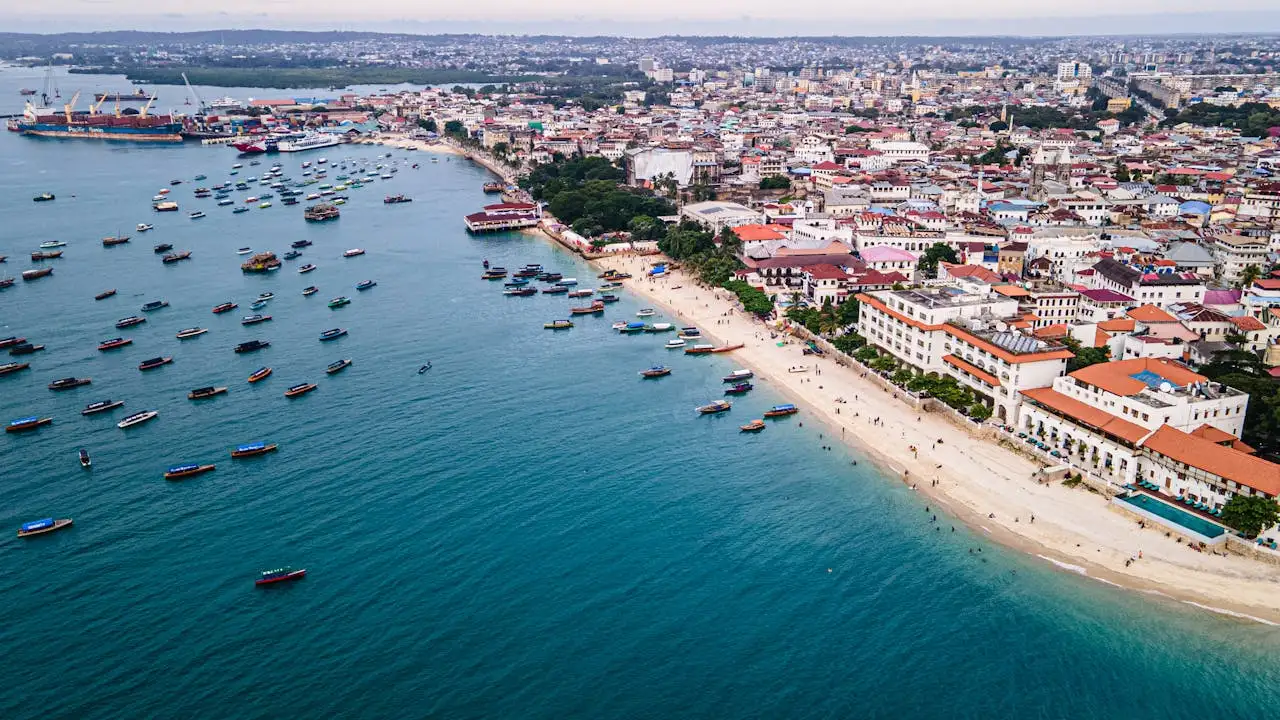
Zanzibar is a semi-autonomous archipelago off Tanzania with a history that has almost nothing to do with the mainland. It was the seat of the Sultanate of Oman, the centre of the East African slave and spice trades, and a Persian, Indian, Arab and African crossroads for a thousand years. Stone Town is the physical record of that — a UNESCO maze of coral-rag houses with carved doors that are Indian in pattern and Omani in construction.
The beaches are the other half and they are genuinely extraordinary: white coral sand, water in three shades of turquoise, and dhows with lateen sails still working the channel. The north coast around Nungwi holds its water at all states of the tide; the east coast around Paje has enormous tidal movement and has become one of the world's best kitesurfing spots because of it.
Two things need saying before booking. The tide on the east coast is not a detail — at low water the sea withdraws several hundred metres and swimming is impossible for hours at a time, twice a day, and people who booked the photograph rather than the coast are routinely surprised. And Zanzibar requires every visitor to buy inbound insurance from its own state insurer; your British policy is not accepted and you can be refused entry without the ZIC certificate.
On the ground
Five things worth doing
- 01
Get lost in Stone Town deliberately
The old town is a UNESCO site of about eighty hectares with no street plan worth the name, and walking it without a destination is the point. It is free. The carved doors are the thing to look at — brass-studded Indian ones, geometric Omani ones — and the fish and produce market at Darajani is where the island shops. Take a guided walk on the first morning for about £15 to get your bearings, then do it alone.
- 02
Eat at Forodhani night market
The seafront gardens turn into a grill market every evening from about six: prepared seafood skewers, Zanzibar pizza, sugar cane juice pressed to order. Free to walk into, and a plate of grilled prawns or a Zanzibar pizza runs 5,000 to 10,000 shillings (£1.60 to £3.20), so two people eat properly for under a tenner. Two rules — agree the price before anything is handed over, because the tourist markup here is aggressive, and choose grills where the food is being cooked rather than sitting under a lamp. The sugar cane juice with lime and ginger is the thing to have.
- 03
Take a spice tour, and taste rather than shop
The plantations inland from Stone Town grow clove, nutmeg, cinnamon, cardamom and vanilla, and a half-day tour with a guide runs about £15 to £20 including transport. It is genuinely interesting — you are shown the plants and made to identify them by smell — and it usually ends at a stall. Buy spices at Darajani market instead, where the same vanilla pods cost a third and the money stays local.
- 04
Swim with the Mnemba reef, not the dolphins
The atoll off the north-east is a marine reserve with the best snorkelling in Zanzibar; a half-day boat is about £30 to £45 including the park fee. The dolphin tours at Kizimkazi in the south are a different proposition — boats chase pods and drop swimmers into their path, and it is now widely regarded as harmful. If you want dolphins, several operators run responsible watching trips that do not put people in the water.
- 05
Learn to kite at Paje
The east coast lagoon at Paje has flat shallow water inside the reef and a steady cross-shore wind for much of the year, which is why it is one of the world's best places to learn. A group lesson runs about £45 an hour and a beginner course to independent riding around £300. The season follows the trade winds and there are two of them a year, so ask the school which months they are actually teaching in before booking flights.
After the flight
What it costs once you land
Local prices rather than resort ones. Zanzibar is more expensive than mainland Tanzania and taxi fares are fixed per vehicle rather than per person, which makes them good value for a group and poor for one.
- Beer, local bar £1.80 a Kilimanjaro or Safari; resort bars are three times it
- Dinner for two, mid-range £18 in Stone Town; the night market feeds two for under £8
- Airport to Stone Town £12–£16 fixed per car, not per person; Nungwi is about £40
- ZIC inbound insurance £35 per adult, compulsory, and separate from your own travel policy
- Sunbed and parasol £5 per set where beaches are not hotel-run
- Zanzibar pizza at Forodhani £1.60
Checked August 2026. Sources at the foot of this page.
Before you book
Practical, for a British passport
Entry rules are for a British Citizen passport holder and come from gov.uk, read on 2026-08-07. They change; check before you fly.
- Airport
- ZNZ, Abeid Amani Karume International, ten minutes from Stone Town and about an hour from the northern and eastern beaches. Small and slow — arrivals can take a while and the ZIC insurance desk is part of the process. Taxi fares are fixed per vehicle by route and posted; agree which route and which price before loading bags.
- Entry
- Tanzanian visa plus compulsory state insurance. USD 50 visa + USD 44 insurance (about £74) — the insurance is a separate purchase from Zanzibar Insurance Corporation. Up to visa-dependent; the insurance covers up to 92 days. Expiry at least 6 months after the date you arrive, and at least one blank page. Zanzibar is the one destination on this list where your own travel insurance is not accepted. Every visitor must hold an inbound policy issued by the Zanzibar Insurance Corporation, bought before arrival, and you can be refused entry without it. A British annual multi-trip policy does not substitute — you buy the ZIC policy as well, not instead. The Tanzanian visa itself is an e-visa or issued on arrival. Buy both through official channels; the FCDO has warned about unauthorised agents.
- Currency
- Tanzanian shilling, though tourism prices are quoted and often required in US dollars — bring clean, recent notes, because torn or pre-2009 bills are refused. Cards work in hotels and a few restaurants and nowhere else. ATMs in Stone Town dispense shillings and are reliable; the beaches have very few.
- Language
- Swahili, with English widely spoken across tourism and in Stone Town. Away from those, less so. A few words of Swahili are received well — this is a place where the greeting matters before the question.
- Time zone
- Three hours ahead of the UK in winter and two ahead of British Summer Time. Tanzania does not change its clocks, so the gap moves when Britain does.
- Plugs
- Type G and D, 230V. British type-G plugs fit most sockets without an adapter. Power cuts are frequent and most hotels run generators with a short gap before they pick up.
- Health
- The GHIC does not apply, and the compulsory ZIC policy is inbound cover rather than proper travel insurance — you need both. Malaria is present year round: prophylaxis and repellent are not optional here, and this is the destination on this list where that matters most. Yellow fever certification is required if you arrive from a country with transmission risk. Drink bottled water.
- Safety
- The FCDO advises against travel within twenty kilometres of the Mozambique border on the mainland, far from Zanzibar. On the island the risks are petty theft on beaches and in Stone Town after dark, and the sea. This is a conservative Muslim society: cover shoulders and knees away from the beach, and be aware that Ramadan changes daytime eating and drinking on the island.
A bed
Where to stay in Zanzibar
The coast you choose decides your holiday more here than almost anywhere, because the tide behaves completely differently on each side of the island.
Nungwi
The northern tip, and the one part of the island where the sea stays deep at low water — which is why it has the most hotels and the most visitors. Wide sand, sunsets over the water, dhow trips and dive shops. Busier and more developed than anywhere else, with beach touting that some people find wearing, and an hour from the airport.
Stays in Nungwi Opens in a new tab KITE AND TIDEPaje
The east coast, with a wide shallow lagoon inside the reef that empties dramatically twice a day and fills again — extraordinary to look at, and one of the best flat-water kitesurfing spots anywhere. Younger, more relaxed and cheaper than the north. If you want to swim on demand rather than by the tide table, this is the wrong coast.
Stays in Paje Opens in a new tab THE HISTORYStone Town
The old capital, with the carved doors, the market, the night grills and the whole thousand-year history within walking distance. Ten minutes from the airport and the natural first or last night of a trip. There is no beach here to speak of — it is a working port city — so almost nobody stays the whole week, and the choice of well-rated rooms is smaller than on the coast.
Stays in Zanzibar City Opens in a new tabEvery area pinned on one map, set to the dates of the fare above. Change them for your own trip and it reloads live availability.
Open the Zanzibar map Opens in a new tabGetting around
Taxis are the practical answer and the fares are fixed per vehicle by route rather than metered or per person — airport to Stone Town about twelve to sixteen pounds, airport to Nungwi thirty to forty, Stone Town to Nungwi similar. That makes them poor value alone and reasonable for four. Agree the route and price before the bags go in, and book through your hotel for anything after dark.
The dala-dala is the local shared minibus or converted lorry, runs fixed routes across the island for well under a pound, and is how Zanzibar travels. It is slow, crowded and an experience rather than transport, and it will not take you door to door with luggage. Between the beach villages there is very little lateral connection — most routes run in and out of Stone Town rather than around the coast.
Hiring a car or a scooter requires a Zanzibar temporary permit obtained on arrival, and the roads to the eastern beaches are variable and become genuinely poor in the wet season. Most visitors do not bother: a driver hired for a day costs about fifty pounds and removes the permit, the parking and the police checkpoints in one.
Food and local tips
Zanzibari food is Swahili coastal cooking with a heavy Indian and Omani inheritance, built on coconut, tamarind and the spices the island traded. Look for urojo, the tangy turmeric soup sold as Zanzibar mix with fritters and crisps thrown in; pweza wa nazi, octopus in coconut curry; and biryani that owes more to Muscat than to Mumbai. Breakfast is mandazi, a lightly spiced doughnut, with sweet spiced tea.
Eat at Forodhani in the evening and in the small places behind the seafront the rest of the time, where a plate costs a fifth of what a hotel charges. Two practical points: agree prices before ordering at the night market, and drink the fresh juices from stalls that press in front of you rather than from a jug. Alcohol is available in hotels and tourist restaurants but not generally elsewhere — this is a Muslim island and the beaches are the exception rather than the rule.
Urojo, the Zanzibar mix
A sharp turmeric and tamarind soup with potato, bhajia, crisps and chilli piled in — a whole meal in a bowl and unlike anything else on the coast. About 3,000 shillings (£1) from a stall in Stone Town.
Ready for Zanzibar?
Pick your departure airport and see what the route costs today from each of the ten we track.
See the £586 fare Opens in a new tabSame band
Other long-haul destinations
Where the numbers came from
- Zanzibar taxi fares by route zanzibarcab.com Opens in a new tab read 2026-09-26
- The compulsory ZIC inbound insurance and its cost tanzaniatourism.uk Opens in a new tab read 2026-08-08
- Tanzanian visa rules and the ZIC requirement gov.uk Opens in a new tab read 2026-08-08
- Entry rules for a British Citizen passport gov.ukOpens in a new tab read 2026-08-07