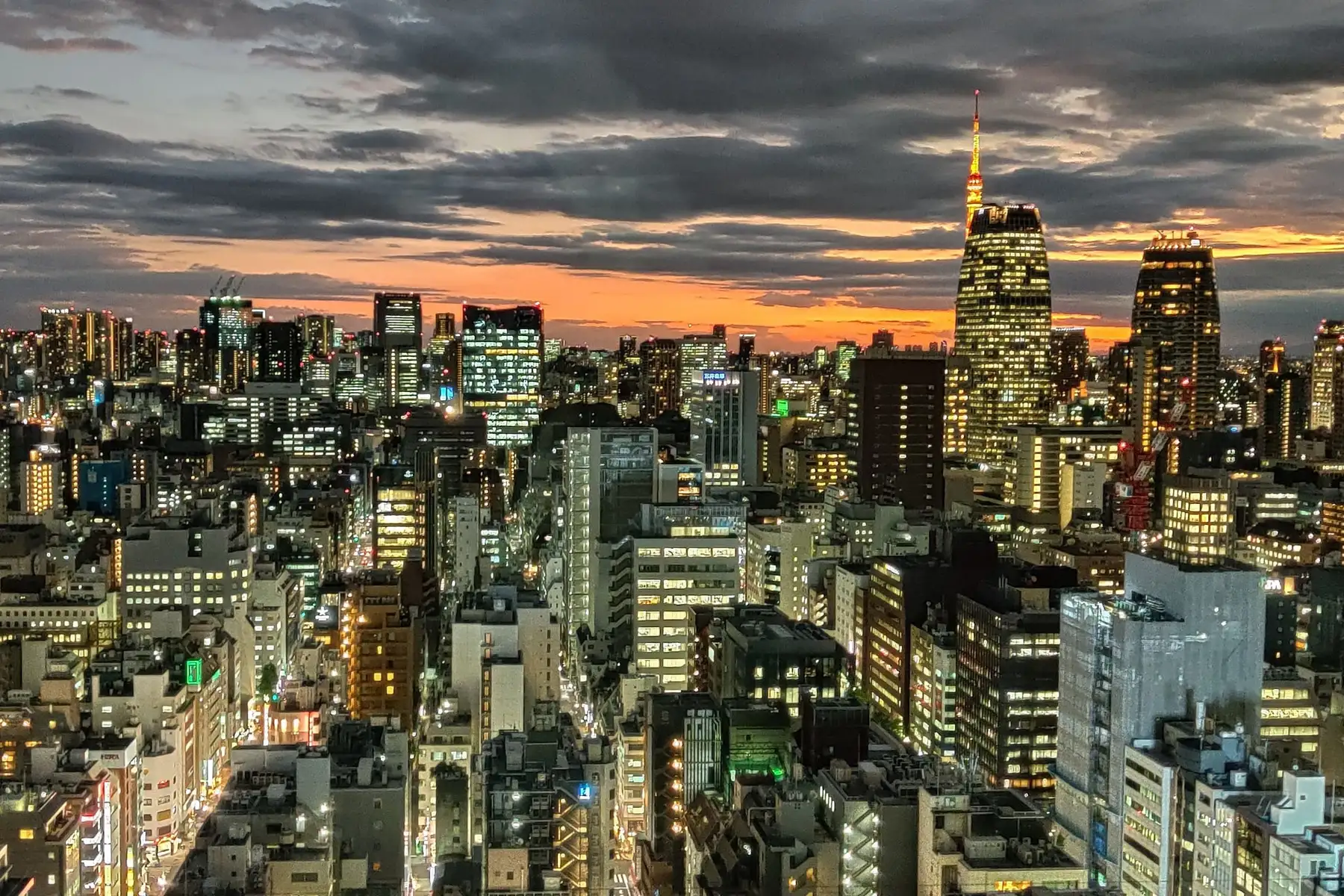
DESTINATION · TOKYO
Tokyo, which asks nothing
No visa, no arrival form, no fee, no passport-validity trap. Of the thirty destinations we price, this is the only one where a valid British passport is the entire requirement.
- Airport
- TYO · Japan
- On sale
- 12 of 12 months
- Airport spread
- £713 across 7 UK airports
Today's best fare
London Tokyo
£742
Measured on a live search, refreshed hourly. Prices move — confirm on Kiwi.com.
Departure airports
£713 apart, depending where you take off
Every UK airport searched separately for this destination, cheapest first, as a return fare for one person with taxes in. Manchester to Tokyo and London to Tokyo are not the same route and we do not price them as one. Each figure is a fare of one stop at most — the same limit as the price at the top of this page — and each is that airport's own cheapest week, so the dates change from row to row. Every link opens on the dates its price was found on.
7 of 10 airports have a fare to Tokyo within one stop today. The rest either need two connections and most of a day to get there — which we will not print a price for — or did not answer the last search. London covers Heathrow, Gatwick, Stansted, Luton, City and Southend in one search.
From your airport
How long is the flight to Tokyo?
Distance, nonstop flight time, whether a direct flight exists and what it costs, worked out separately for each of the ten UK airports.
The year, month by month
When Tokyo is worth the airfare
Average daytime high for each month. The greyed months are ones we refuse to advertise — not because they are cheap, but because the place cannot deliver what the page promises.
- Jan 10°
- Feb 10°
- Mar 14°
- Apr 19°
- May 23°
- Jun 26°
- Jul 30°
- Aug 31°
- Sep 27°
- Oct 22°
- Nov 17°
- Dec 12° today's fare
12 of 12 months on sale. No closed season.
Tokyo is on the Pacific edge of a mountainous archipelago and gets four sharp seasons plus a fifth that the rest of the world does not have a word for. The summer is subtropical and heavy — this is a city at the latitude of Tunis, and the humidity in the peak weeks is what surprises visitors more than anything else. The winter is dry, bright and cold, with far more clear days than a British winter and almost no snow at sea level.
The fifth season is tsuyu, the rain front that stalls over the country for several weeks between spring and summer, and it is a genuine wet season rather than the occasional shower. It is followed by the typhoon window in the late summer and early autumn, when a storm can suspend the rail network and cancel flights for a day at a time. Neither closes the city — everything here is indoors and connected underground — but both change what a week feels like.
The two famous windows are the cherry blossom in the spring and the maples in the late autumn, and both are extraordinary and both put the whole country on the move. Blossom in particular lasts about a week, moves north across the country and cannot be booked in advance with any confidence. For a British calendar, the quiet, cheap and genuinely pleasant stretch is the winter: crisp, clear, empty, and with the mountain visible from the city on more mornings than in any other season.
The rail pass is probably not worth it
The seven-day nationwide pass is around ¥50,000 (£256), rising again in October. For a trip based in Tokyo it will not repay itself; it only makes sense with two or more long bullet-train legs.
The case for it
Why Tokyo
Tokyo is not a city with a centre; it is a set of towns that grew into each other around railway stations, which is why Shinjuku, Shibuya, Ikebukuro and Ueno all feel like downtowns of separate places. Thirty-seven million people live in the metropolitan area and the thing that makes it navigable is the rail network — roughly nine hundred stations, running to the second, carrying more passengers than any system on earth.
For a British traveller the appeal is that everything works and almost nothing is familiar. Vending machines sell hot coffee in cans on freezing platforms. A department store basement is two floors of food halls. A meal at a counter with six seats can cost eight pounds and be the best thing you eat all year. Crime is close to statistically absent and lost property is handed in as a matter of course.
The reservations are cost and effort. Japan is no longer the eye-wateringly expensive country of the 1990s, but Tokyo hotel rooms are small and not cheap, and the weak yen that made recent years a bargain is a currency position rather than a permanent feature. And the language barrier is real away from the tourist spine — station signage and menus in the big districts are bilingual, but a neighbourhood izakaya may have neither, and almost nobody speaks English on the phone.
On the ground
Five things worth doing
- 01
Go up Shibuya Sky at the right hour
An open rooftop deck two hundred and thirty metres above the Shibuya crossing, and the best view in the city because it looks at Tokyo rather than out of it. Online tickets are ¥2,700 (about £14) before three in the afternoon and ¥3,400 (£17.50) after, with the sunset slots going weeks ahead. The roof closes in rain or high wind and they refund it. Nothing loose is allowed up there — phones on a strap only, and bags go in a locker.
- 02
Get a Suica and stop thinking about fares
The stored-value card taps you through every train, metro, bus and convenience store in the country. A Welcome Suica for visitors costs ¥1,500 (about £7.70) and is entirely spendable credit with no deposit; the standard card carries a ¥500 deposit you get back. It works on your phone too. This single purchase removes the only genuinely confusing thing about Tokyo, which is that a dozen operators run the network and buying paper tickets means understanding which.
- 03
Spend a morning in Asakusa, then the river
Sensō-ji is Tokyo's oldest temple, free to enter, and the approach through Nakamise-dōri has been selling snacks to pilgrims for three hundred years. Go before eight and it is almost empty. From the pier behind it, the Sumida river bus runs down to Hamarikyu gardens for about ¥1,200 (£6) — a route that shows you the back of the city rather than the front, and ends in a seventeenth-century garden with skyscrapers behind it.
- 04
Book teamLab weeks ahead
The digital art collectives' permanent Tokyo installations are timed-entry and dynamically priced at roughly ¥3,600 to ¥5,600 (£18 to £29) depending on the day. They sell out. Planets involves walking barefoot through shin-deep water, so wear something you can roll above the knee and skip it if you cannot manage uneven footing in the dark. It is the single most photographed thing in Tokyo and it is also, unusually, better in person.
- 05
Eat standing up at a station counter
Tachigui soba bars sit inside or beside most large stations: you buy a ticket from a machine, hand it over, eat in five minutes standing at a counter and leave. A bowl is ¥400 to ¥600, around £2 to £3. It is not a novelty, it is how a great many people have lunch, and it is the cheapest good meal in the city. The machines have photographs and often an English button; if not, the top-left option is usually the plain house bowl.
After the flight
What it costs once you land
Everyday Tokyo prices rather than hotel or tourist-district ones. The pound has been strong against the yen for several years, which is why Japan reads as cheaper than it used to — that is a currency position and not a permanent feature.
- Beer, izakaya £3.50 a convenience store can costs about £1.20
- Dinner for two, mid-range £35 an izakaya with several small plates; a ramen counter is £8 a head
- Haneda to central Tokyo £2.70 monorail or Keikyu; from Narita the express is £16 to £21
- Metro single £1 distance-based, tapped with a Suica; a 24-hour metro pass is about £4
- Shibuya Sky ticket £14 before three in the afternoon; £17.50 for the sunset slots
- Station soba, standing £2.50
Checked August 2026. Sources at the foot of this page.
Before you book
Practical, for a British passport
Entry rules are for a British Citizen passport holder and come from gov.uk, read on 2026-08-07. They change; check before you fly.
- Airport
- TYO covers both: Haneda (HND), fifteen minutes from central Tokyo by monorail and the one to prefer, and Narita (NRT), sixty kilometres out with a rail journey of an hour and a fare six times higher. A cheaper Narita arrival can cost the difference back in transfers and in an hour each way — check which one a fare uses.
- Entry
- No visa. No fee. Up to 90 days. Valid for the length of your stay, with a blank page for the stamp. No extra period of validity is required. One of the few destinations on this list asking nothing beyond a valid passport — no form, no fee, no authorisation. Visit Japan Web lets you file immigration and customs in advance and use the fast lane, but it is a convenience rather than a requirement. Japan has announced a pre-travel authorisation of its own for the future; it is not in force.
- Currency
- Japanese yen. Japan is far more cash-based than its reputation suggests: cards work in hotels, department stores and chains, and a great many small restaurants, temples and markets are cash only. The 7-Eleven ATMs accept foreign cards reliably and are open around the clock, which is the standard way visitors draw money.
- Language
- Japanese. Station and metro signage is bilingual and major districts are well served, but restaurant menus, small shops and telephone service frequently are not. Google Translate's camera mode is genuinely useful here. Pointing is understood and English is often read better than it is spoken.
- Time zone
- Nine hours ahead of the UK in winter and eight ahead of British Summer Time. Japan does not observe daylight saving, so the gap moves when Britain changes rather than when Japan does.
- Plugs
- Type A, 100V — the lowest mains voltage of any destination on this list. A British type-G plug does not fit. Modern chargers handle 100V without trouble; older appliances may run slowly or not at all.
- Health
- The GHIC does not apply and Japanese healthcare is good and expensive, so insurance is essential. The specific thing to check is medication: several drugs that are ordinary in Britain, including some cold remedies containing pseudoephedrine and certain ADHD medicines, are prohibited outright and carrying them is a criminal matter. Check before you pack rather than at the border.
- Safety
- The FCDO has no warning against travel. Japan is among the safest countries on earth and petty crime against visitors is rare. The genuine hazards are geological and seasonal: earthquakes are frequent and mostly harmless, hotels post evacuation instructions, and typhoons can suspend rail and air travel for a day or two in the late summer.
A bed
Where to stay in Tokyo
Tokyo's rail network makes almost any station workable, so the question is which kind of evening you want when you step out of the hotel.
Shinjuku
The busiest railway station in the world sits under it, which makes this the easiest base for going anywhere, including the airports. Around it: department stores, the Golden Gai drinking alleys, Kabukichō, and a large park. The widest range of hotel stock in the city. It is also loud, crowded and disorienting, and the station itself takes several attempts to learn.
Stays in Shinjuku Opens in a new tab THE OLD CITYAsakusa
North-east, around Sensō-ji, and the closest thing Tokyo has to a historic quarter — low buildings, old shops, the river at the bottom of the street. Rates run well below the western districts for the same standard and the atmosphere at seven in the morning is worth the trade. Further from the nightlife and the modern shopping, and quiet after about nine.
Stays in Asakusa Opens in a new tab YOUNGER AND CENTRALShibuya
The crossing, the fashion, the music and the best concentration of small restaurants, with Harajuku and Omotesandō a walk away. Well connected and the most immediately recognisable part of the city. Prices are high, the hotel rooms are among the smallest anywhere, and the crowds at the scramble do not thin until very late.
Stays in Shibuya Opens in a new tabEvery area pinned on one map, set to the dates of the fare above. Change them for your own trip and it reloads live availability.
Open the Tokyo map Opens in a new tabGetting around
Buy a Suica or Pasmo at the airport and stop thinking about it. One tap covers the JR lines, the two metro operators, the private railways, the buses and a great many shops and lockers. Without one you have to work out which of a dozen companies runs the line you want and buy the right paper ticket, which is the single thing that makes Tokyo look complicated when it is not.
The rail network does everything. Trains are punctual to the minute, clean, and stop running between roughly one and five in the morning — which is the one hard constraint on an evening out, because a taxi home across Tokyo costs more than the night out did. The Yamanote loop line connects most of the districts a visitor wants and is the easiest line to use, because you cannot get on it in the wrong direction for long.
Do not buy the Japan Rail Pass for a Tokyo trip. At around ¥50,000 for seven days it needs two or more long-distance bullet train journeys to break even, and a city stay will not get near that. Buy individual shinkansen tickets if you take a day trip to Kyoto or Hakone; they are expensive but far less than the pass. Taxis are excellent, spotless and priced accordingly.
Food and local tips
Tokyo has more restaurants than any city on earth and the good ones are usually specialists — a place that makes ramen makes ramen, and a place with a long menu is usually an izakaya, which is the point of an izakaya. The cheapest tier is astonishing value: a ticket-machine ramen counter, a standing soba bar, a conveyor sushi chain or a department store food hall at the end of the day, when the prepared food is marked down hard.
Convenience stores are not an emergency option here. 7-Eleven, Lawson and FamilyMart sell genuinely good onigiri, egg sandwiches, fried chicken and coffee at a couple of pounds, and Japanese people eat from them constantly. Two etiquette points that matter: do not tip, ever, and do not eat while walking. Cash matters more than you expect — many of the best small places have no card machine at all.
A department store depachika at seven in the evening
Two basement floors of food halls under any large store, where the prepared counters cut prices sharply as closing approaches. A dinner for two that would cost £40 upstairs comes to about £12.
Ready for Tokyo?
Pick your departure airport and see what the route costs today from each of the ten we track.
See the £742 fare Opens in a new tabSame band
Other long-haul destinations
Where the numbers came from
- Shibuya Sky ticket prices and time slots tokyocheapo.com Opens in a new tab read 2026-08-08
- Suica card pricing and airport transfer fares tokyocheapo.com Opens in a new tab read 2026-08-08
- Japan Rail Pass 2026 prices and the October increase japan-guide.com Opens in a new tab read 2026-08-08
- Entry rules for a British Citizen passport gov.ukOpens in a new tab read 2026-08-07