DESTINATION · MAURITIUS
Mauritius, ringed by its own reef
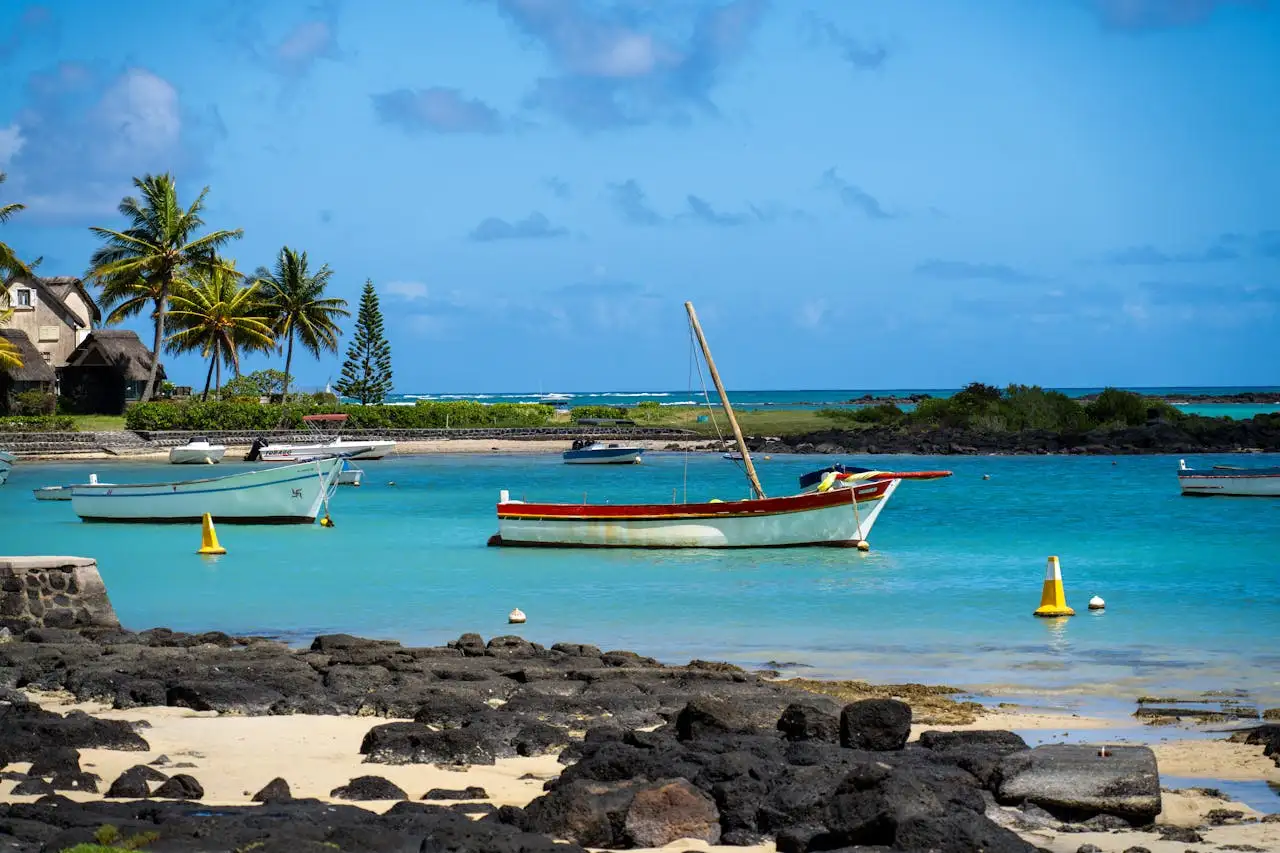
A barrier reef runs almost the whole way round the island, which is why the water inside it is flat, shallow and warm on every coast — and why Mauritius offers what most of the Indian Ocean sells at four times the price.
- Airport
- MRU · Mauritius
- On sale
- 9 of 12 months
- Airport spread
- £391 across 10 UK airports
Today's best fare
London Mauritius
£720
Measured on a live search, refreshed hourly. Prices move — confirm on Kiwi.com.
Departure airports
£391 apart, depending where you take off
Every UK airport searched separately for this destination, cheapest first, as a return fare for one person with taxes in. Manchester to Mauritius and London to Mauritius are not the same route and we do not price them as one. Each figure is a fare of one stop at most — the same limit as the price at the top of this page — and each is that airport's own cheapest week, so the dates change from row to row. Every link opens on the dates its price was found on.
All 10 airports have a fare to Mauritius within one stop today. London covers Heathrow, Gatwick, Stansted, Luton, City and Southend in one search.
From your airport
How long is the flight to Mauritius?
Distance, nonstop flight time, whether a direct flight exists and what it costs, worked out separately for each of the ten UK airports.
The year, month by month
When Mauritius is worth the airfare
Average daytime high for each month. The greyed months are ones we refuse to advertise — not because they are cheap, but because the place cannot deliver what the page promises.
- Jan 30° not sold
- Feb 30° not sold
- Mar 29° not sold
- Apr 28°
- May 26°
- Jun 24°
- Jul 24°
- Aug 24°
- Sep 25°
- Oct 27°
- Nov 28°
- Dec 29° today's fare
9 of 12 months on sale. The reason is below, not in the numbers.
Mauritius is in the southern hemisphere and its seasons are inverted, so its cool dry half falls across the British summer and its warm wet half across our winter. The island is small and mountainous, which gives it more local variation than its size suggests: the central plateau is consistently cooler and wetter than the coast, and the east is windier than the west because the south-east trades hit it first. The lagoon temperature barely moves at all.
What takes this destination off our board is the cyclone belt. Mauritius sits in the south-west Indian Ocean basin, and through the warm half of the year tropical systems form and track past it. A direct hit is uncommon in any given year, but the disruption is not: the island issues graded cyclone warnings, and at the higher classes everything shuts — shops, transport, the airport — and you are confined to your hotel. That is a different category of risk from rain, and it is why the fare being cheap then is not an argument.
The rest of the year is close to faultless: dry, clear, and with the sea still warm because the lagoon holds its heat. For a British calendar the good stretch runs across our summer and autumn, which is convenient in that it does not compete with the winter-sun destinations on this board. The one thing to plan around is the Mauritian school holidays and the run-up to the new year, when domestic demand fills the coastal hotels.
Print the All in One form
Mauritius requires an online travel form completed before arrival, and the desk wants a printed copy showing the QR code. A phone screenshot is routinely refused, which is a bad discovery after eleven hours in the air.
The case for it
Why Mauritius
Mauritius sits eight hundred kilometres east of Madagascar and is volcanic, mountainous and improbably green — nothing like the flat coral islands it gets compared with. A near-continuous barrier reef encircles it, enclosing a lagoon that rarely gets deep, so the sea is calm and swimmable almost everywhere. The interior rises to jagged basalt peaks with sugar cane between them and a rainforest national park at the centre.
It is also the most culturally layered place on this board. The island was uninhabited until the Dutch arrived, then French, then British, and was populated by enslaved Africans and later by indentured Indian labourers — so a village will have a Hindu temple, a mosque and a Catholic church within a few hundred metres, three languages in daily use and a cuisine that is genuinely all of them at once. Creole is what people speak, English is what the government writes in, French is what the newspapers are in.
The reservations are cost and season. Mauritius is not cheap by Indian Ocean standards once you leave the beach — imported groceries are dear, car hire is not, and restaurant prices are European. And it sits in the south-west Indian Ocean cyclone belt: for a stretch of the year the risk is real enough that we stop advertising it, because a cheap fare into a tropical cyclone warning is not a bargain.
On the ground
Five things worth doing
- 01
See the Seven Coloured Earths at Chamarel
Dunes of volcanic clay in seven distinct colours that never mix, however much rain falls on them, plus a hundred-metre waterfall and a giant tortoise enclosure in the same park. Entry is about 500 rupees (£8.50). It is small — twenty minutes at the dunes themselves — so go for the whole Chamarel loop, which includes the waterfall viewpoint and the rum distillery down the road. Early morning light shows the colours best.
- 02
Walk in Black River Gorges
The island's national park covers most of what remains of the native forest, and entry is free. The Macchabée trail and the short walk to Alexandra Falls are both well marked; the longer routes need proper shoes because the basalt is slippery when wet. This is where the endemic birds are — the Mauritius kestrel was down to four wild individuals in the 1970s and is here because of that recovery. Go early, and take water; there is nothing on the trails.
- 03
Snorkel the lagoon at Blue Bay
A marine park in the south-east with the best-preserved coral on the island, reachable from the beach or by glass-bottom boat for about 500 rupees (£8.50) a head. Because the reef encloses it, the water is calm and shallow enough for anyone to snorkel without a boat. Go on a weekday: at weekends the bay fills with Mauritian families and the boat traffic makes the visibility worse rather than better.
- 04
Take the Port Louis market in the morning
The central market in the capital is free to walk into and is the fullest expression of the island's mix — Chinese herbalists, Indian spice sellers, Creole fruit stalls, and a food court upstairs where a plate costs a pound. It shuts in the early afternoon and is at its best before ten. Combine it with the Aapravasi Ghat, the UNESCO-listed immigration depot where half a million indentured labourers first landed, which is a short walk away and costs nothing.
- 05
Drive the island rather than book excursions
Car hire is about £30 a day, the roads are good, driving is on the left and a British licence is accepted — which makes Mauritius one of the easiest self-drive destinations on this list. Almost every excursion sold at a hotel is somewhere you could reach yourself in under ninety minutes for the cost of the fuel. The exception is the sea: catamaran days to Île aux Cerfs at around £45 including lunch are worth paying for.
After the flight
What it costs once you land
Local prices away from the hotel beaches. The gap between a resort restaurant and a village one is very wide here; the gap between a supermarket and home is not, because almost everything on a shelf is imported.
- Beer, local bar £1.80 a Phoenix; hotel bars are three to four times it
- Dinner for two, mid-range £25 a table d'hôte or a Creole restaurant, not a resort
- Airport to Grand Baie £30 taxi, about an hour across the island; Flic-en-Flac is similar
- Car hire, per day £30 the single best value here — driving is on the left, roads are good
- Sunbed and parasol £0 all beaches are public by law; hotels provide their own
- Dholl puri from a street van £0.50
Checked August 2026. Sources at the foot of this page.
Before you book
Practical, for a British passport
Entry rules are for a British Citizen passport holder and come from gov.uk, read on 2026-08-07. They change; check before you fly.
- Airport
- MRU, Sir Seewoosagur Ramgoolam International, in the south-east of the island — which matters, because the resorts are mostly in the north and west and the transfer is forty-five minutes to an hour. Grand Baie is the far corner from it. There is an express bus to Port Louis, but almost everyone takes a car.
- Entry
- No visa, but a compulsory online form. No fee. Up to 60 days. Valid for the duration of your stay, with one blank page. Fill in the Mauritius All in One travel form before you arrive and travel with a printed copy showing the QR code — a phone screenshot is routinely refused at the desk. You must also be able to show onward or return travel. The officer writes your permitted end-date into the stamp; it is not automatically the full 60 days.
- Currency
- Mauritian rupee. Cards work in hotels, supermarkets and larger restaurants; buses, markets, street food and small shops want cash. ATMs are widespread and reliable. Euros and sterling are quoted for excursions but you will get a poor rate paying in them.
- Language
- Mauritian Creole is what everyone speaks; English is the language of government and law, French of the media and much of business. Signage is mostly English and menus mostly French. No barrier at all for a British visitor, and this is one of the easiest places on the list to be understood.
- Time zone
- Four hours ahead of the UK in winter and three ahead of British Summer Time. Mauritius does not change its clocks, so the gap moves when Britain does.
- Plugs
- Type G and C, 230V. British three-pin plugs fit the type G sockets, which are standard in most hotels — another legacy of the British period, and one of only a handful of destinations here where no adapter is needed. Older buildings still have type C, so pack one anyway.
- Health
- The GHIC does not apply. Private clinics in the north and centre are good and expect payment or an insurer's guarantee up front; the public hospitals are free but basic. There is no malaria. Dengue occurs and is daytime-biting, so repellent is a daylight habit. Tap water is treated and generally safe, though most visitors drink bottled.
- Safety
- The FCDO has no warning against travel and Mauritius is among the safer destinations on this list. The practical risks are opportunistic theft from beaches and hire cars, and the water: the lagoon is calm but the reef passes have strong outgoing currents, and drownings happen where people swim through a gap in the reef without realising it is a gap.
A bed
Where to stay in Mauritius
The reef runs round the whole island, so every coast has a lagoon — the difference is wind, development and how far you are from the airport.
Grand Baie
The northern resort town, with the widest choice of hotels, restaurants and boat operators on the island and an actual town to walk around in the evening. Sheltered water, calm swimming and the best base for anyone without a car. It is the busiest and most developed part of Mauritius, and it is the furthest point from the airport — an hour each way.
Stays in Grand Baie Opens in a new tab BEST BEACHFlic-en-Flac
The long west-coast strip, with the island's best stretch of sand, calm sheltered water and the sunsets. Quieter than Grand Baie with a decent line of restaurants behind the beach, and closest to Black River Gorges and Chamarel. Less to do after dark, and the strip itself is a road rather than a town.
Stays in Flic en Flac Opens in a new tab QUIETESTTrou aux Biches
Just south of Grand Baie on the north-west coast, with a long shallow public beach, casuarina trees for shade and a much calmer feel than its neighbour. Good snorkelling straight off the sand and some of the better-rated smaller properties. A shorter list of places to eat, and you will drive or take a taxi into Grand Baie for an evening out.
Stays in Trou aux Biches Opens in a new tabEvery area pinned on one map, set to the dates of the fare above. Change them for your own trip and it reloads live availability.
Open the Mauritius map Opens in a new tabGetting around
Hire a car. At about thirty pounds a day with driving on the left, good roads, a British licence accepted and every corner of the island within ninety minutes, this is one of the most rewarding self-drive destinations anywhere. It also removes the excursion mark-up, which is where most of the cost of a Mauritius holiday hides. The motorway between the airport and Port Louis is fast; the coast roads are narrow and slow.
The bus network is extensive, very cheap and genuinely usable — routes connect every town for well under a pound, with conductors selling tickets on board. It is slow, it stops running in the early evening, and it will not take you to a hotel gate. For a week on one beach with a couple of trips out it is a perfectly good substitute for a car.
Taxis are not metered. Agree the fare before you get in, and be aware that hotel-arranged cars cost noticeably more than one flagged in the street. Drivers will offer themselves as guides for a day at around fifty to seventy pounds, which is a reasonable deal for four people and removes the parking and the navigation.
Food and local tips
Mauritian food is the most interesting on this board because it is four cuisines that have been talking to each other for two centuries. Look for rougaille, a Creole tomato stew; vindaye, fish or octopus pickled with mustard seed and turmeric; mine frite, the Chinese fried noodles that became a national dish; and biryani that arrived with indentured labourers from Bihar. The street food is where this is clearest and cheapest.
Dholl puri is the thing to eat first: two thin flatbreads stuffed with ground yellow split peas, filled with bean curry, pickle and chilli, wrapped in paper and handed over for about fifty pence. It is sold from vans and stalls everywhere and it is the national snack by a distance. Beyond that, look for a table d'hôte — a family home serving a set Creole menu — which is both the best value and the best food you will eat here.
Dholl puri, from a van
Two soft split-pea flatbreads wrapped round bean curry, tamarind and chilli, eaten standing up. About 25 rupees (£0.50) and sold everywhere from mid-morning until the batch runs out.
Ready for Mauritius?
Pick your departure airport and see what the route costs today from each of the ten we track.
See the £720 fare Opens in a new tabSame band
Other long-haul destinations
Where the numbers came from
- Chamarel Seven Coloured Earth entry price chamarel7colouredearth.com Opens in a new tab read 2026-08-08
- Taxi and car hire costs mauritiusattractions.com Opens in a new tab read 2026-08-08
- The All in One travel form and entry rules gov.uk Opens in a new tab read 2026-08-08
- Entry rules for a British Citizen passport gov.ukOpens in a new tab read 2026-08-07