DESTINATION · MALDIVES
The Maldives, and the transfer nobody prices
The airfare is the easy part. A seaplane to a far atoll runs £355 to £630 a head each way, which for two people can exceed the cost of getting here from Britain — and it is quoted after you have chosen the resort.
- Airport
- MLE · Maldives
- On sale
- 12 of 12 months
- Airport spread
- £1,200 across 6 UK airports
Today's best fare
London Maldives
£570 £576
Measured on a live search, refreshed hourly. Prices move — confirm on Kiwi.com.
Departure airports
£1,200 apart, depending where you take off
Every UK airport searched separately for this destination, cheapest first, as a return fare for one person with taxes in. Manchester to Maldives and London to Maldives are not the same route and we do not price them as one. Each figure is a fare of one stop at most — the same limit as the price at the top of this page — and each is that airport's own cheapest week, so the dates change from row to row. Every link opens on the dates its price was found on.
6 of 10 airports have a fare to Maldives within one stop today. The rest either need two connections and most of a day to get there — which we will not print a price for — or did not answer the last search. London covers Heathrow, Gatwick, Stansted, Luton, City and Southend in one search.
From your airport
How long is the flight to Maldives?
Distance, nonstop flight time, whether a direct flight exists and what it costs, worked out separately for each of the ten UK airports.
The year, month by month
When Maldives is worth the airfare
Average daytime high for each month. The greyed months are ones we refuse to advertise — not because they are cheap, but because the place cannot deliver what the page promises.
- Jan 30°
- Feb 31°
- Mar 31° today's fare
- Apr 32°
- May 31°
- Jun 31°
- Jul 31°
- Aug 31°
- Sep 30°
- Oct 30°
- Nov 30°
- Dec 30°
12 of 12 months on sale. No closed season.
The Maldives sits almost on the equator, so there is no temperature season here at all — the air and the sea barely move through the year. What changes is the monsoon direction. The north-east monsoon brings the dry season, with calm seas, light winds and the visibility that makes the photographs; the south-west monsoon brings the wet season, with more cloud, choppier water and rain that arrives in short heavy bursts rather than settling in.
The practical difference is underwater rather than overhead. In the dry season the water is clearer and the eastern sides of the atolls fish better; in the wet season the plankton that reduces visibility is also what draws the manta rays and whale sharks, and the action moves to the western sides. Divers often prefer the season everyone else avoids, for exactly that reason. Neither half closes anything, which is why this destination carries no closed months.
For a British calendar the dry season falls across our winter, which is why it is both the best and the most expensive time to come — Christmas and New Year here are the single steepest fortnight of the year anywhere on this board, with resorts imposing minimum stays and compulsory gala dinners. The shoulder weeks at either end of the dry season are the value: the same water, half the rate, and the transfer prices unchanged.
Ask for the transfer cost in writing
It is quoted separately from the room and can exceed the airfare from Britain. Two people on a seaplane to a far atoll can add over a thousand pounds to a holiday that looked booked.
The case for it
Why Maldives
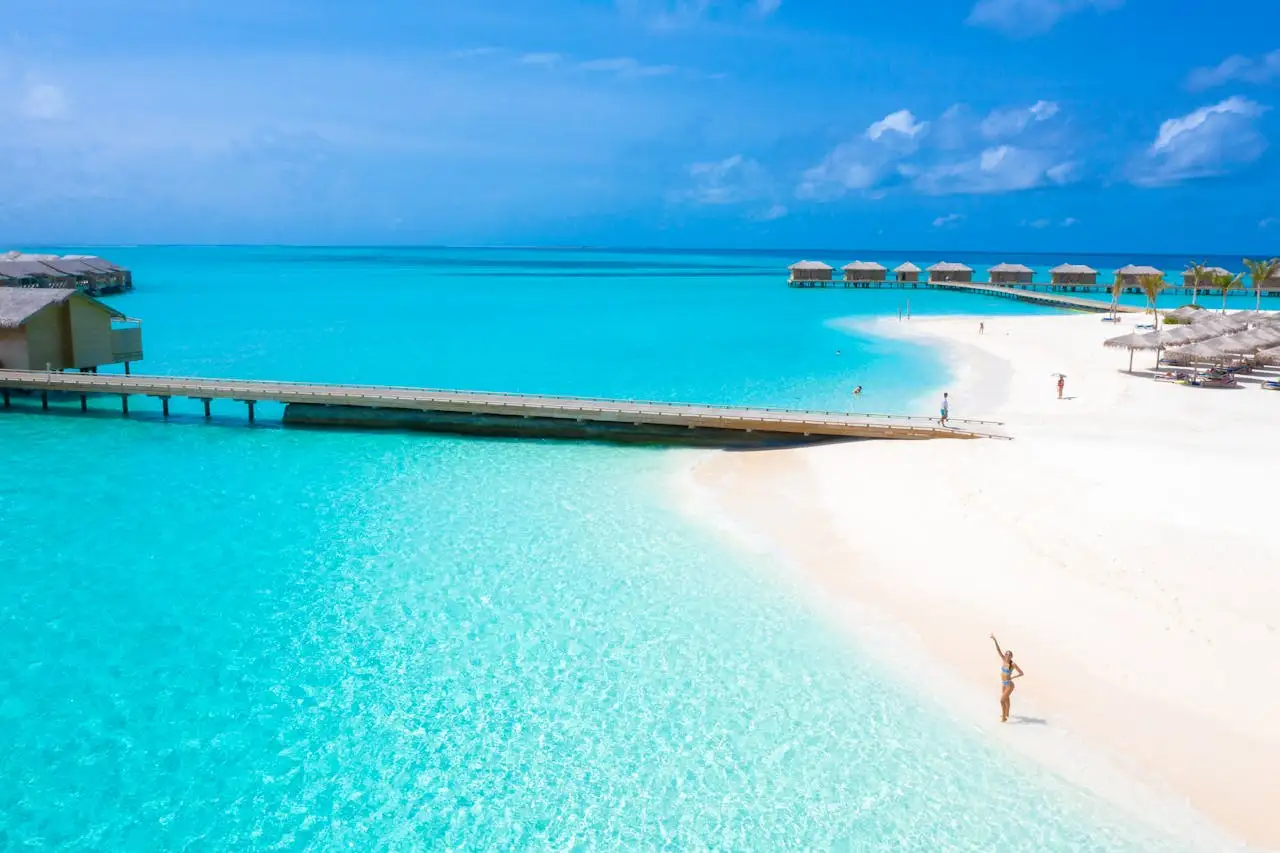
The Maldives is twenty-six atolls of coral built on the rim of a submerged volcanic ridge, spread over eight hundred kilometres of the Indian Ocean, with an average ground elevation of about a metre and a half. Almost none of it is land. What that produces is the specific thing people come for: reef flats in water shallow enough to read a book in, dropping to a wall a few metres out, on more than a thousand islands of which about two hundred are inhabited.
The structure of a trip here is unusual and it is worth understanding before booking. One resort occupies one island — there is nowhere to walk to and nothing to compare prices against once you arrive — and you reach it by speedboat, domestic flight or seaplane depending on distance. Since 2009 foreigners have also been able to stay on inhabited local islands, which opened a version of this destination at a tenth of the price.
The reservations are money and expectation. Transfers are the hidden cost and they are large: a seaplane is £355 to £630 per person each way, a speedboat £120 to £315, and neither is included in the room rate you compared. On a local island there is no alcohol, modest dress is expected outside designated bikini beaches, and it is a Muslim village rather than a resort — which is the whole appeal to some travellers and a shock to others.
On the ground
Five things worth doing
- 01
Choose the transfer before you choose the resort
This is the decision that sets the budget. Islands in North and South Malé atoll are a speedboat away at £120 to £315 a head return; anything further needs a seaplane at £355 to £630 each way, or a domestic flight plus a boat. Seaplanes fly in daylight only, so a late arrival means an unplanned night in Malé at your own cost. Ask for the transfer price in writing before you book the room, because it is quoted separately and it is not optional.
- 02
Snorkel the house reef rather than booking excursions
The reason to come is usually a hundred metres from your door and costs nothing. Most resorts and guesthouses have a house reef with a drop-off you can swim to, and it will show you turtles, reef sharks and rays without a boat. Excursions run £45 to £90 a head. Ask specifically about the house reef before booking — some islands have a lagoon and no accessible reef at all, and the photographs never make that clear.
- 03
Consider a local island like Maafushi
Guesthouses on inhabited islands cost a fraction of a resort and are reached by public ferry for about $3 (£2.40) or a scheduled speedboat at about $25 (£20). Maafushi is the established one, with dive shops, a bikini beach and boat trips. The trade-offs are real: no alcohol on the island, modest dress in the village, and a beach shared with a working community. For many British travellers it is the difference between one night and a fortnight.
- 04
Dive or snorkel with manta rays in season
The atolls host large aggregations of reef manta rays that follow the plankton as the monsoon shifts, moving between the eastern and western sides of the archipelago through the year. A two-tank dive day runs about £90 to £130; snorkelling trips are roughly half. Hanifaru Bay in Baa atoll is the famous site and is regulated — snorkel only, limited numbers, permits. Ask what is being seen this week rather than trusting a brochure.
- 05
Spend an afternoon in Malé
The capital is one of the most densely populated cities on earth, packed onto two square kilometres, and it is free to walk across in half an hour. The fish market at the waterfront in the late afternoon, the coral-stone Friday Mosque from 1658 and the produce market are the three things worth the time. Most visitors transit without leaving the airport island; if you have a long connection, the ferry across costs pennies.
After the flight
What it costs once you land
Two entirely different economies exist here. Resort-island prices are set by a monopoly with no competitor within twenty miles; local-island prices are a tenth of them. The figures below give both where they differ.
- Beer, resort bar £10 alcohol exists only on resort islands and liveaboards, never in villages
- Dinner for two, guesthouse £20 on a local island; a resort à la carte dinner is £80 and up
- Seaplane transfer £355–£630 per person, each way, and quoted separately from the room
- Speedboat transfer £120–£315 per person return, for the atolls near Malé
- Public ferry to a local island £2.40 per person; the scheduled speedboat is about £20
- Snorkel hire, per day £8 free at most resorts; bring your own mask and it costs nothing
Checked August 2026. Sources at the foot of this page.
Before you book
Practical, for a British passport
Entry rules are for a British Citizen passport holder and come from gov.uk, read on 2026-08-07. They change; check before you fly.
- Airport
- MLE, Velana International, on its own island next to Malé. Every arrival transfers from here by boat or seaplane, and the seaplane terminal operates in daylight only — an evening arrival to a far atoll means an overnight in Malé, which resorts do not always mention. Domestic flights to the outer atolls leave from the same island.
- Entry
- Free visa on arrival plus an online declaration. No fee. Up to 30 days. Expiry at least one month after the date you arrive. One month is the shortest passport-validity rule on this list by a distance — but it is the rule for the Maldives alone, and a connection through Doha, Dubai or Istanbul may impose six months of its own. File the IMUGA traveller declaration in the 96 hours before your flight lands. Alcohol, pork and religious items other than your own are confiscated at customs; the resorts are licensed, the inhabited islands are not.
- Currency
- Maldivian rufiyaa, but resorts price and bill in US dollars and take cards throughout. On local islands cash is more useful and dollars are widely accepted. There is no meaningful reason to obtain rufiyaa for a resort stay; for a guesthouse trip a small amount is handy.
- Language
- Dhivehi. English is spoken universally in tourism, in Malé and by guesthouse staff, and is the language of instruction in schools. No barrier at all for a visitor.
- Time zone
- Five hours ahead of the UK in winter and four ahead of British Summer Time. The Maldives does not change its clocks. Many resort islands run their own clock an hour ahead of Malé time to give guests more daylight in the evening — check which one your dinner reservation uses.
- Plugs
- Type D and G, 230V. British type-G plugs fit in most resorts and many guesthouses without an adapter, which is true of only three destinations on this list — but type D sockets are still common, so pack one anyway.
- Health
- The GHIC does not apply. Medical facilities outside Malé are basic and the serious answer to anything significant is an evacuation, so insurance covering that and covering diving to your intended depth is essential rather than advisable. There is a decompression chamber network across the atolls. Resort water is desalinated and safe; bottled is universal.
- Safety
- The FCDO has no warning against travel to resort islands and notes that Malé has seen occasional political demonstrations. This is a Muslim country: alcohol, pork and religious items other than your own are confiscated at customs, and public modesty is expected on inhabited islands. Resort islands are exempt from all of that by design. The commonest injuries are reef cuts and sunburn.
A bed
Where to stay in Maldives
The decision is really resort or local island, because that sets the transfer and the transfer sets the budget. All three below are inhabited villages inside boat reach of the airport, with guesthouses at a fraction of resort prices; a resort on a far atoll adds a seaplane and several hundred pounds before the first night.
Thulusdhoo
The capital of Kaafu Atoll and about fourteen hundred people, thirty to forty minutes north by speedboat at around $30, or ninety minutes to two and a half hours on the public ferry for about $3. Two of the best-known breaks in the country, Cokes and Chickens, sit off the island, which sets the tone — the guesthouses fill with surfers between March and October. It also holds the only Coca-Cola factory in the Maldives, which is where one of those waves got its name.
Stays in Thulusdhoo Opens in a new tab QUIETER, STILL BY BOATGuraidhoo
Thirty-two kilometres south in South Malé Atoll, about forty-five minutes by speedboat or two hours on the public ferry, which does not run on Fridays. Thirteen guesthouses rather than a strip of them, channel diving on the doorstep and day trips to the South Malé resorts. The bikini beach is not on the island itself but on Lhosfushi, an uninhabited islet across a short footbridge.
Stays in Guraidhoo Opens in a new tab THE CHEAP WAYMaafushi
A local island ninety minutes by public ferry or forty-five by speedboat, with guesthouses instead of resorts and a fraction of the price. Dive shops, excursions and a designated bikini beach. It is an inhabited Muslim village, so no alcohol on the island, modest dress away from the marked beach, and a shore shared with people who live there — which is the point for some travellers and wrong for others.
Stays in Maafushi Opens in a new tabEvery area pinned on one map, set to the dates of the fare above. Change them for your own trip and it reloads live availability.
Open the Maldives map Opens in a new tabGetting around
There is no getting around in the usual sense. Once you are on a resort island you are on it — the island is the destination, walking round it takes fifteen minutes, and every departure from it is a boat that has to be booked and paid for. This is worth internalising before you go, because it is the single biggest difference between the Maldives and every other beach destination on this list.
Between islands, the options run from a public ferry at a couple of pounds to a private speedboat at hundreds. The public ferry network connects inhabited islands only, on limited schedules — often a few departures a week on a given route — and does not serve resorts at all. Scheduled tourist speedboats fill the gap for the popular local islands and cost about twenty pounds.
For the outer atolls the sequence is a domestic flight to a regional airstrip and then a boat, which is usually cheaper than a seaplane and takes longer. Seaplanes are the fastest and by far the dearest, they fly only in daylight, and they are weather-dependent. Whichever it is, it is arranged by the resort rather than by you, and it appears on the bill.
Food and local tips
On a resort island you eat what the resort serves, and the pricing follows from having no competitor within twenty miles: a half-board upgrade or an all-inclusive package almost always works out cheaper than paying à la carte, and the drinks are where the margin sits. Check what the board basis actually includes before you go, because the gap between full board and all-inclusive on a week can run to several hundred pounds either way.
On a local island you eat Maldivian food, which is tuna, coconut and chilli in various arrangements and is genuinely good. Mas huni — shredded smoked tuna with grated coconut, onion and lime, eaten with flatbread — is breakfast. Garudhiya is a clear tuna broth with rice and lime. Short eats, the fried savoury snacks sold in tea shops for pennies, are the thing to graze on. There is no alcohol anywhere on an inhabited island and no way around that.
Mas huni and roshi for breakfast
Smoked tuna shredded with fresh coconut, onion and lime, scooped up with warm flatbread. About £2 in a guesthouse or a Malé tea shop, and the national breakfast for a thousand years.
Ready for the Maldives?
Pick your departure airport and see what the route costs today from each of the ten we track.
See the £570 fare Opens in a new tabSame band
Other long-haul destinations
Where the numbers came from
- Seaplane and speedboat transfer costs immaldives.com Opens in a new tab read 2026-08-08
- Local island ferry and speedboat fares to Maafushi budgetmaldives.com Opens in a new tab read 2026-08-08
- Entry rules, the IMUGA declaration and customs restrictions gov.uk Opens in a new tab read 2026-08-08
- Entry rules for a British Citizen passport gov.ukOpens in a new tab read 2026-08-07