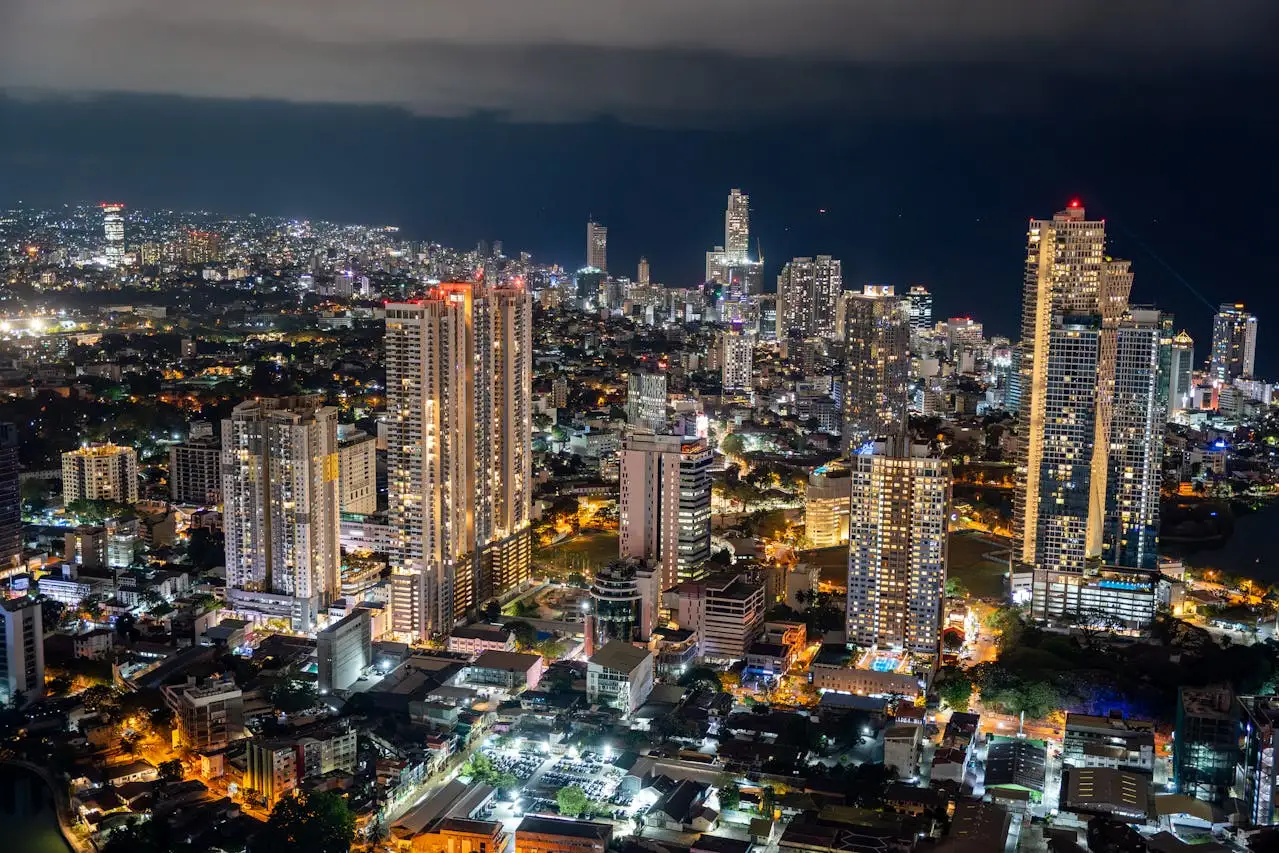
DESTINATION · SRI LANKA
Sri Lanka, where one coast is always dry
Two monsoons arrive from opposite directions at opposite times of year, so the island has no closed season — only a wrong side. Pick the side, not the month.
- Airport
- CMB · Sri Lanka
- On sale
- 12 of 12 months
- Airport spread
- £839 across 9 UK airports
Today's best fare
London Sri Lanka
£533
Measured on a live search, refreshed hourly. Prices move — confirm on Kiwi.com.
Departure airports
£839 apart, depending where you take off
Every UK airport searched separately for this destination, cheapest first, as a return fare for one person with taxes in. Manchester to Sri Lanka and London to Sri Lanka are not the same route and we do not price them as one. Each figure is a fare of one stop at most — the same limit as the price at the top of this page — and each is that airport's own cheapest week, so the dates change from row to row. Every link opens on the dates its price was found on.
9 of 10 airports have a fare to Sri Lanka within one stop today. The rest either need two connections and most of a day to get there — which we will not print a price for — or did not answer the last search. London covers Heathrow, Gatwick, Stansted, Luton, City and Southend in one search.
From your airport
How long is the flight to Sri Lanka?
Distance, nonstop flight time, whether a direct flight exists and what it costs, worked out separately for each of the ten UK airports.
The year, month by month
When Sri Lanka is worth the airfare
Average daytime high for each month. The greyed months are ones we refuse to advertise — not because they are cheap, but because the place cannot deliver what the page promises.
- Jan 31°
- Feb 31°
- Mar 32°
- Apr 32°
- May 31°
- Jun 30°
- Jul 30°
- Aug 30°
- Sep 30°
- Oct 30° today's fare
- Nov 30°
- Dec 30°
12 of 12 months on sale. No closed season.
Sri Lanka has two monsoons and they are the whole planning problem. The Yala monsoon arrives from the south-west and soaks the west and south coasts and the hill country; the Maha monsoon comes from the north-east and soaks the east coast and the north. The central mountains keep them apart. Because they run at opposite times of year, there is no month in which the entire island is wet — but there is no month in which all of it is dry either.
That is why this destination carries no closed season. What it needs instead is a decision about which coast. The south and west — Galle, Mirissa, Bentota — are at their best across the British winter, which is also when the hill country is clearest and the whale watching off Mirissa runs. The east coast at Arugam Bay and Trincomalee is the opposite: it comes good through the British summer, when the south is being rained on.
The two short inter-monsoon periods bring thunderstorms almost anywhere and are the least predictable weeks of the year. For a British calendar the practical answer is that the classic itinerary — cultural triangle, hill country, south coast — lines up with our winter, which is also the peak season and the most expensive. The shoulder weeks at either end are noticeably cheaper for weather that is only slightly less reliable.
The visa is free — do not pay for it
Sri Lanka's electronic travel authorisation has been issued free of charge since 2025. The agency sites that appear above the official portal in search results still charge fifty dollars for the same form.
The case for it
Why Sri Lanka
Sri Lanka is a teardrop of about sixty-five thousand square kilometres with a mountain massif in the middle of it, and that massif is why the island works the way it does. It splits the weather: two monsoons come in from opposite directions six months apart, and the mountains wring each one out on the side it hits. The practical effect is that one coast is in its dry season whenever the other is not, and a well-planned trip simply moves.
For its size it holds an improbable amount. Eight UNESCO sites, including a fifth-century palace on top of a two-hundred-metre rock, a tooth of the Buddha in a temple in Kandy, and a Dutch fort at Galle that is still a working town inside its walls. Leopards, elephants and blue whales are all reachable in a fortnight. The hill country is terraced tea planted by the British and looks it.
Two current facts that change trips. The electronic travel authorisation is now free — no fee at all — which no third-party site will tell you, because they charge for it. And the Kandy-to-Ella railway, the journey the island is sold on, has been partly suspended since Cyclone Ditwah in late 2025, with services running from further down the line instead. Check the state of it before building an itinerary around that ride.
On the ground
Five things worth doing
- 01
Climb Sigiriya at first light
A fifth-century royal citadel on top of a two-hundred-metre granite plug, with frescoes halfway up and a lion's paws at the final staircase. Entry for foreign visitors is $35 (about £28), which is the most expensive ticket in the country and worth it. Twelve hundred steps, no shade, and the gate opens at seven — be there for it, because by nine the metal stairways are hot to touch and full. Two hours up and down at a steady pace.
- 02
Take the hill country train, whatever is running
The line from Kandy through Nuwara Eliya to Ella is among the great railway journeys and costs almost nothing: about LKR 600 (£1.60) in second class and LKR 3,000 (£8) in first. Reserved seats sell out weeks ahead; unreserved second class is standing room and is how most people ride it, hanging out of the door. Part of the route has been suspended since the 2025 cyclone with trains starting further down the line — check what is actually running before booking accommodation around it.
- 03
Walk the walls at Galle Fort
A Portuguese and then Dutch fortification on the south coast, still inhabited, with churches, warehouses and a lighthouse inside ramparts you can walk the whole way round. It is free. Do the circuit in the last hour of daylight when the town comes out to do the same and the cricket starts on the green. The museums inside charge small fees; the fort itself is a living town rather than a site, which is the point.
- 04
Go on safari at Yala or Wilpattu
Yala has the highest density of leopards anywhere and gets the crowds to match — twenty jeeps at a sighting is normal in the busy season. Wilpattu is larger, quieter and harder, with fewer guaranteed sightings and a better experience. A half-day jeep with park fees runs about £45 to £60 a head. Book the dawn slot rather than the afternoon, and choose a driver who will leave a crowded sighting rather than joining it.
- 05
Drink tea where it is grown
The hill country above Nuwara Eliya is terraced with tea planted from the 1860s, and most working estates run a factory tour and tasting for LKR 1,000 to 2,000 (about £2.60 to £5.30). It takes an hour and it is genuinely interesting rather than a gift-shop exercise — you follow the leaf from the withering troughs to the graded bins. The plucking is still done by hand by Tamil women whose families were brought here for it, and the guides do not gloss over that.
After the flight
What it costs once you land
Everyday Sri Lankan prices. This is among the cheapest destinations on the whole board once you have landed, and the gap between local prices and hotel prices is wide but not extreme.
- Beer, local bar £1.80 a Lion Lager; alcohol is taxed heavily and shut on poya full-moon days
- Dinner for two, mid-range £14 rice and curry with several dishes; a street kottu is under £2
- Airport to Colombo £5 metered taxi or a pre-booked car; the expressway coach is under £2
- Hill country train, first class £8 second class is about £1.60 and is where the open doors are
- Tuk-tuk, per kilometre £0.20 insist on the meter, or use the PickMe app which fixes it
- Rice and curry lunch £1.60
Checked August 2026. Sources at the foot of this page.
Before you book
Practical, for a British passport
Entry rules are for a British Citizen passport holder and come from gov.uk, read on 2026-08-07. They change; check before you fly.
- Airport
- CMB, Bandaranaike International, thirty kilometres north of Colombo and about forty minutes on the expressway. Almost nobody stays in Colombo itself — Negombo is fifteen minutes from the airport and is where most itineraries start and end. There is a second airport at Mattala in the south which handles very little.
- Entry
- Electronic Travel Authorisation. Free — the ETA has been issued free of charge since 2025 — it used to cost $50. Up to 30 days, extendable. Expiry at least 6 months after the day you arrive. Free, and that is the point worth making: almost every third-party site still quotes the old fifty-dollar fee, and the agencies that appear above the official portal in search results charge for a form the government now gives away. Apply on Sri Lanka's own immigration site and pay nothing.
- Currency
- Sri Lankan rupee. Cards work in hotels and city restaurants; everything else is cash, and rural areas are entirely cash. ATMs are widespread in towns and charge a fixed fee per withdrawal. The rupee cannot be obtained or spent outside the country, so change what is left before you fly.
- Language
- Sinhala and Tamil, with English widely spoken as a legacy of British rule and used on most signage. No real barrier for a visitor, and English is more common here than in most of South Asia.
- Time zone
- Five and a half hours ahead of the UK in winter and four and a half ahead of British Summer Time. Sri Lanka does not change its clocks, so the gap moves when Britain does.
- Plugs
- Type D and G, 230V. British type-G plugs fit many sockets here without an adapter, which is unusual on this list — but the older round-pin type D is still very common, so pack one anyway.
- Health
- The GHIC does not apply. Private hospitals in Colombo are good; outside the cities facilities thin quickly and the answer to anything serious is transport, so insurance covering evacuation matters. Dengue is present year round and is mosquito-borne in the daytime, so repellent is a daytime habit here rather than an evening one. Drink bottled water.
- Safety
- The FCDO has no blanket warning against travel. Sri Lanka is generally safe for visitors and the commonest problems are transactional — tuk-tuk drivers without meters, gem and spice-garden commissions, and unofficial guides at the archaeological sites. The roads are the genuine hazard: overtaking on blind bends is normal practice and a hired driver is safer than a hired car.
A bed
Where to stay in Sri Lanka
Nobody stays in one place here. This is a moving trip, and these are the three stops almost every itinerary is built around rather than three parts of one town.
Kandy
The last kingdom to fall to the British, wrapped around a lake in the hills, with the Temple of the Tooth at its centre and the botanical gardens outside it. The natural base between the ancient sites to the north and the hill country to the south, and the widest choice of rooms in the interior. Traffic in the centre is heavy and the town itself is workaday rather than pretty.
Stays in Kandy Opens in a new tab TEA AND TRAINSElla
A small hill town at the far end of the famous railway, surrounded by tea estates, waterfalls and the Nine Arch Bridge. It has become the backpacker centre of the island and the main street reflects that — cafés and yoga rather than anything Sri Lankan. The setting is exceptional and the walks from the door are the reason to be here. Check what the trains are actually doing before relying on arriving by rail.
Stays in Ella Opens in a new tab THE COASTGalle
A Dutch fort on a headland on the south coast, still lived in, with boutique hotels inside the walls and beaches a short drive either side. The best base for the southern coast and an easy run from the airport on the expressway. Inside the fort is expensive by Sri Lankan standards; the town outside the walls is a fraction of it and five minutes away.
Stays in Galle Opens in a new tabEvery area pinned on one map, set to the dates of the fare above. Change them for your own trip and it reloads live availability.
Open the Sri Lanka map Opens in a new tabGetting around
Hire a car with a driver. This is the standard way to see Sri Lanka and it costs about £40 to £55 a day including the driver's own food and lodging, which is less than self-drive in most of Europe. The roads are narrow, the overtaking is committed, and the driver knows which mountain route is passable — all of which is worth more than the saving on doing it yourself. Agree the itinerary and the daily rate in writing before you set off.
The trains are cheap, slow and wonderful, and they are transport as well as an attraction. Reserved first and second class seats on the hill country line sell out well ahead; unreserved second and third class are always available and are how most people travel. Buses go everywhere for pennies, are frequent, and are driven with an enthusiasm that is not for everyone.
In towns, tuk-tuks. Insist on the meter or use the PickMe app, which is Sri Lanka's ride-hailing service and fixes the fare in advance — it removes the single most tiresome negotiation of the trip. Expect around 100 rupees a kilometre metered. Self-drive car hire requires a temporary Sri Lankan permit and is rarely worth the trouble.
Food and local tips
Rice and curry is not a dish, it is a format: rice with five to ten small curries around it, at least half of them vegetable, plus sambol, papadum and often a dry fish. It is the national lunch, it costs a pound or two at a local place, and it is a completely different experience from a hotel version. Ask for it at a village restaurant rather than reading a menu. Sri Lankan food is hotter than Indian food and nobody warns British visitors of this.
The two other things to find are kottu roti — flatbread chopped on a hot plate with egg, vegetables and meat, announced by the rhythmic clang of the blades from half a street away — and hoppers, bowl-shaped fermented rice pancakes eaten at breakfast with an egg in the middle. Both are street food and both are best after dark. Alcohol is heavily taxed and is not sold at all on poya days, the monthly full-moon holidays, which catches visitors out.
Kottu roti, from the sound of it
Roti chopped with vegetables, egg and curry on a steel plate with two blades, which is why you hear it before you see it. About 400 rupees (£1.05) from a street stall after dark.
Ready for Sri Lanka?
Pick your departure airport and see what the route costs today from each of the ten we track.
See the £533 fare Opens in a new tabSame band
Other long-haul destinations
Where the numbers came from
- Sigiriya and attraction entrance fees for foreign visitors slvoyo.com Opens in a new tab read 2026-08-08
- Hill country train fares and the suspended section thecommonwanderer.com Opens in a new tab read 2026-08-08
- The free electronic travel authorisation and entry rules gov.uk Opens in a new tab read 2026-08-08
- Entry rules for a British Citizen passport gov.ukOpens in a new tab read 2026-08-07