DESTINATION · CAPE TOWN
Cape Town, with no hour to lose
Eleven hours south and almost no time difference at all — one hour in our winter, none in our summer. The only long-haul destination we price where you land without jet lag.
- Airport
- CPT · South Africa
- On sale
- 12 of 12 months
- Airport spread
- £790 across 10 UK airports
Today's best fare
London Cape Town
£536 £579
Measured on a live search, refreshed hourly. Prices move — confirm on Kiwi.com.
Departure airports
£790 apart, depending where you take off
Every UK airport searched separately for this destination, cheapest first, as a return fare for one person with taxes in. Manchester to Cape Town and London to Cape Town are not the same route and we do not price them as one. Each figure is a fare of one stop at most — the same limit as the price at the top of this page — and each is that airport's own cheapest week, so the dates change from row to row. Every link opens on the dates its price was found on.
All 10 airports have a fare to Cape Town within one stop today. London covers Heathrow, Gatwick, Stansted, Luton, City and Southend in one search.
From your airport
How long is the flight to Cape Town?
Distance, nonstop flight time, whether a direct flight exists and what it costs, worked out separately for each of the ten UK airports.
The year, month by month
When Cape Town is worth the airfare
Average daytime high for each month. The greyed months are ones we refuse to advertise — not because they are cheap, but because the place cannot deliver what the page promises.
- Jan 26°
- Feb 27°
- Mar 25°
- Apr 23°
- May 20°
- Jun 18°
- Jul 18°
- Aug 18°
- Sep 19°
- Oct 21°
- Nov 24° today's fare
- Dec 25°
12 of 12 months on sale. No closed season.
Cape Town has a Mediterranean climate in the southern hemisphere, which is the whole point for a British traveller: its dry, warm, cloudless half falls exactly across our worst months. The peninsula sits where the cold Benguela current meets warmer water, and the practical consequence is that the Atlantic beaches at Camps Bay and Clifton are beautiful and genuinely freezing, while False Bay on the other side of the mountain is meaningfully warmer for swimming.
The local wind is a character in its own right. The south-easter, known as the Cape Doctor, blows hard through the warm months — it clears the air and lays the famous tablecloth of cloud over the mountain, and it also closes the cableway, cancels the Robben Island ferry and makes an exposed beach unpleasant. It is not a reason to avoid the season, but it is why an itinerary here should be flexible about which day you do the mountain.
There is no closed period. The wet half of the year is cooler and greener with rain arriving in fronts off the Atlantic, and it is materially cheaper — the whale watching along the coast is at its best then, and the city is at its emptiest. For a British calendar the Christmas and New Year fortnight is when the whole of South Africa holidays here and prices treble; the weeks either side of it are the same city at a normal rate.
Two genuinely blank pages, facing
South Africa requires two blank passport pages and enforces it at the desk. A nearly full passport is the commonest reason a British traveller is refused boarding for Cape Town.
The case for it
Why Cape Town
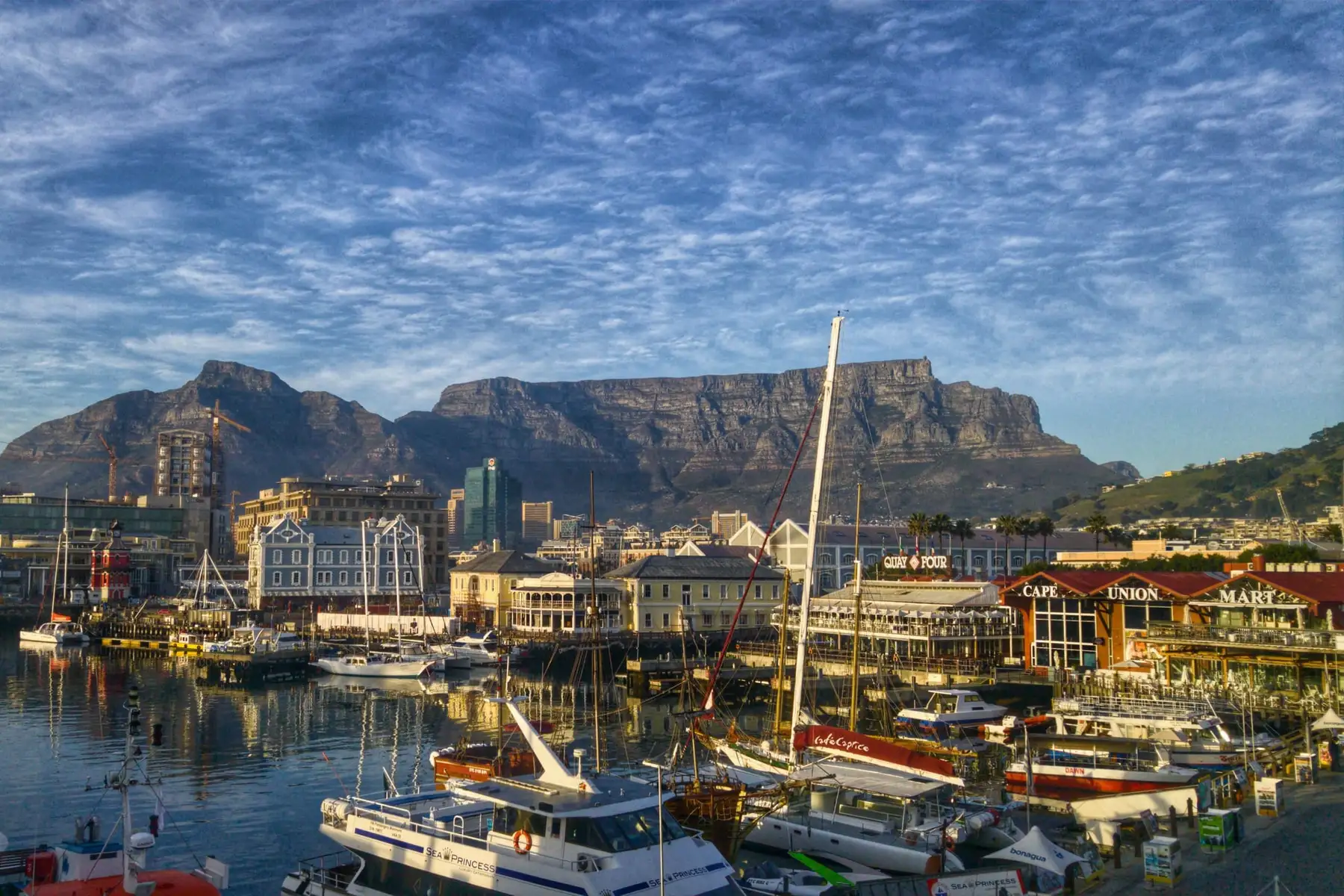
Cape Town sits at the meeting of two oceans on a peninsula with a fifteen-hundred-metre block of sandstone in the middle of it, and that geography does everything. Table Mountain splits the city into an Atlantic side and a False Bay side with different water temperatures and different weather on the same afternoon. The mountain is inside the city, not beside it: you can be on a cable car from a suburban street and on a plateau with rock hyraxes twenty minutes later.
For a British traveller the two structural advantages are the clock and the calendar. Cape Town is one hour ahead of the UK in our winter and level with us in our summer, so an eleven-hour flight arrives with no jet lag at all — the only destination on this board where that is true. And its seasons are inverted, which makes it a proper summer holiday in the months Britain has none.
The reservations are real and worth stating plainly. This is a city with among the highest inequality in the world and violent crime rates far above anything in Europe, concentrated in areas visitors do not go but not confined to them — the advice about not walking at night and not displaying phones is practical rather than nervous. Electricity supply has been unreliable for years, so check your hotel has a generator. And the two blank passport pages South Africa requires are enforced at the desk.
On the ground
Five things worth doing
- 01
Go up Table Mountain, and check the wind first
The cableway costs about R450 (£20) return in the morning and around R390 (£17) after one o'clock, and it closes in high wind — check the website the morning you plan to go, because it shuts more often than visitors expect. Book online to skip the queue. The alternative is walking up Platteklip Gorge, which is free, takes two hours, is relentlessly steep and has no shade. Most people walk down and ride up, which is the wrong way round on the knees.
- 02
Book Robben Island weeks ahead
The ferry from the V&A Waterfront plus the island bus tour and the prison tour led by a former political prisoner costs around £37 and sells out days or weeks in advance. Sailings are cancelled in rough seas and the refund process is slow. Take the earliest departure: it is the least likely to be cancelled and the least crowded. Three and a half hours in total, and the prison section is the part that stays with people.
- 03
Drive Chapman's Peak to Cape Point
A road cut into a cliff face between Hout Bay and Noordhoek, with a toll of about R70 (£3) and more pullouts than you will have patience for. It leads to the Cape of Good Hope reserve, where entry for foreign visitors is R303 (£13). Baboons in the car park are organised and will open an unlocked door — keep windows up and food out of sight. The whole loop is a full day with the penguins at Boulders on the way back.
- 04
Spend a day in the winelands
Stellenbosch and Franschhoek are forty-five minutes inland and tastings run about R100 to R200 (£4.50 to £9) for five wines, which is a fraction of European prices for wine of the same quality. Do not drive it — South African drink-driving enforcement is strict and the limit is low. The Franschhoek wine tram is a hop-on tourist tram between estates for around £30 and removes the problem entirely, which is why it books out.
- 05
Walk Kirstenbosch on the mountain's back
A botanical garden on the eastern slopes, entry about R250 (£11), planted almost entirely with South African species and backed by the Table Mountain buttresses. The Boomslang canopy walkway curves out over the treetops. Summer sunset concerts on the lawn are a local institution and worth timing a visit around. It is on the opposite side of the mountain from the city, so pair it with Constantia rather than with the Waterfront.
After the flight
What it costs once you land
Cape Town prices where residents pay them. The rand has been weak against the pound for years, which is why restaurant and wine prices read as improbable to a British visitor — that is a currency position rather than a permanent feature.
- Beer, local bar £2.20 a Castle or a craft pint; the Waterfront is roughly double
- Dinner for two, mid-range £35 two courses and a bottle of very good local wine
- Airport to the city £8.70 Uber, about twenty-five minutes; metered taxis cost considerably more
- Car hire, per day £22 worth it for the peninsula and the winelands; fuel is cheap
- Wine tasting, five wines £4.50–£9 at an estate in Stellenbosch or Franschhoek
- Gatsby sandwich, shared £4
Checked August 2026. Sources at the foot of this page.
Before you book
Practical, for a British passport
Entry rules are for a British Citizen passport holder and come from gov.uk, read on 2026-08-07. They change; check before you fly.
- Airport
- CPT, twenty-five minutes east of the city on a good road. Small, calm and easy by the standards of the other long-haul airports on this list. There is a MyCiTi bus into the centre for about a pound, which runs frequently in daylight; most visitors take an Uber, which costs a few pounds more and goes to the door.
- Entry
- No visa. No fee. Up to 90 days. Expiry at least 30 days after you intend to leave, and at least two blank pages. Two genuinely blank pages, facing each other — South Africa has refused entry over this, and a passport that is nearly full is the commonest reason a British traveller is turned back at Cape Town. Travelling with anyone under 18 brings extra documentary requirements, including birth certificates showing both parents.
- Currency
- South African rand. Cards work almost everywhere including car parks and small cafés, and contactless is normal. Keep some cash for car guards — the men in high-visibility vests who watch parked cars expect five or ten rand and this is a real informal economy rather than a scam.
- Language
- English is one of twelve official languages and is universal in Cape Town, alongside Afrikaans and Xhosa. No barrier whatsoever, and signage is in English throughout.
- Time zone
- Two hours ahead of the UK in our winter and one ahead of British Summer Time — which for an eleven-hour flight means effectively no jet lag in either direction. South Africa does not change its clocks, so the gap moves when Britain does.
- Plugs
- Type M, 230V — the large three round-pin South African plug, which fits nothing else on earth. A British type-G plug does not fit and a standard European adapter usually will not either. Buy a South African adapter specifically; many hotels now also fit type C and G sockets, but do not rely on it.
- Health
- The GHIC does not apply. Private hospitals in Cape Town are excellent and expensive and expect an insurer's guarantee up front, so comprehensive cover is essential. Tap water in Cape Town is safe and good. Malaria is not present in the Western Cape — that only becomes a question if you travel to the northern game reserves.
- Safety
- The FCDO has no blanket warning against travel but is explicit that violent crime is high by international standards. In practice: use Uber rather than walking after dark, do not display phones or jewellery, keep car doors locked and nothing on the seats, and avoid the N2 corridor and townships except with a guide. Hiking on Table Mountain should be in groups and on the main routes.
A bed
Where to stay in Cape Town
The mountain divides the city and the areas below sit on different sides of it, with different weather and different water. All three are a short Uber from the centre.
Camps Bay
The Atlantic seaboard under the Twelve Apostles, with the best-known beach, a strip of restaurants along the front and the sunsets people book the trip for. The widest choice of well-rated properties in the city. The water is genuinely cold, the south-easter hits this side hard, and you are twenty minutes from the city centre and the Waterfront by road.
Stays in Camps Bay Opens in a new tab WALK INTO TOWNGardens
The city bowl below the mountain, between the centre and the lower cableway station — leafy streets, Kloof Street's restaurants and cafés, and the only base where walking to dinner is normal. Best for a city-led trip rather than a beach one. No sea view and no beach, and like all of the bowl it is quiet enough after dark that an Uber is the sensible way home.
Stays in Gardens Opens in a new tab BETWEEN THE TWOSea Point
A dense residential strip along the Atlantic with a three-kilometre promenade that is the city's best public space — joggers, dog walkers, families, all day and into the evening. Rates below Camps Bay for the same view, restaurants that serve residents rather than visitors, and a short hop to both the Waterfront and the bowl. No swimmable beach; the promenade pools are the substitute.
Stays in Sea Point Opens in a new tabEvery area pinned on one map, set to the dates of the fare above. Change them for your own trip and it reloads live availability.
Open the Cape Town map Opens in a new tabGetting around
Uber is the default and it works well — it is cheap, ubiquitous, and it removes both the negotiation and the question of where you have parked. A cross-city run is a few pounds. This is also the standard local advice for moving after dark, and it is worth following rather than treating as excessive caution.
Hire a car for the peninsula and the winelands, which are the two days that need one. The roads are good, fuel is cheap, and driving is on the left with a British licence accepted. Two rules: never leave anything visible in the car, and do not drink and drive, because enforcement is strict and the limit is lower than at home. Park where there is a car guard and give them a coin.
The MyCiTi bus network is clean, cheap and useful along the Atlantic seaboard and to the airport, and largely irrelevant elsewhere. The hop-on sightseeing bus is genuinely one of the better ways to do the mountain, the Waterfront and Kirstenbosch in a day without a car. Minibus taxis are how most of the city travels and are not aimed at, or comfortable for, visitors with luggage.
Food and local tips
Cape Town eats better than almost anywhere at the price. The Cape Malay tradition — bobotie, denningvlei, koesisters — comes from the enslaved and exiled communities of Indonesia and Malaysia and is the city's own cooking; the Bo-Kaap is where to look for it. Braai is the national institution and is a social event rather than a menu item. Seafood is excellent and cheap, and snoek, a local fish smoked or grilled, is worth ordering.
The wine is the argument that needs no help: bottles that would cost thirty pounds in Britain are eight here, and estates pour five wines for the price of a pint. Tipping runs at ten to fifteen per cent and car guards get a coin. One local dish to try once: the Gatsby, a foot-long roll stuffed with chips and masala steak or polony, invented in Athlone, cut into quarters and designed to feed four people for four pounds.
Bobotie in the Bo-Kaap
Spiced minced lamb under a baked egg custard, with yellow rice and chutney — the Cape Malay dish the city was built on. About R160 (£7) in a restaurant on Wale Street.
Ready for Cape Town?
Pick your departure airport and see what the route costs today from each of the ten we track.
See the £536 fare Opens in a new tabSame band
Other long-haul destinations
Where the numbers came from
- Table Mountain cableway and Cape Point entry prices tablemountaincablecar.com Opens in a new tab read 2026-08-08
- Robben Island ferry and tour prices visitrobbenisland.com Opens in a new tab read 2026-08-08
- Entry rules, blank-page requirement and passport validity gov.uk Opens in a new tab read 2026-08-08
- Entry rules for a British Citizen passport gov.ukOpens in a new tab read 2026-08-07